
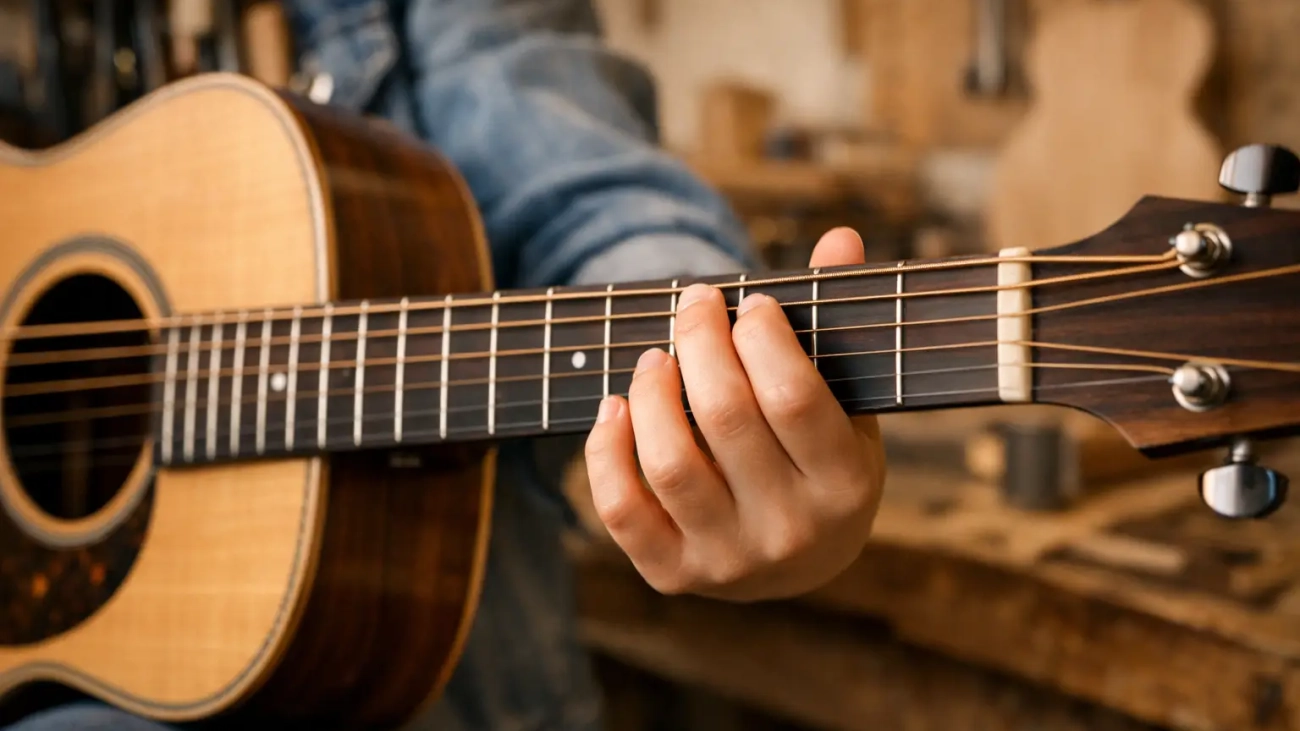
A player should not have to negotiate with an instrument before making music. So, can a guitar be built for small hands? Absolutely. But the meaningful answer is not a smaller guitar in a generic sense. It is a guitar whose proportions are considered as one living system: scale length, neck profile, nut width, string spacing, body depth, balance, and the player’s particular technique.
For a serious guitarist, comfort is not a concession to sound. It is one of the conditions that allows sound to emerge freely. When the left hand can reach without strain and the right hand meets the strings naturally, the player is better able to shape color, control articulation, and let musical intention travel directly into the instrument.
Can a Guitar Be Built for Small Hands Without Compromise?
It can be built without the usual compromises, provided the design begins with the player rather than a catalog specification. The question is not simply whether a hand is small. Finger length, palm width, thumb flexibility, shoulder mobility, posture, repertoire, and the force of a player’s attack all matter. A guitarist with a small hand and exceptional finger extension may need something very different from a player with the same hand size who has a shorter reach or a sensitive wrist.
A well-conceived custom guitar does not merely reduce dimensions. It preserves the relationships that make an instrument musical. If a neck is narrowed indiscriminately, right-hand string spacing may become cramped. If scale length is shortened too far, the response and tension can lose a sense of clarity. If the body is made shallow without attention to its voicing, some of the air and authority of the lower register may disappear.
The art lies in choosing where to make room for the player while protecting the instrument’s voice. This is why an ergonomic guitar should be designed as a whole, not altered by a single measurement.
The Measurements That Change the Experience
Scale length and the reach between frets
Scale length has a direct effect on left-hand reach. A traditional classical scale of 650 mm has a particular tension, attack, and sense of breadth. For many players with smaller hands, a 640 mm scale offers a valuable reduction in the distance between frets, especially in the first position and during wide stretches. A 630 mm scale can be appropriate in certain cases, though it calls for careful tonal planning.
A shorter scale reduces string tension when the same strings are used. That can make barrés, extensions, and legato passages easier, while also changing the way the guitar responds under the fingers. The builder can account for this through string selection, top thickness, bracing, bridge design, and the overall stiffness of the soundboard. The goal is not to imitate a longer-scale guitar exactly. It is to create a voice with its own poise, quickness, and depth.
For flamenco players, the balance may lean toward immediacy, dry clarity, and a fast percussive response. For classical repertoire, a player may seek sustaining trebles, separation of voices, and a fuller bass foundation. The right scale is therefore a musical decision as much as an ergonomic one.
Nut width, string spacing, and neck shape
Nut width is often the first specification players notice. A standard classical nut may be 52 mm, while 50 mm or 48 mm can feel markedly more approachable to a smaller hand. Yet nut width alone tells only part of the story. The spacing of the strings at both nut and saddle must remain comfortable for the right hand, particularly for players who use refined fingerstyle technique.
The neck profile is equally consequential. A neck that is too deep can force the thumb into an exhausting position, even when the fingerboard is relatively narrow. A carefully shaped profile, with appropriate shoulder transitions and a measured depth, can allow the hand to settle around the neck rather than fight it.
There is no universally superior profile. Some players prefer a more substantial neck because it supports a relaxed hand. Others need a leaner shape to reach cleanly across the fingerboard. The answer is found through observation: how the hand closes, where tension appears, whether the thumb stays mobile, and how naturally the player can shift from one position to another.
Body proportions and playing position
Small hands are sometimes accompanied by a smaller frame, but not always. Even so, body geometry deserves as much attention as neck geometry. A guitar that is difficult to hold will affect both hands. Excessive body depth can push the right arm outward and rotate the fretting hand into a less favorable angle. A wide lower bout may feel imposing when seated, even if the neck itself is perfectly proportioned.
A slightly reduced body can be remarkably satisfying when it is intelligently voiced. Smaller dimensions can bring focus, transparency, and a rapid response to the note. They need not produce a small sound. Woods, arching, air volume, soundboard stiffness, bracing, and varnish all contribute to how a body develops its resonance.
The point is not to pursue volume at any cost. A mature instrument gives the player a broad expressive range, from an intimate pianissimo to a tone that carries with dignity. For many musicians, that responsiveness is more valuable than sheer force.
What a Custom Build Can Solve That a Factory Model Cannot
Production guitars must serve an average player. Even excellent factory instruments are designed around repeatable specifications, available components, and a defined price structure. A bespoke guitar begins elsewhere: with the musician’s body, ear, repertoire, and artistic priorities.
During a thoughtful consultation, the builder can consider a player’s current instrument alongside the passages that create difficulty. Is the problem a first-position stretch? A persistent ache at the base of the thumb? Fatigue during long rehearsals? Crowding in the right hand? Or is the player accustomed to compensating for a body that sits too high or too far to the right?
Those details lead to decisions that work together. A reduced scale may be paired with a subtly narrower nut and a neck profile shaped to the player’s hand. The body can be proportioned for balance in the seated position. The action can be refined to support clean articulation without becoming needlessly demanding. The final result should feel neither undersized nor specialized in a limiting way. It should feel inevitable, as though the guitar has met the player where music begins.
At Scharpach, this kind of work is not treated as an accessory to the build. It is part of the instrument’s identity. The same attention given to resonance, select tonewoods, bracing, and finish belongs to the relationship between the musician and the neck.
The Trade-Offs Worth Considering
A smaller-hand guitar is not automatically better simply because it is easier to reach around. Extreme reductions can create new limitations. Very narrow string spacing may interfere with complex right-hand patterns. An overly short scale may change the firmness of the attack in ways a player does not enjoy. A very compact body may offer less of the physical bass presence desired in some concert settings.
These are not reasons to avoid customization. They are reasons to approach it with precision. A player who performs Bach, Villa-Lobos, and contemporary classical music may arrive at different priorities than a flamenco guitarist focused on rasgueado, picado, and fast positional movement. An archtop player may value neck access, acoustic projection, and an elegant balance across the strings in a different way again.
It also helps to distinguish temporary discomfort from genuine mismatch. A new technique can feel unfamiliar before it becomes natural. But recurring pain, chronic tension, or a reach that consistently disrupts musical phrasing are not badges of discipline. They are useful information about the instrument-player relationship.
A Better Question Than “Small”
Rather than asking whether a guitar is small enough, ask whether it allows the hands to remain open, calm, and available. Can you form a barre without hardening the shoulder? Can you sustain a wide interval without twisting the wrist? Can the right hand place each finger with confidence? Can you play for an hour and still feel that the instrument is inviting you forward?
The finest ergonomic design is nearly invisible. It does not announce itself through novelty. It lets the player forget measurements and return to phrasing, touch, silence, and the distinctive color of a note held just long enough.
A guitar built for smaller hands should never ask the musician to become smaller in expression. It should give that expression a more natural path into sound.