
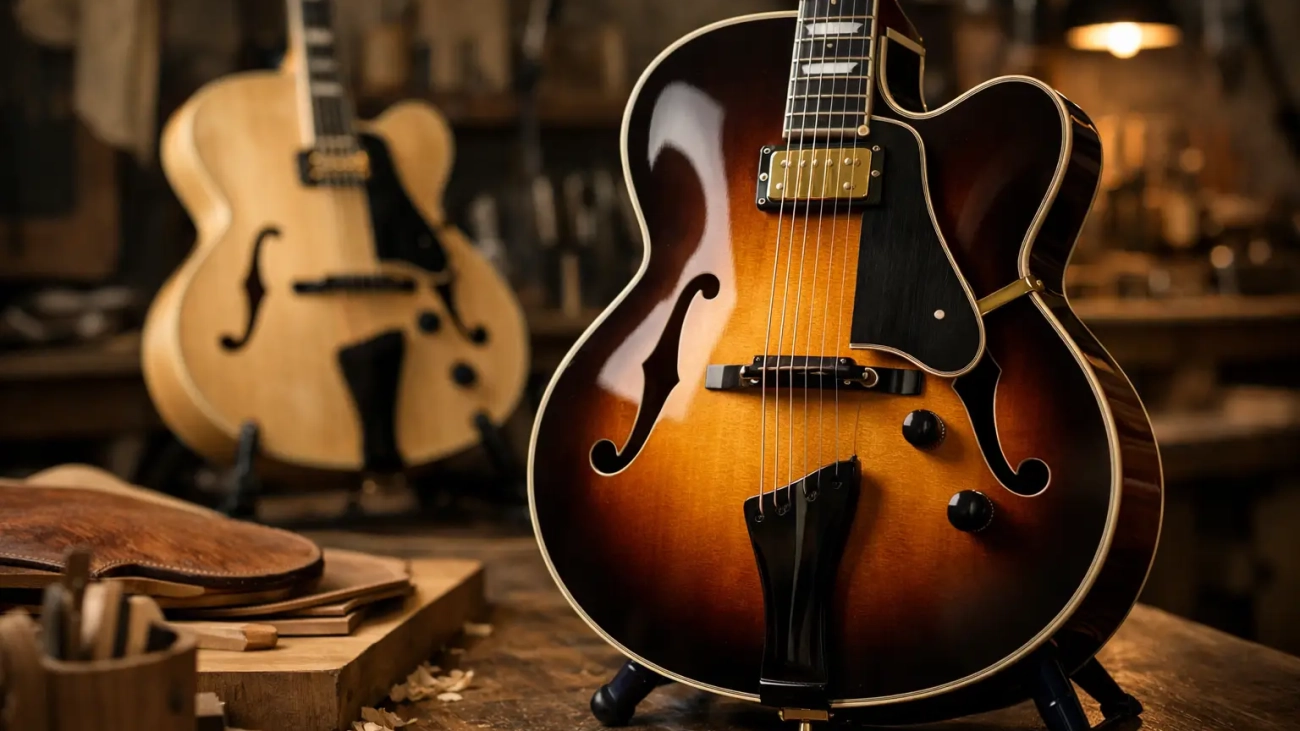
The first chord tells you almost everything. Not the voicing itself, but the way the note rises, the resistance under the right hand, the bloom after the attack, and whether the instrument gives something back that feels alive. When players search for the best archtop guitars for jazz professionals, they are rarely searching for a brand name alone. They are searching for a particular relationship between touch, tone, projection, and personality.
That is why this category resists simple rankings. A jazz professional does not need the same archtop for every room, every ensemble, or every touch. The guitarist playing amplified quartet dates at moderate volume may want focus, quick decay, and controlled low end. A solo player or duo performer may need more acoustic complexity, greater overtone content, and a top that breathes more freely. In both cases, the finest archtops are not merely impressive objects. They are responsive musical partners.
What defines the best archtop guitars for jazz professionals
At the professional level, an archtop must do more than sound good in isolation. It must hold its identity under a microphone, through an amplifier, and in an ensemble. That means balance matters as much as beauty. A strong fundamental helps single-note lines remain articulate. Controlled compression under the pick can make fast phrasing feel clean and confident. Evenness across the fingerboard is essential, especially for players who live in close-voiced harmony and upper-register melody.
Construction is central to this. A carved top and back generally offer more tonal nuance, more dynamic range, and a more complex response than pressed laminates. Laminate archtops, however, have their own legitimacy. They often deliver excellent feedback resistance and a direct, dry attack that works beautifully in amplified jazz settings. The question is not which is inherently superior. The question is which voice serves the player.
Body depth and lower bout width shape the experience as much as wood choice. A larger 17-inch instrument can produce remarkable authority and breadth, but not every player wants that physical scale or that amount of acoustic air. A 16-inch archtop may feel faster, more intimate, and more comfortable on long sessions. Neck carve, scale length, setup, fretwork, and string tension then determine whether the instrument disappears into the hands or remains something the player must manage.
The classic categories of professional jazz archtops
There is no serious discussion of the best archtop guitars for jazz professionals without acknowledging the broad families players tend to choose from. The traditional carved acoustic archtop remains the reference point for many purists. These instruments favor acoustic character first – woody mids, a singing treble register, and the kind of depth that rewards a nuanced right hand. When fitted with a floating pickup, they preserve more of the top’s movement and often retain a more open acoustic identity.
Then there is the laminated electric archtop, long associated with the focused, urbane language of amplified jazz guitar. These guitars can offer a tighter low end and a more immediate note profile, especially useful in ensembles where clarity matters more than acoustic luxuriance. They tend to be less temperamental at stage volume and can excel when the amplifier is part of the instrument rather than a mere reinforcement.
A third category deserves more respect than it often receives: the modern custom archtop built around the individual player rather than around a historical template. For professionals with defined touch, repertoire, and sonic priorities, this is often where the search becomes most meaningful. A bespoke instrument can account for hand size, preferred action, right-hand attack, left-handed requirements, body dimensions, pickup philosophy, and the exact tonal balance the player hears before a note is played.
Woods, voicing, and why materials are never just materials
In archtop building, wood selection is not decorative. It is musical architecture. Spruce remains the classic top wood for good reason. A fine piece of carved spruce offers strength with elasticity, allowing the top to respond with speed while still carrying harmonic color. Maple, often used for back and sides, contributes definition, projection, and structural stability. Within those broad categories, however, the differences can be profound.
Dense, highly figured maple may emphasize brilliance and projection, while another set may produce a drier, more grounded response. The same is true of spruce. Two tops from the same species can behave differently under the knife, under tension, and under a player’s hand. This is why master-level archtop work depends not only on materials but on judgment. Thicknessing, arching, graduation, bracing, and varnish all shape how the wood ultimately speaks.
Varnish deserves special mention because many players underestimate its influence. A heavy, less responsive finish can restrain the instrument. A finely judged finish protects while allowing resonance to develop with freedom. Over time, the right finish and the right build invite tonal maturity rather than suppress it. For a professional musician, that matters. An archtop should not only perform now. It should continue to deepen.
Factory excellence versus custom commission
There are excellent factory-made archtops, and it would be dishonest to pretend otherwise. High-end production instruments from respected makers can offer consistency, immediate availability, and a known tonal tradition. For some professionals, that is exactly the right choice. If a player needs a dependable instrument with a familiar vocabulary and predictable resale visibility, a top-tier factory archtop may serve beautifully.
But factory excellence has limits. It is designed around averages – average hands, average ergonomics, average tonal preferences, average aesthetics. Professional players are rarely average in their needs. One may want the low end softened to leave space for a bassist. Another may want a more vocal midrange for chord melody. Another may need a left-handed instrument without compromise. Another may want a slightly shorter scale to reduce fatigue without losing articulation.
This is where the custom path becomes persuasive. In a serious commission, the instrument begins not with inventory but with listening. The builder studies the player’s touch, hears what is missing from the current instrument, and translates those needs into dimensions, wood choices, voicing decisions, and visual restraint or flourish. The result can be far more than a luxurious object. It can be a more accurate extension of the musician’s intent.
A master atelier such as Scharpach represents this philosophy clearly. The point is not abundance of options for its own sake. The point is refinement – removing what is generic and building toward a voice that belongs unmistakably to the player.
How professionals should choose an archtop
The most reliable way to choose is to begin with use, not mythology. Ask where the guitar will live. If it is primarily for amplified club work, a tighter and more feedback-resistant instrument may be the wiser choice than an extremely resonant carved body. If it is for solo performance, recording, or intimate acoustic settings, the richer complexity of a carved archtop may prove more rewarding.
Next, consider your right hand. Players with a heavy attack often benefit from an instrument that can absorb force without hardening or collapsing. Lighter players may want a more sensitive top that responds immediately at low energy. The same guitar that feels richly expressive to one player can feel vague or overly soft to another.
Then consider physical scale. Professionals often tolerate uncomfortable instruments for too long because they admire the sound. Yet shoulder fatigue, left-hand strain, and body size mismatch eventually affect phrasing and endurance. A superb archtop should support the body as well as the ear.
Pickup design also matters more than many admit. Floating pickups often preserve more acoustic character and top vibration. Built-in humbuckers can offer another kind of authority and electric focus. Neither choice is universally better. It depends on whether the player wants to hear more wood through the amp or more amplifier through the guitar.
What separates a fine archtop from a lifetime instrument
A fine archtop may impress in the first ten minutes. A lifetime instrument reveals itself over years. Its virtues become clearer as repertoire changes, as strings come and go, as rooms vary, and as the player’s ear grows more demanding. It remains coherent. It rewards subtlety. It keeps offering new color without losing its center.
That kind of instrument is rarely defined by ornament, price, or reputation alone. It is defined by integrity – in design, in execution, in tonal purpose. The best archtop guitars for jazz professionals are the ones that let the musician sound more fully like himself or herself, with less resistance and more truth.
If you are choosing at this level, be patient enough to listen beyond first impressions. The right archtop does not shout. It resonates with conviction, meets the hand with quiet certainty, and stays with you long after the final chord has faded.