
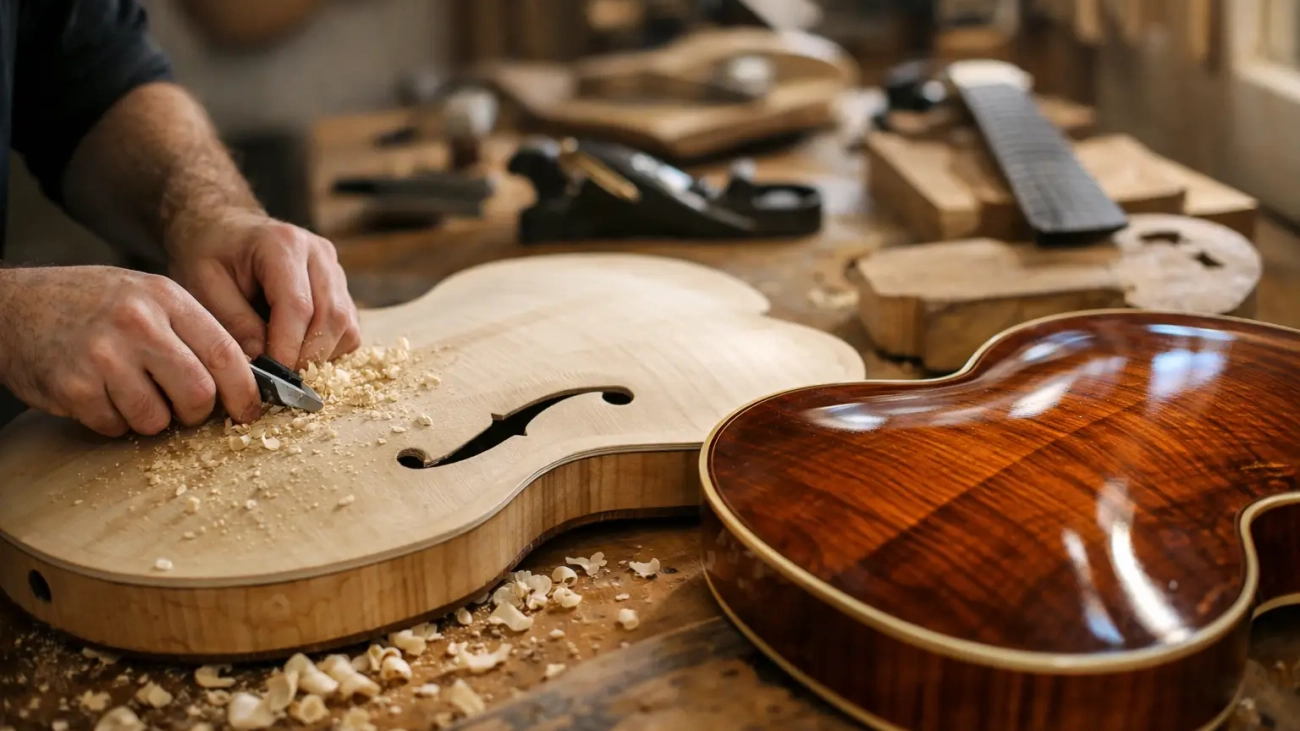
A fine archtop is recognized long before the first amplified note. You feel it in the way the top resists and yields under the hand, in how a single line carries shape and air, and in how chords separate without turning brittle. That is the work of an archtop guitar builder – not simply assembling parts, but determining how wood, geometry, tension, and touch will meet in the hands of one player.
For serious musicians, that distinction matters. The archtop sits in a rare place between architecture and voice. It must project authority, yet remain sensitive. It must offer clarity, but not at the expense of warmth. And because these instruments are asked to serve very different musical lives – solo jazz, ensemble comping, fingerstyle, studio work, even crossover repertoire – the right build is never generic.
The archtop guitar builder as tonal architect
An archtop guitar builder is often described as a craftsperson, and that is true, but it is only part of the picture. At the highest level, the builder is making a sequence of tonal decisions long before the guitar takes its final form. Arching height, graduations, scale length, neck angle, bridge mass, top stiffness, and the relationship between back and top all influence the instrument’s response.
On paper, those variables can sound technical to the point of abstraction. In practice, they are deeply musical. A lightly built carved top may offer quickness, bloom, and a more vocal attack, but it may also ask for a more controlled right hand. A stiffer top can bring focus and headroom, particularly valuable for players who need stronger projection and cleaner note separation in an ensemble. Neither direction is inherently better. The question is always who the guitar is for, how it will be played, and what kind of sound should remain after the note leaves the string.
That is why a serious custom build begins with listening. Not only to the instrument one hopes to create, but to the musician who will live with it.
Why no two archtops should be approached the same way
Factory logic depends on repeatability. Fine luthiery depends on discernment. Even when two sets of wood come from the same species, they will not flex, ring, or compress in precisely the same way. Grain width, density, seasoning, cut, and internal damping all shape the outcome.
For an archtop guitar builder, material selection is not cosmetic sorting. It is the beginning of voicing. Maple can provide brilliance, structure, and projection, but one set may lean toward a dry, quick response while another carries more overtone content and elasticity. Spruce is equally varied. Some tops reward a lighter hand and open into color. Others support a firmer attack and preserve clarity under pressure.
This is where the difference between an expensive guitar and a meaningful one becomes plain. Price alone does not create intimacy between player and instrument. Careful matching does. The build must serve the musician’s touch, repertoire, and tonal expectation, not a predetermined formula.
Carved construction, response, and nuance
In the archtop world, carved construction continues to hold a special place because it allows the builder to shape responsiveness with far greater precision. Through carving and graduation, the top and back can be brought into a balance that affects how quickly the guitar speaks, how notes develop, and how the body supports the midrange.
Pressed instruments have their place and can be musically satisfying, especially when consistency and cost are priorities. But a carved archtop offers a deeper level of individual tuning. It can be made more immediate or more elastic, more direct or more atmospheric. For a player searching for a singular voice rather than a category of sound, that flexibility is decisive.
The quiet importance of setup
Many players underestimate how much of an archtop’s character is either revealed or muted by setup. Nut spacing, fretwork, neck profile, bridge fitting, string choice, and action height all determine whether the instrument feels alive or merely correct.
An excellent archtop guitar builder understands setup as part of the instrument’s musical design, not as an afterthought. A player with a strong acoustic attack may need a different balance than someone working primarily through an amplifier with a lighter touch. A fingerstyle player often hears and feels details differently from a pick player. Even left-handed commissions require more than a mirrored layout. They require the same intelligence of proportion, balance, and response as any master-grade build.
What discerning players should ask an archtop guitar builder
The most useful questions are not about decoration first. They are about sound, feel, and future. How does the builder voice an instrument for warmth versus projection? What are the tonal implications of different scale lengths or body depths? How will the neck shape support long sessions or demanding repertoire? What happens to the instrument as it matures over years of playing?
These are not small matters. A fine archtop develops a relationship with time. The finish, the wood, the tension history, and the player’s own habits all contribute to its evolution. Some instruments open gradually and become more complex with use. Others begin with great brilliance and settle into a drier, more seasoned voice. A builder with long experience will speak candidly about those tendencies rather than making universal promises.
Just as important is whether the builder can translate your language into practical decisions. Many musicians do not describe sound in technical terms. They may say they want more depth, less edge, a quicker attack, a softer top end, stronger fundamentals, or a more forgiving feel under the fingers. A master builder hears those descriptions and understands what must change in the instrument to move toward that result.
The best custom archtops are collaborations
There is a romantic myth that a great instrument arrives fully formed from the bench through intuition alone. In reality, the finest commissions are collaborations shaped by discipline and trust. The player brings artistic intention, physical preferences, and tonal memory. The builder brings experience, material knowledge, and the ability to make choices that endure.
That collaboration should feel specific from the beginning. Body size is not merely a visual preference. It affects comfort, projection, and air movement. Cutaway or non-cutaway is not only aesthetic. It changes structure and access. Pickup choices influence not just amplified sound but also weight and acoustic behavior. Even visual restraint can be a tonal philosophy. Simplicity often allows the essential qualities of the instrument to speak more clearly.
At Scharpach, this understanding has long guided the commission process: the guitar is built around the musician, not the market. For players who have spent years adapting themselves to whatever a standard instrument happened to offer, that reversal can be transformative.
How to recognize serious workmanship in an archtop guitar builder
The signs are not always flashy. Clean purfling and elegant binding matter, but they are not the whole story. More revealing is whether the guitar feels coherent. Does the neck invite the hand naturally? Does the instrument remain balanced across registers? Do single notes have body without becoming cloudy? Do chords retain shape under pressure? Does the dynamic range feel intentional rather than accidental?
A serious builder also leaves room for restraint. The pursuit of volume alone can make an archtop coarse. Chasing softness alone can make it vague. Pursuing brilliance without support can produce a voice that impresses briefly and tires quickly. Mature workmanship is often heard in balance – in an instrument that offers authority without heaviness, sweetness without weakness, and complexity without confusion.
This is especially true for professional and advanced amateur players, whose ears have already moved beyond novelty. They are not looking for a guitar that merely sounds expensive. They are looking for one that reveals more of their own phrasing, time, articulation, and harmonic sense.
Choosing the right archtop guitar builder means choosing a philosophy
Every accomplished builder carries a philosophy, whether stated plainly or not. Some pursue historical faithfulness. Some favor modern precision and increased stability. Some emphasize acoustic richness, while others build with amplified performance foremost in mind. None of these paths is automatically right for every musician.
The real question is whether the builder’s values align with your own. If you hear the guitar as a lifelong artistic partner rather than a replaceable tool, then the build process must honor that seriousness. It should allow for nuance. It should respect individual ergonomics. It should treat tone not as a specification sheet, but as something lived and recognized through experience.
That is what separates a true archtop commission from a transaction. You are not simply ordering dimensions and materials. You are giving form to a musical intention that may stay with you for decades.
The best time to speak with an archtop guitar builder is not when you have memorized every technical term. It is when you know enough about your own playing to recognize what is missing. From there, the right instrument can begin – not as a luxury for its own sake, but as a more faithful extension of the music you already hear.