
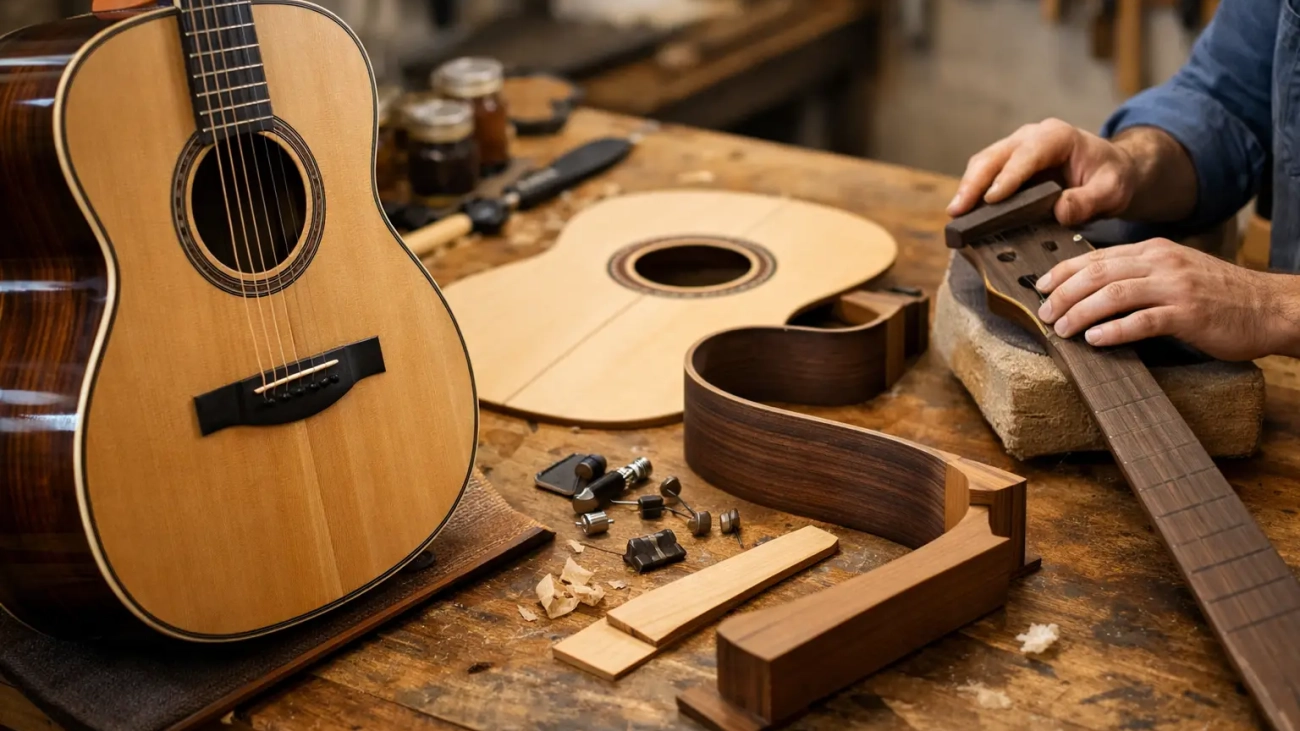
A commissioned guitar begins long before wood is joined or a rosette is set into the soundboard. For a serious player, the real question is not simply what is included in a guitar commission, but whether every decision serves the music they are trying to make. A fine instrument is a conversation between player and maker: technique, repertoire, touch, sound, proportion, and beauty gradually taking physical form.
At Scharpach, a commission is not the selection of options from a fixed catalog. It is the creation of a singular instrument, built around the musical life of the person who will play it. The details vary with each guitar, but the process is held together by the same principles: attentive listening, exacting craftsmanship, and a devotion to resonance that cannot be hurried.
What Is Included in a Guitar Commission?
A custom commission typically includes the complete journey from an initial musical consultation through design, construction, voicing, setup, and final presentation. It also includes something less easily listed but equally essential: the maker’s judgment. After decades at the bench, a luthier understands which choices will support one another and which attractive ideas may work against the instrument’s voice.
The commission usually begins with a discussion of the player’s present instrument and the qualities they wish to preserve or leave behind. A classical guitarist may seek greater color separation, a more immediate response under the right hand, or increased depth in the bass. A flamenco player may need the dry, percussive attack and low action that make rasgueado and golpe speak cleanly. An archtop player may be listening for warmth, projection, articulation, or a particular balance between acoustic complexity and amplified clarity.
From there, the builder develops a direction for the instrument. This can include body form, scale length, neck profile, string spacing, soundboard character, woods, visual details, and the final playing setup. These elements are not separate luxuries. They are parts of one system, and changing one may influence the rest.
The Consultation: Defining a Personal Musical Brief
The most valuable part of a commission is often the earliest. A thoughtful consultation gives shape to desires that can initially seem difficult to describe. Some players speak in technical terms. Others know only that they want a guitar that feels freer, warmer, faster, more powerful, or closer to the sound they hear internally. Both are useful starting points.
A maker may ask about repertoire, ensemble work, recording needs, hand size, posture, preferred strings, and the character of guitars the player has owned. For left-handed players, the discussion also addresses the fundamental geometry of a properly conceived left-handed instrument rather than treating the orientation as an afterthought. A guitar built for the player’s body and technique can reduce unnecessary effort and allow the hands to work with greater confidence.
This stage should also establish realistic priorities. No instrument can be the loudest, darkest, most delicate, and most explosive in every register at once. A very light, responsive top may offer remarkable immediacy but ask for more thoughtful care in changing climates. A larger body may deepen the lower register, while a more compact form can favor comfort and focused projection. The finest result comes from understanding which musical qualities matter most.
Materials Selected for Sound, Not Just Appearance
In a master-grade guitar, wood selection is an acoustic decision before it is a visual one. The soundboard has a central role in determining responsiveness, overtone content, and dynamic range. Spruce may offer crystalline clarity, headroom, and a long tradition of tonal refinement. Cedar can bring warmth, color, and an intimate immediacy. Neither is inherently superior. The right choice depends on the player, the design, and the voice the instrument is meant to carry.
Back and sides contribute their own character, whether the aim is the depth and complexity of rosewood, the focused warmth of mahogany, or another carefully chosen tonewood. The neck, fingerboard, bracing stock, and internal components matter as well. A guitar is not transformed by an impressive species name alone. It is transformed by the maker’s ability to read each piece of wood for stiffness, weight, grain, elasticity, and potential.
The visual language of the guitar is developed alongside its acoustic one. A commission can include a rosette designed around a particular aesthetic, restrained purfling, custom bindings, an elegant headstock, carefully selected tuners, and details in wood, shell, or other materials. Restraint is often the greater luxury. Ornament should frame the instrument’s identity without competing with the music.
Design for the Hands as Much as the Ear
A guitar can possess a beautiful voice and still remain an imperfect companion if it does not sit naturally in the hands. That is why ergonomic design is a meaningful part of a commission. Scale length, nut width, string spacing at the bridge, fingerboard contour, neck depth, and shoulder shape can be considered in relation to the player’s technique and physical comfort.
For a player with smaller hands, subtle changes in neck dimensions or scale length may make demanding stretches feel more manageable. For a concert artist accustomed to a particular spacing, preserving that reference can help the new guitar feel immediately familiar. Some choices require balance. Wider spacing may offer the right hand greater room for tonal control, yet feel more demanding to the fretting hand. A skilled maker does not merely follow measurements. He considers how those measurements will feel after hours of practice and performance.
The body itself can also be shaped around comfort and projection. Arm bevels, altered body depths, or carefully considered proportions may be appropriate for some commissions. These are not universal upgrades. Every addition affects construction, air movement, weight, and visual purity, so it should earn its place in the design.
The Work at the Bench: Construction and Voicing
Once the design is settled, the private work of building begins. The guitar is made by hand through a sequence of exacting operations: preparing and joining the soundboard, shaping the bracing, bending the sides, constructing the body, carving the neck, fitting the fingerboard, and bringing every component into alignment.
Voicing is among the most consequential parts of this work. It is the gradual refinement of the soundboard and bracing so the guitar has the intended balance of strength, flexibility, and response. The builder listens through the hands as much as through the ears, judging the wood’s resistance and behavior at each stage. This is where experience becomes audible.
A commissioned guitar should not be treated as a fixed blueprint reproduced without thought. Even two sets of the same species can behave differently. The maker must respond to the individual materials, making small decisions that no specification sheet can fully predict. That is one reason hand-built guitars carry such distinct personalities.
The finish is part of this acoustic and visual discipline. Traditional varnish work, carefully applied and patiently cured, protects the instrument while allowing the wood to remain alive. A finish that is too heavy can restrain vibration; one that is too fragile may not suit the player’s intended use. The proper approach depends on the design and the desired balance of beauty, resonance, and durability.
Final Setup and the Beginning of Ownership
A commission includes the final setup that allows the guitar to become a true playing instrument. Nut and saddle work, fret dressing, action height, relief, intonation, and string choice are assessed with care. The aim is not merely low action or easy pressure. The aim is a setup that supports clarity, control, and the player’s preferred attack without sacrificing the guitar’s voice.
The final meeting with the instrument is an important moment. A new guitar may feel immediately expressive, but it will also continue to develop as it is played. Fine woods settle, vibrate, and reveal greater complexity over time. The player becomes part of that development through daily contact, repertoire, and attention.
A serious commission also benefits from clear expectations around care, humidity, transport, and future adjustments. A handmade guitar is built for longevity, but longevity is a partnership. Proper storage and occasional professional attention protect not only the instrument’s condition but its musical potential.
The best way to approach a guitar commission is to bring honest musical questions rather than a crowded list of features. Speak about the sound that moves you, the passages that resist your hands, and the music you hope to grow into. A worthy instrument will not simply reflect those answers. It will give them a voice.