
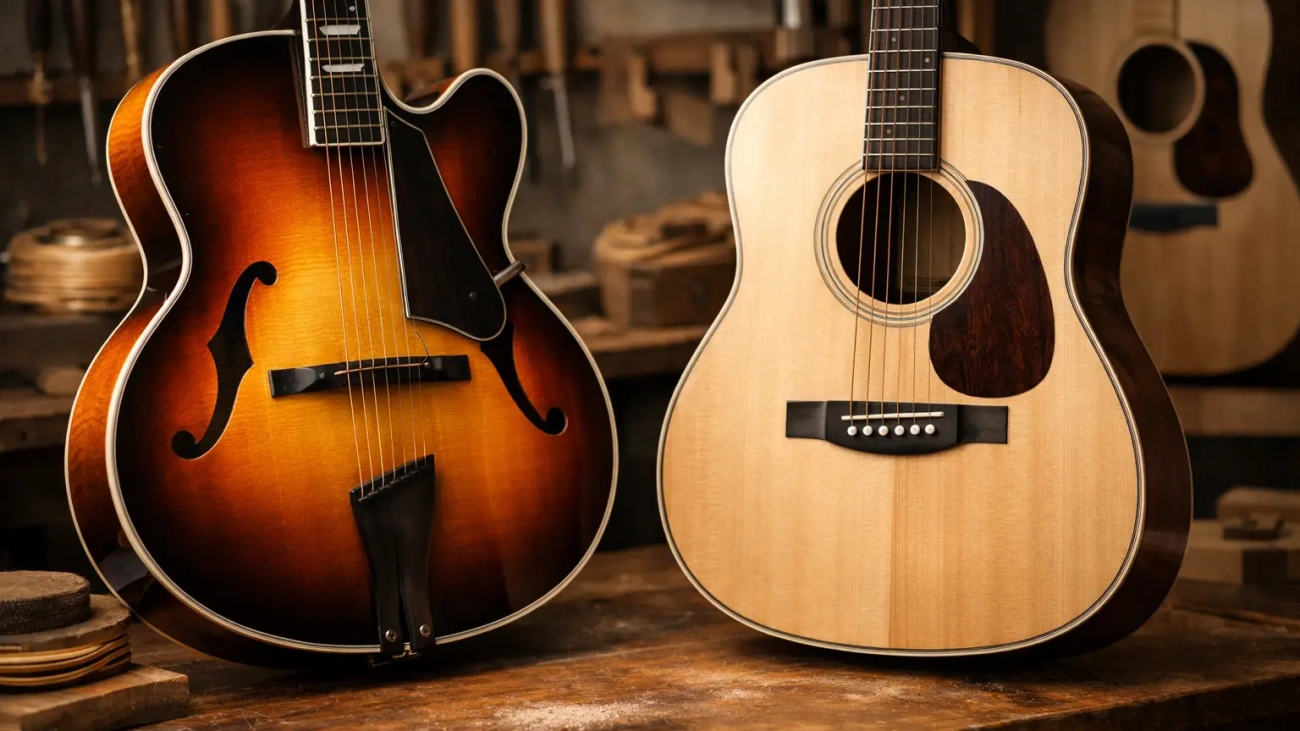
A guitarist who has spent years refining touch can hear the difference before the first phrase is complete. An archtop carries a note with a focused, sculpted authority; a flat top opens beneath the fingers, offering bloom, air, and a wider wash of harmonic color. In the question of archtop guitar vs flat top, there is no universal winner. There is only the instrument whose voice meets your repertoire, technique, and musical imagination.
The distinction is more profound than silhouette. These guitars are shaped by different acoustic principles, different traditions, and different ideas of what a note should become after it leaves the string. For a serious player, understanding those principles is the beginning of a more personal choice.
Archtop Guitar vs Flat Top: The Essential Difference
A flat-top guitar has soundboards and backs that are, as the name suggests, largely flat panels. The top is usually braced internally, most often with a variation of X-bracing or fan bracing depending on the instrument’s musical purpose. Its soundboard moves broadly in response to the strings, producing a generous field of overtones and the familiar enveloping character associated with steel-string acoustics, classical guitars, and flamenco guitars.
An archtop is built around carved, arched plates, much like a member of the violin family. Its top and back are graduated in thickness and formed into curves that create strength, directional response, and a particular relationship between attack and decay. Rather than relying on a central soundhole, a traditional archtop typically uses f-holes, which contribute to its distinctive visual language and acoustic behavior.
This difference in construction creates a difference in intention. A fine flat top often invites the player to explore the fullness around each note. A fine archtop tends to define the note, giving it a clean edge, a rapid rise, and a controlled departure. Neither quality is inherently superior. The question is whether your music needs a broad landscape or a sharply drawn line.
The Voice of the Flat Top
A flat top is often chosen for its generosity. It can offer deep bass, shimmering treble, and a harmonic complexity that supports the voice beautifully. Strummed chords gain body and depth; fingerstyle passages can unfold with a sense of space that feels almost orchestral. The instrument does not simply state the note. It allows the note to develop.
For the player whose work moves through singer-songwriter repertoire, contemporary fingerstyle, folk, Americana, classical, or flamenco traditions, this breadth can be indispensable. A well-made flat top responds to subtle changes in nail, fingertip, pick angle, and right-hand placement. The player can move from warmth near the fingerboard to clarity near the bridge without losing the natural cohesion of the instrument.
Wood selection has an especially visible role here. A spruce top may offer headroom, clarity, and a long tonal future. Cedar can bring immediate warmth and quick response under a lighter touch. Rosewood, maple, walnut, and mahogany each shape the balance of fundamental tone, overtone content, and projection. Yet wood species alone never tells the whole story. The voicing of the top, the stiffness of the braces, the air volume of the body, and the finish all determine how those materials speak together.
The trade-off is that a flat top’s harmonic richness can become diffuse in certain ensemble settings. In a dense acoustic mix, its warmth may require more careful microphone placement or amplification. Its sustain, while beautiful, can also blur fast harmonic movement if a player needs strong separation between notes.
The Voice of the Archtop
The archtop was born for presence. Its sound is defined by immediacy, separation, and projection that does not depend on excessive volume. A well-voiced carved archtop can place a single note in the center of an ensemble with remarkable poise. The attack is articulate, the midrange carries authority, and chords retain an elegant internal order.
This makes the archtop a natural companion for jazz players, particularly those who value rhythmic precision, chord melody work, and a clear acoustic identity. It also appeals to players in swing, blues, early popular music, and modern improvised styles who want a guitar that answers quickly and leaves room for the next musical thought.
The classic carved spruce top and maple back and sides remain revered for good reason. Spruce combines sensitivity with strength, while maple often provides focus, speed, and a refined restraint in the overtone range. However, an archtop can be voiced in many directions. A deeper body may offer greater warmth and low-end support. A lighter graduation can encourage a more open, responsive character. A carefully chosen finish can preserve the freedom of the plates and allow the guitar to mature with grace.
An archtop is not necessarily louder than a flat top in every context. Its strength is often perceived projection: the ability of its essential voice to travel through a room and remain intelligible among other instruments. That clarity is one reason a great archtop feels so alive in the hands of an experienced player.
Feel, Ergonomics, and the Player’s Right Hand
Tone begins in the hands, and body design changes the conversation between player and instrument. Archtops are commonly built with a raised bridge and a tailpiece, which creates a particular string feel and break angle over the bridge. The response can feel taut, immediate, and rhythmically exact. Many players appreciate how clearly the instrument reflects pick articulation and dynamic control.
Flat tops generally place the bridge directly on the soundboard, creating a different transfer of string energy into the top. Depending on scale length, bracing, action, and string choice, they can feel elastic, yielding, and deeply connected to the player’s touch. Fingerstyle musicians often prize that sensation of drawing sound from the top rather than striking sound into the instrument.
Body depth, lower-bout width, neck profile, nut width, and scale length deserve equal attention. A player with a refined ear should not accept an instrument that compromises the body. The most resonant guitar in the world cannot become a lifelong companion if it causes fatigue or resists the player’s natural technique. For left-handed musicians in particular, a purpose-built instrument is far more meaningful than a reversed standard design. Bracing, asymmetry, pickguard placement, and visual balance all deserve to be conceived for the player rather than adapted as an afterthought.
Choosing by Repertoire Is Useful, but Not Enough
A practical starting point is simple. If your musical life is centered on comping in a jazz ensemble, chord melody, and clean single-note phrasing, an archtop is likely to feel immediately at home. If you accompany a voice, write songs, play fingerstyle arrangements, or seek a broad acoustic palette, a flat top may offer the more natural foundation.
But repertoire should not become a cage. Some players want an archtop with unusual warmth and sustain for solo work. Others seek a flat top with dry, rapid response and restrained overtones for recording or ensemble precision. The finest custom instruments emerge when general categories give way to specific questions: How hard do you play? Do you use fingers, nails, or a pick? Which frequencies do you want to hear under your ear? What should the guitar do when you lean into a phrase, and what should it withhold?
These questions are why commissioning an instrument is not merely a matter of selecting woods from a list. It is a process of listening. A master luthier considers the player’s technique, repertoire, physical requirements, and desired tonal horizon, then shapes thicknesses, bracing, arching, neck geometry, and finish into a unified response. At Scharpach, that dialogue is treated as part of the craft itself, because a guitar becomes exceptional when its design serves one musician with uncommon precision.
The Value of Time in a Handmade Instrument
Both archtops and flat tops continue to reveal themselves over years of playing. As the woods settle into vibration and the instrument becomes accustomed to being played, its response can gain ease, color, and complexity. This development is not magic, nor is it guaranteed by an expensive label. It begins with sound material, thoughtful construction, careful setup, and an instrument built with enough sensitivity to grow.
A thin, well-applied finish matters because it protects the wood without smothering it. Proper humidity care matters because fine plates and braces are living material, responsive to their environment. So does the discipline of a setup that respects the player’s needs. A handmade guitar is not fragile in spirit, but it rewards attention.
The right choice may become clear when you stop asking which guitar is more versatile and ask which one makes you play more honestly. Choose the instrument whose first note invites the next, then give it the years and music required for its true voice to emerge.