
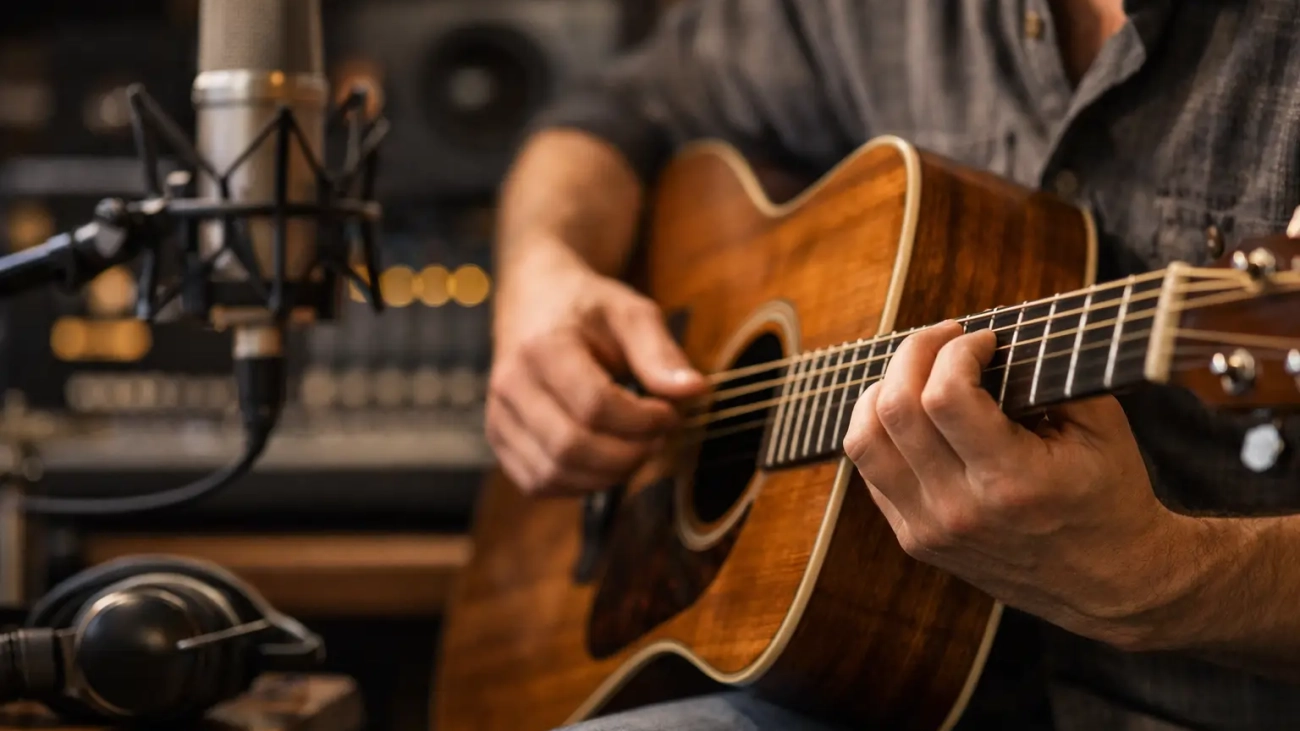
A microphone does not simply capture a guitar. It exposes the relationship between the player, the room, the strings, and the instrument’s voice with sometimes ruthless honesty. Guitar voicing for professional recording begins long before microphone choice or equalization. It begins in the way a top responds to the lightest touch, how the bass supports the melody, and whether the treble carries color without becoming brittle under a close microphone.
For the serious player, this is not a technical concern reserved for engineers. It is part of musical identity. A fine guitar that speaks with balance, headroom, and a clear harmonic center gives the performer more freedom at the session. Less correction is needed later, and more of the player’s intention remains intact.
What Voicing Means in a Recording Instrument
In luthiery, voicing is the deliberate shaping of an instrument’s response. It involves the subtle relationship of soundboard thickness, bracing, arching, materials, stiffness, mass, and finish. The goal is not simply more volume. It is a particular distribution of energy: how quickly a note begins, how it develops, what harmonics accompany it, and how gracefully it fades.
This differs from chord voicings, though the two meet in the studio. A guitarist may arrange a chord with great care, leaving air around a vocal or choosing inner voices that support a melody. Yet the instrument itself must present those notes distinctly. If its low midrange is congested, the sophistication of the arrangement can disappear into a soft, indistinct bloom. If its upper register is hard or thin, a beautifully placed melody can become tiring under compression.
A guitar made for recording need not sound spectacular from across a crowded room. Projection has value, particularly onstage, but a microphone listens at close range. It hears grain, separation, the shape of the attack, and small shifts in timbre between notes. The finest recorded sound often comes from an instrument that remains composed rather than exaggerated.
Guitar Voicing for Professional Recording: The Qualities That Matter
The first requirement is balance across the register. A powerful low E is alluring in a showroom, but in a recording it can dominate the image and force the engineer to filter away part of the instrument’s natural body. A well-voiced guitar allows the bass to be present and round while leaving room for the middle strings, where accompaniment and counterpoint so often live.
Treble response deserves equal attention. For classical and flamenco players, the first string must sing, not merely cut through. A recording microphone can make a sharp treble seem louder than it feels under the ear. The most useful high register carries a core of warmth beneath its clarity, so a melodic line retains substance at both pianissimo and full voice.
Then comes note separation. Dense harmony, campanella passages, artificial harmonics, and contrapuntal writing all ask the guitar to reveal several musical events at once. When the top has been carefully tuned and the body supports it without excessive overlap, individual notes retain their outline. The result is not clinical. It is intelligible, which allows the performer to shape phrases instead of fighting a wash of sound.
Dynamic range is another essential quality. A studio performance often moves from a whispering introduction to a firm rhythmic passage within a few measures. An instrument with a narrow dynamic window may sound attractive at one level but flatten when the player asks more of it. A responsive guitar offers gradations. It responds immediately to a soft rest stroke, yet accepts a stronger attack without closing down, rattling, or producing a harsh transient.
Finally, consider sustain in context. Long sustain is not automatically superior. In a sparse solo piece, a lingering note can create a beautiful field of resonance. In fast music or layered arrangements, too much carryover can blur the harmony. The desirable quality is controlled sustain: enough life for a note to bloom, enough discipline for the musical line to remain clear.
The Soundboard Is Where the Conversation Begins
The soundboard is the instrument’s primary speaker, and its voicing demands judgment rather than formula. Two pieces of spruce with similar visual character can differ profoundly in stiffness, weight, and responsiveness. Cedar brings its own possibilities: an immediate, richly colored response that can be especially compelling beneath a sensitive microphone. Neither is universally better.
Spruce often rewards a player who values a broad dynamic palette, clean articulation, and tonal development over years of playing. Cedar may offer a more immediate intimacy and a complex warmth at modest input. But wood species alone cannot predict a recording result. The selection of the individual set, the bracing design, the graduation of the top, and the maker’s ear determine whether the finished instrument has coherence.
Back and side woods also influence the recorded character. Rosewood may offer depth, overtone richness, and a spacious envelope. Maple can bring speed, focus, and a more defined edge around each note. Cypress has an immediacy and dryness prized in flamenco, where rhythmic authority must remain clear. These are tendencies, not guarantees. The musical question is always more useful than the material question: what must this guitar say when the red light is on?
A thin, carefully applied finish lets the soundboard move with less restraint, but it also requires precision. Varnish is not decoration applied after the real work is done. Its weight, elasticity, and aging behavior become part of the instrument’s final voice. A finish that preserves vitality without sacrificing protection is one of the quiet marks of serious workmanship.
Attack, Noise, and the Truth of Close Microphones
Close recording makes the beginning of a note unusually important. The transient tells the listener whether a sound is a fingernail, fingertip, pick, rest stroke, or apoyando attack. It provides rhythm and definition, but it can also become a problem when the instrument produces a click that is disconnected from the note that follows.
A refined guitar does not erase the player’s touch. It translates it. On a well-voiced classical guitar, the attack has enough articulation to establish the note, followed by a rounded musical body. On a flamenco instrument, the response may be drier and more percussive, but the rhythmic edge should still feel integrated with the pitch. On an archtop, the player may seek a quick bloom with a focused fundamental, so comping remains elegant beneath horns or voice.
Some mechanical noise is part of an honest guitar recording. Fingers moving on wound strings, a breath before a phrase, and the soft contact of the hand can contribute intimacy. The issue is proportion. If the guitar requires aggressive noise reduction, excessive de-essing, or drastic equalization to sit in a mix, the instrument or setup may be working against the music.
Fresh strings, appropriate action, and a settled humidity level matter greatly. So does the player’s right-hand position. Before changing microphones, it is often worth moving the hand one inch toward the bridge or soundhole and listening again. A beautifully voiced instrument gives meaningful tonal choices through technique rather than forcing the player into one narrow response.
Choosing a Voice for the Music You Record
The ideal recording guitar depends on repertoire and working conditions. A solo classical artist recording Bach may value separation, a stable center pitch, and a treble capable of carrying long lines. A flamenco player may prioritize speed, dryness, and a decisive response to rasgueados and golpes. A singer-songwriter using nylon strings may need warmth that supports the vocal without occupying its crucial midrange.
For layered sessions, restraint can be a virtue. A guitar with monumental bass and dense overtones may sound magnificent alone, then become difficult to place beside piano, strings, or a second guitar. A more focused instrument may leave space naturally, preserving its character with little processing. Conversely, for a single-guitar recording in a generous room, a complex and expansive voice can supply much of the emotional landscape.
This is why a personal consultation matters in a commissioned instrument. The maker should ask not only what guitars the player admires, but where the guitar will be heard. Will it be captured close in a dry studio? Played through a single stereo pair in a hall? Used for concert performance one week and intimate overdubs the next? At Scharpach, such questions belong to the foundation of a build, because a guitar’s finest qualities are meaningful only when they serve the musician’s actual work.
Let the Instrument Reduce the Work of the Session
Engineering remains an art, and even the most exceptional guitar benefits from thoughtful microphone placement, room selection, and performance preparation. Yet recording should refine a voice, not manufacture one. When the instrument arrives with balanced fundamentals, elegant overtones, and a response that follows the player’s intention, the session becomes less corrective and more musical.
The most memorable recordings preserve a sense that someone is in the room, shaping time and tone with their hands. Choose a guitar whose voice gives that presence room to remain human.