
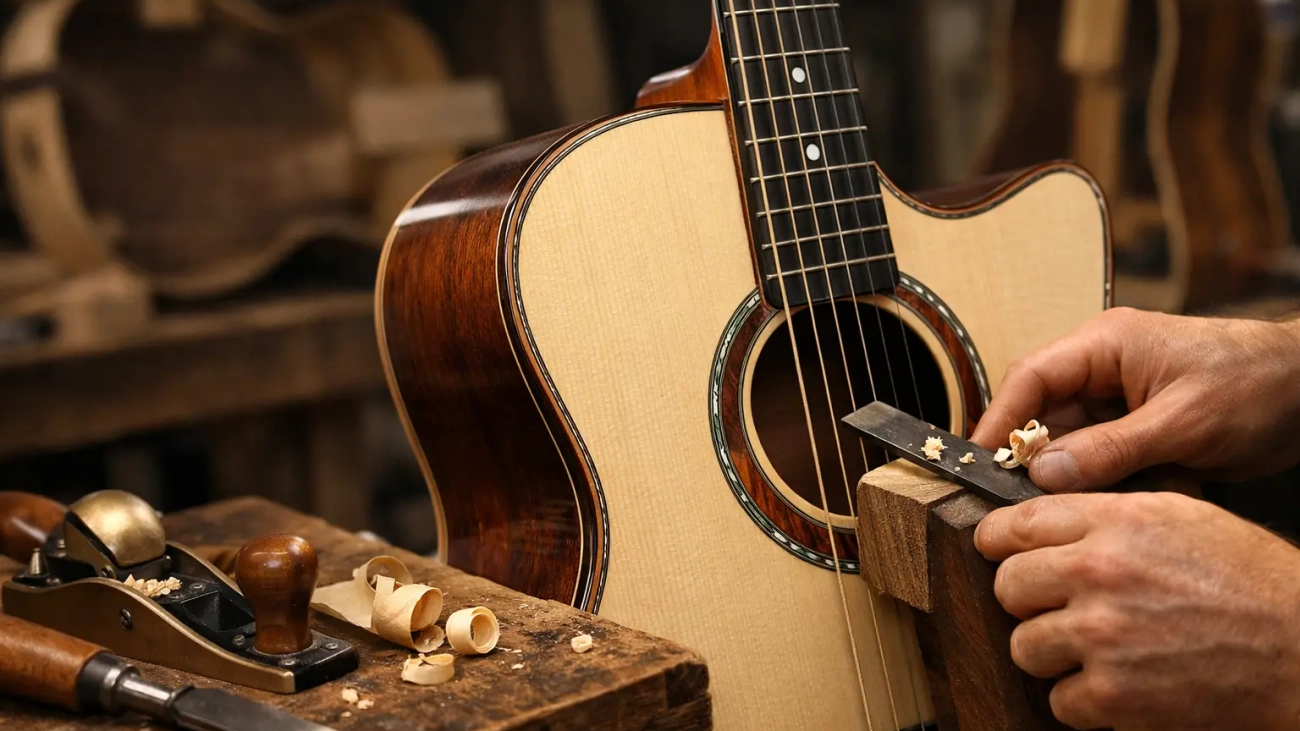
A serious player can feel the difference before the first note fully blooms. The neck settles into the hand with a kind of inevitability. The top responds with less effort. A phrase that felt slightly constrained on a factory instrument suddenly opens. That is where luxury handmade guitars begin to justify themselves – not in ornament alone, but in the intimate relationship between player, touch, and sound.
At the highest level, a guitar is not simply assembled. It is voiced. Every meaningful choice affects the result: scale length, top thickness, neck profile, bridge mass, body geometry, varnish, and the character of the wood itself. What separates a luxury instrument from an expensive one is the coherence of those decisions. The finest handmade guitars are not built to impress in a showroom for five minutes. They are built to reveal more over years of playing.
Why luxury handmade guitars feel different
Mass production is exceptionally good at consistency. It is far less capable of intimacy. A factory guitar is designed to satisfy a broad range of players, which means compromise is built into its DNA. Neck dimensions are standardized. Bracing patterns are repeated. Tops are thicknessed within production tolerances. Even very good factory instruments are asked to be many things to many people.
A handmade guitar follows a different logic. It is built around a player, a repertoire, and a tonal idea. A classical guitarist with a refined right-hand technique will ask different things of an instrument than a flamenco player who needs speed, dryness, and percussive authority. An archtop player chasing warmth, projection, and note separation lives in another world again. In a true atelier setting, those differences are not treated as minor preferences. They shape the build from the beginning.
This is why luxury in luthiery is not merely about rare wood or visual elegance, though both can matter. Luxury is precision directed toward musical identity. It is the refusal to leave crucial expressive details to chance.
The real value of a bespoke build
For advanced players, the search for an instrument often becomes frustrating for a simple reason: excellent guitars still may not be the right guitars. One may have power but lack nuance under a light touch. Another may offer beautiful trebles but a bass response that never quite anchors the music. A third may sound impressive in front of the player yet feel resistant in the left hand after an hour.
A bespoke process addresses those gaps by replacing assumption with dialogue. The builder learns how the musician plays, what repertoire matters most, how much resistance the player prefers, how the guitar should project, and how the instrument should age tonally over time. Ergonomics become part of the art rather than an afterthought. For left-handed players especially, this level of care is often the difference between accommodation and true authorship.
That process also changes the emotional quality of ownership. When a guitar is commissioned with intention, it carries more than specifications. It carries memory, anticipation, and trust. The finished instrument does not feel interchangeable because it was never conceived as a product for the anonymous market.
Materials matter, but judgment matters more
Much is said about tonewoods, and for good reason. The top, back, sides, neck, fingerboard, and internal structure all shape responsiveness, projection, and color. Yet in the luxury world, the wood itself is only part of the story. The more decisive factor is the luthier’s judgment.
A master builder does not simply select spruce, cedar, rosewood, maple, or ebony by species name. He evaluates stiffness, density, elasticity, grain behavior, cut, age, and the hidden potential within each set. Two tops from the same species can ask for entirely different treatment. One may reward lighter bracing for openness. Another may need more restraint to preserve control and longevity.
The finish is equally misunderstood. A heavy finish can inhibit movement. A carefully applied varnish preserves beauty while allowing the instrument to breathe and develop. In fine guitar making, surface treatment is never just cosmetic. It belongs to the acoustic design.
There is, of course, no single recipe for greatness. A player seeking quick attack and transparent articulation may prefer a very different voice from someone who wants depth, bloom, and orchestral complexity. This is why experience matters so profoundly. Fine materials are necessary. They are not sufficient.
Beauty is not separate from sound
In lesser instruments, decoration can serve as a distraction. In a master instrument, beauty supports the whole. Proportion, rosette work, purfling, arching, and the clarity of line all communicate discipline. Restraint often speaks more convincingly than excess.
Collectors understand this instinctively. So do performers. An elegant guitar should reward the eye without ever compromising the ear.
Handmade does not mean romanticized imperfection
There is a persistent fantasy that handcraft means charming irregularity. In serious luthiery, the opposite is true. The hand is valuable because it can make finer distinctions than automated production when guided by skill, patience, and a trained ear.
That applies to fretwork, action, neck geometry, intonation, top tuning, and the countless subtle adjustments that determine whether an instrument merely functions or truly sings. Precision in a handmade guitar is not sterile. It is alive. It serves sensitivity.
This is also where decades of experience become audible. A builder with forty years at the bench has watched instruments mature, settle, open up, and reveal the long-term consequences of earlier decisions. That perspective cannot be rushed. It is earned one instrument at a time.
Who luxury handmade guitars are really for
Not every guitarist needs a commissioned instrument. That is worth saying plainly. If a player is still discovering basic preferences, or needs a versatile tool for rough travel conditions, a well-made production guitar may be the better choice. Luxury should never be reduced to status alone.
But there comes a point in a musician’s life when generic excellence is no longer enough. The ear becomes more demanding. Technique becomes more specific. Repertoire asks for colors that standard instruments only approximate. At that stage, a bespoke guitar stops being indulgence and starts becoming a serious artistic decision.
This is especially true for concert players, recording musicians, advanced amateurs with mature taste, and collectors who understand that a great instrument is not frozen at the moment of purchase. It grows. It settles into the player’s habits. It develops character with use. The best examples become companions rather than acquisitions.
The patience behind heirloom quality
One of the quiet truths of this world is that haste leaves marks. A fine handmade guitar requires time because wood requires time, finishes require time, and judgment requires time. The instrument must be allowed to become itself.
That patience is not inefficiency. It is discipline. A luxury guitar is expected to endure, to remain structurally sound, visually compelling, and musically relevant for decades. It should not peak early and fade. It should deepen.
This is where the language of heirloom quality earns its meaning. An heirloom is not simply old and valuable. It is made so well that another generation may still find life in it.
Commissioning as collaboration
The most rewarding commissions feel less like a transaction and more like an exchange between musical minds. The player brings touch, aspiration, repertoire, and taste. The luthier brings structure, listening, and the ability to translate those qualities into wood and air.
At Scharpach, that philosophy sits at the center of the work. The goal is not to place a prestigious object into a player’s hands. It is to build an instrument with a distinct voice, one that meets the musician at a serious level and keeps revealing itself over time.
In that sense, luxury handmade guitars are not defined by price alone. They are defined by attention. Attention to resonance. Attention to proportion. Attention to the living relationship between musician and instrument. When those things are present, the guitar does more than perform beautifully. It becomes faithful to the person playing it.
If you have reached the point where your ear hears the gap between a very good guitar and your guitar, that instinct is worth trusting.