
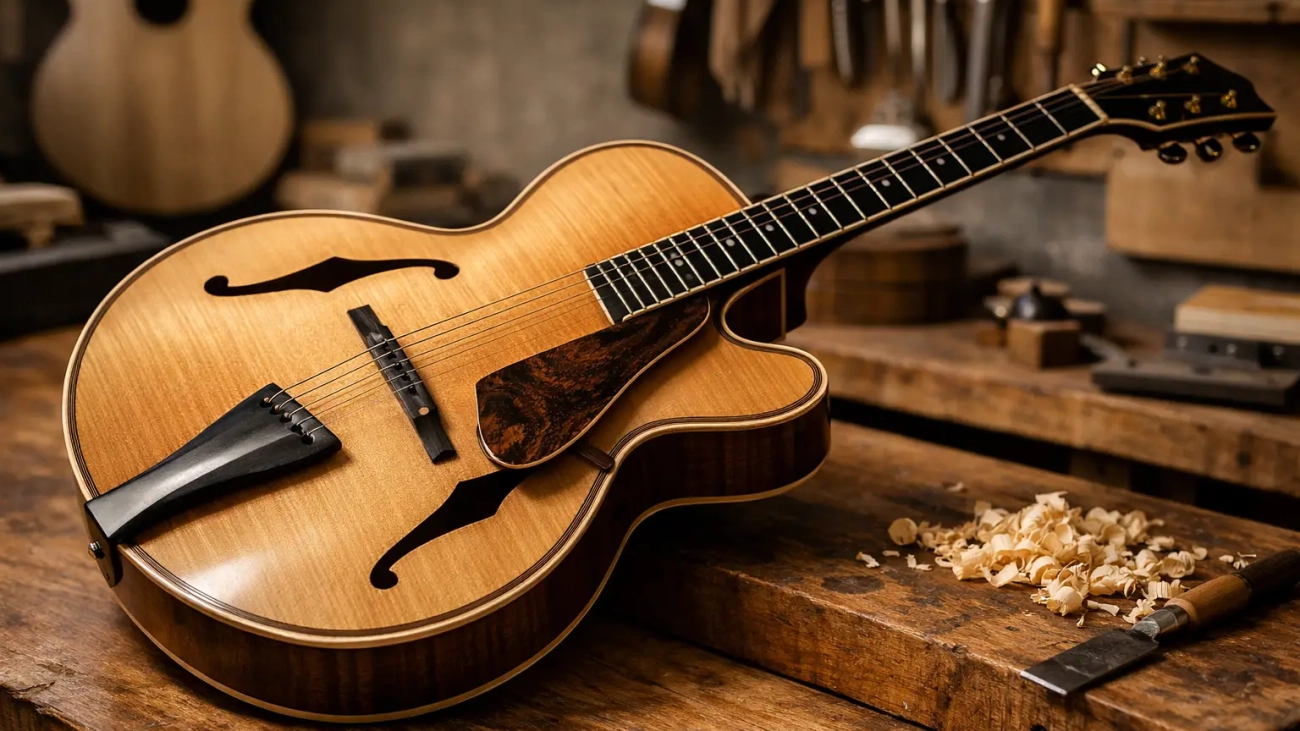
Some guitars ask to be played. A rare few seem to answer before the first note is finished. That is the difference serious musicians hear when they spend time with boutique archtop guitars – not simply volume or visual beauty, but a more intimate relationship between touch, response, and tone.
An archtop at this level is not a category purchase. It is a search for an instrument with a specific musical temperament. For a jazz player, that may mean dry articulation with fast note separation and a carved voice that stays clear under complex harmony. For another, it may mean warmth, bloom, and a singing upper register that carries melody without becoming brittle. The finest work in this field begins with that distinction.
What sets boutique archtop guitars apart
The phrase is often used too loosely. A small-batch instrument is not automatically a boutique instrument, and a high price does not guarantee refinement. Truly boutique archtop guitars are defined by authorship. They carry the judgment of a master builder at every stage – wood selection, plate carving, graduation, neck geometry, bracing, setup, finish, and final voicing.
Factory production, even at a respectable level, is built around repeatability. That has its virtues. Consistency matters, and many production archtops serve players well. But repeatability also asks the instrument to conform to a target. A master-built archtop works in the opposite direction. The build responds to the wood in hand, to the player it is intended for, and to the tonal destination agreed upon from the beginning.
That difference becomes audible in ways experienced players recognize quickly. The attack is cleaner. The midrange carries more character. The low end supports the note rather than crowding it. Chords retain definition. Single notes have shape, not just pitch. Most important, the instrument gives something back to the player at low effort. You do not have to force the guitar into speech.
The carved voice and why it matters
At the heart of the archtop tradition is carved architecture. The top and back are not flat components assembled into a shell. They are shaped, tuned, and graduated to guide movement. This is where much of the instrument’s identity resides.
A responsive carved top can produce an extraordinary balance of immediacy and complexity. The first impression may be focus, but beneath that focus is a layered response that reveals itself over time. A fine archtop does not merely sound good in front of the instrument. It feels coherent under the hands. The player senses where the note begins, how it blooms, and how quickly it leaves space for the next phrase.
That behavior is especially important for musicians whose repertoire depends on articulation. In jazz comping, for example, too much sustain can blur harmonic rhythm. In melodic playing, too little body can make the line sound thin. Boutique work allows these variables to be shaped with far greater precision than standardized manufacturing usually permits.
There is no universal ideal here. Some players want dryness and projection. Others want a more lyrical, almost vocal quality. The point is not that one voice is superior, but that a serious instrument should be built with intention rather than approximation.
Wood, varnish, and tonal consequence
Materials are often discussed in romantic terms, but in truth they matter because they influence behavior. Spruce, maple, ebony, and other traditional choices each bring structural and acoustic properties that affect stiffness, speed, weight, overtone content, and long-term stability. Selection is not a matter of prestige alone. It is a matter of suitability.
The best luthiers choose wood not only for beauty, though beauty has its place, but for how it will function in a specific build. Two tops of the same species can ask for entirely different treatment. One may support a lighter touch and produce remarkable openness. Another may require different graduation to reach its potential. This is why experience matters so much in boutique archtop guitars. A master builder is not following a fixed recipe. He is reading material.
Finish matters as well. Heavy finishes can restrain the liveliness of the plates. A refined varnish system, carefully applied, protects the instrument while preserving movement and nuance. The result is not merely cosmetic elegance. It is part of the guitar’s acoustic freedom.
Why serious players choose commissioned work
For advanced players, the problem is rarely finding an archtop. The problem is finding one that feels inevitable. Many fine instruments impress in a showroom and gradually reveal compromises in scale length, neck shape, body depth, responsiveness, setup, or tonal balance. These issues are not dramatic on paper, but over years of playing they become central.
Commissioned work changes the conversation. Instead of adapting oneself to a finished object, the player participates in shaping an instrument around musical needs and physical reality. Neck dimensions can be tailored to the hand. Setup can reflect attack and string preference. Voicing can lean toward projection, warmth, clarity, or a more complex middle ground. Even visual restraint or ornament can be aligned with the player’s sensibility.
That process is valuable not because it is luxurious, but because it is musically honest. A left-handed guitarist, a performer with highly specific repertoire demands, or a player who has spent decades refining touch should not have to settle for near enough.
The trade-offs no one should ignore
There are trade-offs, and they deserve plain language. A boutique archtop typically requires patience. Build times are measured in months, sometimes longer. Cost is significant because the instrument embodies skilled labor, scarce materials, and years of accumulated knowledge. It may also demand a more discerning ear from the owner. A highly responsive guitar reveals nuance, but it also reveals imprecision.
There is also the question of taste. Some players genuinely prefer the familiar feel and compressed predictability of certain production instruments, especially in amplified settings. Others want a highly ornate archtop, while some are drawn to quiet visual discipline. Boutique does not mean objectively better in every context. It means more deliberate, more individual, and usually more revealing.
How to evaluate boutique archtop guitars
The first test is not decoration. It is response. Listen to how quickly the note speaks, how evenly the register behaves, and whether chords remain intelligible under pressure. Pay attention to what happens when you play softly. A serious archtop should not come alive only when pushed.
Then consider physical relationship. Does the neck encourage confidence without excess effort? Does the guitar balance naturally against the body? Is the setup inviting enough to support long sessions without fighting back? Refinement is often felt before it is analyzed.
Finally, evaluate character rather than spectacle. A mature instrument does not need to be loud in every direction. It needs to be convincing. The best archtops possess a kind of tonal poise – a voice with center, dignity, and room for the player’s own identity.
This is why conversations with the builder matter. The most meaningful commissions begin not with a menu of options but with questions about touch, repertoire, ensemble context, and the sound a player has spent years trying to find. In ateliers such as Scharpach, that dialogue is part of the craft itself. The instrument is shaped not for a market segment, but for a musician.
Boutique archtop guitars as lifelong instruments
A fine archtop often grows more persuasive with time. As the wood settles and the instrument is played, the voice can gain ease, depth, and complexity. This gradual opening is one of the quiet rewards of master-built work. The guitar becomes less like a purchase and more like a companion that continues to reveal itself.
That matters for collectors, but it matters even more for players. An heirloom instrument should not be valuable only because it is rare. Its value should come from years of musical service, from evenings in the studio, rehearsals, performances, and private hours when the player’s ear is at its most exacting.
When boutique archtop guitars are built with intelligence and care, they do more than satisfy preference. They support a deeper level of expression. They remove friction. They invite trust. And for the musician who has spent long enough searching, that is often the moment the instrument stops feeling exceptional and starts feeling like home.
If you are considering one, listen beyond reputation and ornament. Listen for the guitar that seems to understand your hands before you explain them.