
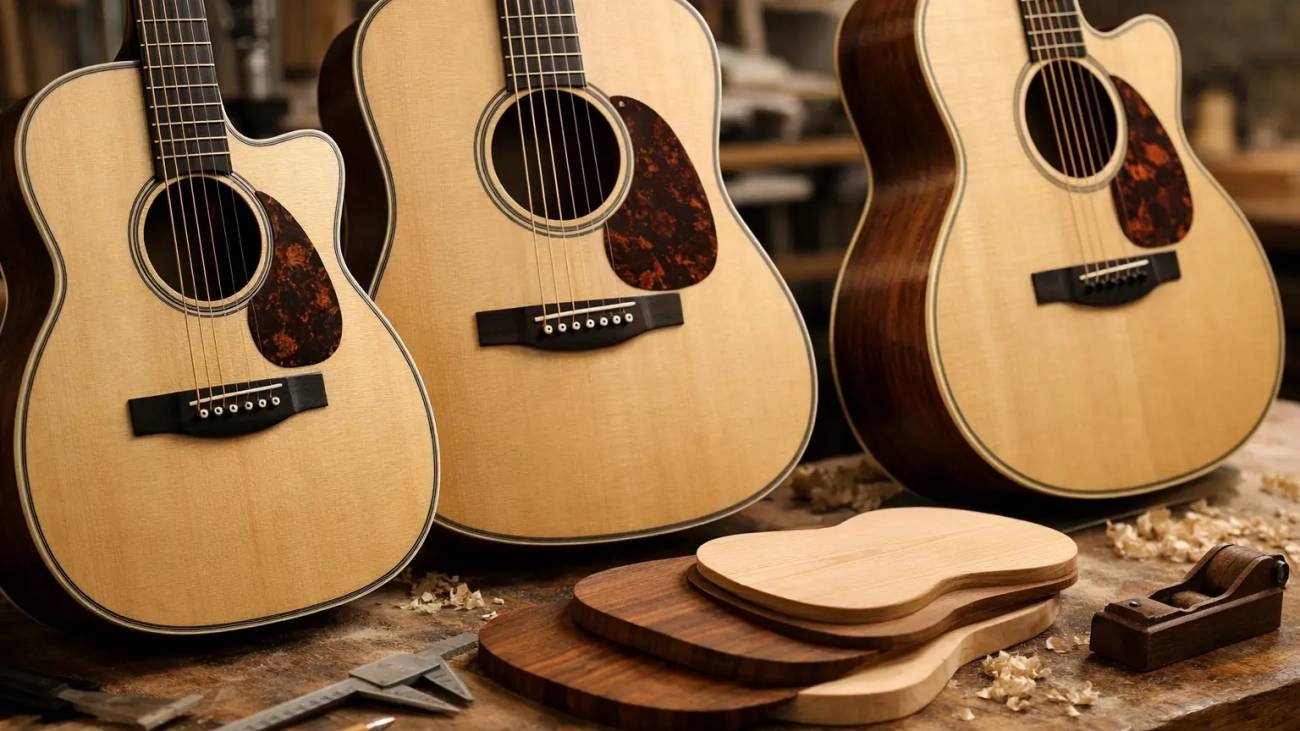
A guitarist may spend years searching for a more intimate treble, a deeper bass, or relief from the tension held in the shoulder after a long rehearsal. Often, the answer is not a different string set or a more costly wood. It begins with proportion. Knowing how to select guitar body dimensions means understanding that the body is not simply a vessel for sound. It is the meeting place of air, wood, arm, chest, and musical intention.
For a handmade instrument, dimensions should never be chosen from a catalog alone. A few millimeters in lower-bout width, body depth, or scale relationship can alter the way a guitar rests against the player, releases its voice, and carries through a room. The proper proportions are those that serve the player and the repertoire together.
Start With the Player, Not the Pattern
Traditional guitar models offer useful points of reference, but a fixed template cannot account for every body, technique, or musical ambition. A concert guitarist who plays seated for several hours has different needs from a flamenco player who moves dynamically through rasgueados, or an archtop player shaping a chord melody at a microphone.
Begin with the physical realities of playing. Height and arm length matter, but so do torso length, shoulder mobility, hand position, and whether the guitar is played predominantly seated or standing. A broad lower bout can offer a generous air chamber and a powerful visual presence, yet it may force a smaller player to reach farther around the instrument. A shallower body may sit closer to the torso and feel immediately familiar, though it can shift the balance of low-end weight and projection.
The goal is not to make the smallest possible guitar or the largest. It is to find a body that disappears from conscious effort, allowing the player to attend fully to phrasing, color, and touch.
Measure comfort in playing position
A guitar should be assessed in the position in which it will actually be used. For classical players, that often means testing the instrument with a footstool or support, with the neck elevated and the waist resting on the left leg. Flamenco players may use a more upright posture and demand freedom for the right arm. Archtop players frequently need a body that remains composed under a strap as well as in a seated position.
Pay particular attention to three contact points: the lower bout against the leg, the upper bout against the chest, and the edge beneath the picking or strumming arm. If the shoulder rises, the wrist collapses, or the forearm feels compressed, the dimensions are working against technique. Gentle edge treatment, a carefully shaped arm area, or a modest reduction in depth can be more meaningful than a dramatic redesign.
For left-handed players, these considerations deserve equal care. Reversing a standard design is only the beginning. The instrument’s balance, cutaway choice, visual lines, and arm contact should be considered as a coherent whole.
How to Select Guitar Body Dimensions for Sound
The body dimensions of an acoustic guitar influence its air resonance, frequency balance, dynamic headroom, and sense of immediacy. They do not determine tone by themselves. Top thickness, bracing architecture, soundhole size, wood selection, bridge placement, and finish all speak at once. Still, dimensions establish the acoustic landscape in which those choices work.
A larger internal air volume generally supports a fuller low register and greater breadth of projection. This can be deeply satisfying for a player seeking orchestral bass, sustained lyrical lines, or an instrument capable of filling a hall. Yet size has consequences. If the top and bracing are not voiced with precision, additional volume can become diffuse rather than powerful, with bass that clouds the middle voices.
A more compact body often responds with speed and focus. Notes can speak with a directness that rewards articulate right-hand work, fast passagework, and nuanced changes of attack. The sound may feel less expansive than that of a large-bodied concert instrument, but it can possess exceptional clarity and intimacy. For many players, that clarity is not a compromise. It is the voice they have been seeking.
Lower-bout width and air volume
The lower bout carries much of the instrument’s air volume and active soundboard area. Increasing its width can enrich bass response and broaden the tonal image, especially when paired with a soundboard capable of remaining supple and controlled. It also changes how far the right arm must travel around the body.
A classical guitar in the traditional range of roughly 14.5 to 15 inches across the lower bout gives many players a familiar equilibrium of comfort and concert-level authority. Moving beyond that range can produce welcome depth for some hands and repertoire, but it should be done with restraint. An instrument is not more expressive merely because it is larger.
Body depth and projection
Depth is one of the most consequential and misunderstood choices. A deeper body can increase air volume and give the sound more physical presence, often supporting warmth and projection. But excessive depth may make the instrument feel cumbersome, move it farther from the player’s body, and produce a bass-forward response that does not suit every musical setting.
A shallower body can offer remarkable immediacy and a more comfortable embrace, particularly for smaller-framed players or those who perform seated for long periods. In a refined build, reduced depth need not mean reduced authority. Careful voicing can preserve color, sustain, and a convincing low register while delivering a quicker, more transparent response.
Upper bout, waist, and balance
The upper bout and waist may seem secondary beside the lower bout, but they shape both ergonomics and identity. A narrower waist can bring the guitar closer to the player’s body and make classical positioning more natural. It also affects the relationship between the two main vibrating areas of the top.
The upper bout contributes to chest contact and visual balance. On an archtop, its proportions also participate in the instrument’s structural and acoustic character, alongside arching, f-hole design, and plate graduation. There is no universal ideal. A player who wants a poised, elegant instrument for refined ensemble work may prefer a different silhouette from one who needs a broad, assertive voice on stage.
Let Repertoire Set the Priorities
Dimensions should support the music a player returns to most often. A concert classical guitarist may value separation between voices, tonal colors across the dynamic range, and projection that remains composed under a firm attack. A flamenco guitarist may favor a leaner, more immediate response, with a body that encourages physical freedom and percussive energy. An archtop player may seek controlled projection, midrange definition, and a body that remains responsive without becoming unruly at volume.
Ask not only, “How loud should this guitar be?” but also, “What should happen when I play softly?” A large body with abundant reserve may be magnificent under a concert attack, while a more restrained format may reveal greater detail at low dynamic levels. The answer depends on touch, venue, and the kind of conversation the player wants with the instrument.
Consider Dimensions as a Whole System
A body cannot be designed in isolation from scale length, neck geometry, and bridge location. A longer scale can bring tension, clarity, and projection, but it may feel demanding in the left hand. A shorter scale can offer warmth and suppleness, yet requires the body and top to be voiced so the instrument retains definition.
Likewise, the position of the bridge on the soundboard has profound consequences for responsiveness. The luthier must balance the desired body outline with the active speaking area of the top. This is why copying the outline of a beloved guitar rarely reproduces its musical character. Proportion is not a drawing. It is a network of relationships.
At Scharpach, the most meaningful dimensions emerge through conversation as much as measurement. The player’s posture, repertoire, favored tonal colors, and expectations for projection provide the essential information. The woods, arching or bracing, and final voicing can then be brought into harmony with a body designed for that individual musician.
Choose for the Music You Will Still Be Playing Years From Now
It is tempting to select a body shape for the first impression it creates: the imposing bass of a large guitar, the sleek elegance of a compact one, the familiar outline of a historic model. A lifelong instrument asks for a quieter judgment. It should remain comfortable in the third hour of practice, responsive when your touch becomes more refined, and capable of revealing new colors as your musical life deepens.
The finest dimensions are rarely those that call attention to themselves. They allow the guitar to rest naturally in the hands and answer with a voice that feels unmistakably your own.