
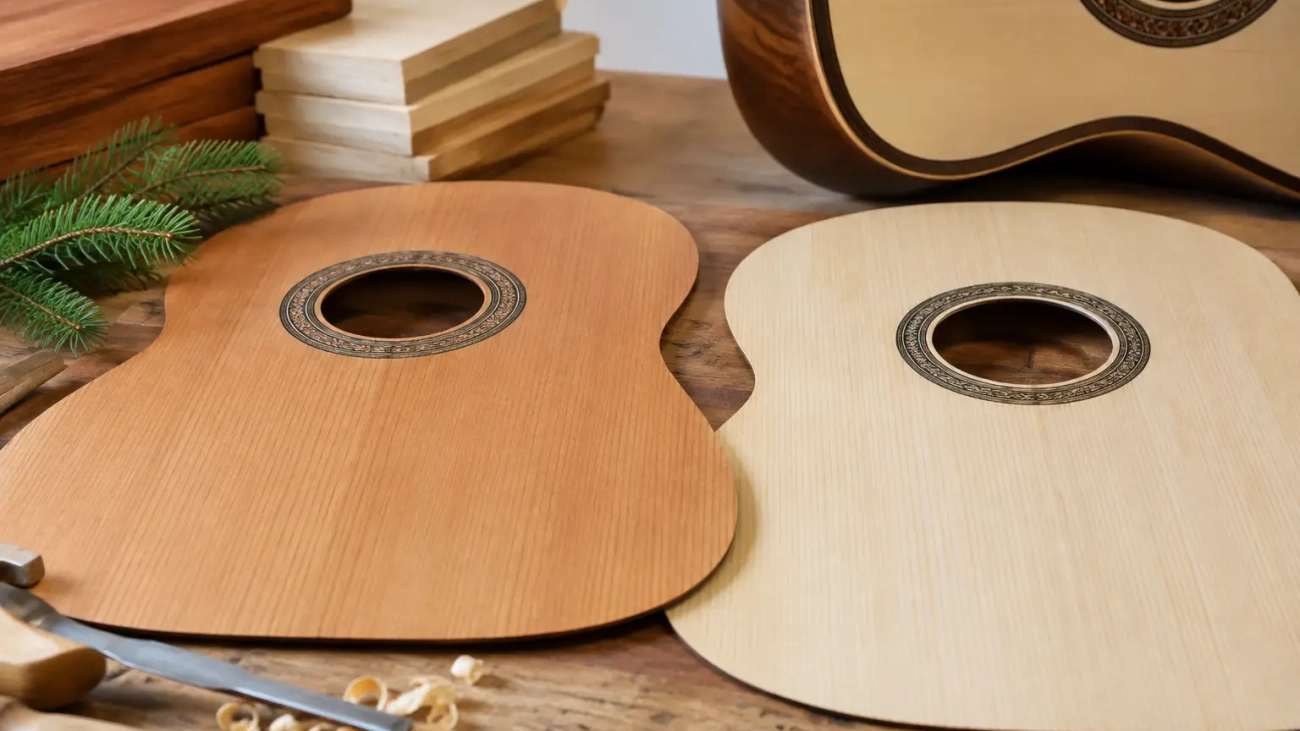
A guitarist can recognize the difference before a single scale is finished. One instrument seems to place the note beneath the fingertip at once, warm and complete. Another asks for a little more intention, then answers with a clear, rising bloom that carries through the room. In the discussion of cedar versus spruce classical guitar tops, this is the essential question: which manner of response serves the player’s voice?
The soundboard is the living heart of a classical guitar. Its species matters deeply, but it does not act alone. The selection and seasoning of the wood, the arching, thicknessing, bracing, finish, and the hands that bring these elements into balance all shape the final result. Cedar and spruce are not competing grades of quality. Each can become extraordinary in a finely made instrument. The meaningful choice lies in character.
Cedar Versus Spruce Classical: The First Difference
Western red cedar is generally associated with immediate warmth, a rich fundamental, and an unusually direct response to a light touch. A well-voiced cedar top often feels generous from the first notes. The player need not press hard to find color or sustain, which makes cedar especially appealing to musicians who value intimacy, nuance, and an enveloping sound beneath the ear.
Spruce, whether European, Engelmann, or another carefully chosen variety, usually presents a different kind of promise. Its voice can be more transparent, more brilliant at the edge of the note, and more willing to expand under stronger input. A fine spruce guitar often has a sense of reserve when new, followed by remarkable openness as the top is played and matures. Its clarity allows separate voices in a chord to remain distinct, even when the music becomes rhythmically or harmonically dense.
These descriptions are useful, but they are not verdicts. An exceptional cedar top can possess projection and definition. A superb spruce top can be warm, supple, and responsive under the gentlest right hand. Wood is a natural material, not a preset. The luthier’s task is to hear the individual piece before the guitar exists.
Cedar: Warmth, Immediacy, and a Singing Fundamental
Cedar is often the natural choice for the player who wants the guitar to feel open from the beginning. Its response can be especially satisfying in lyrical repertoire, where the melody must rise easily from an accompaniment without force. The sound tends to have a rounded center, with a dark-gold color that many players describe as mature, romantic, or vocal.
For the concert guitarist, that immediacy can make a demanding program feel more personal. Subtle changes in nail angle, rest stroke, and vibrato register clearly. For a player returning to serious study after years away, cedar can offer encouragement: the guitar gives generously, even while technique continues to refine.
There are trade-offs. In some cedar instruments, the strong fundamental may place less emphasis on the sparkling overtone structure that certain players seek. A musician whose concept of tone depends on a very crisp attack, wide dynamic headroom, or exceptional separation in rapid contrapuntal passages may prefer the qualities of spruce. This is not a limitation of cedar, but a question of musical priorities.
Cedar also rewards careful construction. Because it can be responsive so readily, the builder must preserve structural integrity without suppressing its natural freedom. A master-grade cedar top selected for stiffness, even grain, and tonal potential can produce a voice of considerable depth, not merely softness.
Spruce: Clarity, Headroom, and a Voice That Grows
Spruce has long held a central place in the classical tradition because it combines strength with remarkable tonal complexity. Its attack is often more defined than cedar’s, and its dynamic range can feel broader. When played softly, a fine spruce top can whisper with precision. When driven with authority, it may continue to open rather than compress.
This headroom is meaningful for performers who move from delicate Renaissance lines to the forceful rhythmic language of Albéniz, Rodrigo, or contemporary repertoire. The player can shape a wider arc of intensity without losing the identity of the note. In an ensemble, spruce’s articulation can also help the guitar retain presence among other instruments.
Many musicians are drawn to the way spruce develops. A newly completed instrument may sound focused and somewhat contained, particularly beside an immediately expressive cedar guitar. With regular playing, however, the top settles into its work. The bass gains depth, the trebles acquire complexity, and the entire voice becomes more integrated. For some owners, witnessing this evolution is part of the pleasure of commissioning an instrument.
That said, no serious player should choose spruce merely because it is traditional or because it may become more open over time. If your touch is naturally light and your ear consistently seeks a velvety, already-developed sound, cedar may be the more truthful partner. A guitar should meet the musician where the music begins, not demand that the musician adopt someone else’s ideal.
How Repertoire and Technique Guide the Choice
The most useful comparison is not cedar against spruce in the abstract, but your hands on each voice. Think about the music you return to when no one asks you to play. If you are drawn to cantabile melodies, richly voiced arrangements, and close, expressive phrasing, cedar may feel immediately familiar. If you relish the architecture of a fugue, the bite of a well-defined rest stroke, or the dramatic span from pianissimo to fortissimo, spruce may offer the greater field of expression.
Technique matters just as much. Players with a strong right hand often appreciate the resistance and expansion of spruce. Those whose artistry lies in refined color changes and minimal effort may find cedar especially responsive. Yet these are tendencies, not rules. A sensitive player can make either wood speak beautifully, and a thoughtfully built guitar can be tailored far beyond the broad labels attached to its top.
For flamenco-influenced playing, the decision becomes even more specific. The desired dryness, percussive clarity, attack, and rapid decay or sustain must be considered alongside the top wood. For crossover musicians, a guitar may need warmth for solo work while retaining enough definition to record cleanly under microphones. These are conversations worth having before a single brace is shaped.
The Build Matters More Than a Simple Wood Label
Two cedar guitars can differ more from one another than a cedar and a spruce guitar made with a shared tonal philosophy. The top is only one part of an acoustic system. The stiffness-to-weight ratio of a particular soundboard, the chosen bracing pattern, the mass of the bridge, the air volume of the body, and the treatment of the finish all influence response and color.
A builder may voice a spruce top for quick, intimate response, or build a cedar instrument with exceptional clarity and projection. At Scharpach, the choice begins not with a stock specification but with listening: to the wood, to the player’s repertoire, and to the kind of sound that player hears internally. The best commission does not chase a generalized description of cedar or spruce. It pursues a coherent instrument.
Aesthetic preferences may also enter the decision. Cedar often deepens toward a warm amber-brown as it ages, while spruce usually begins pale and gradually takes on a golden patina. Both can become strikingly beautiful over decades. Still, visual beauty should support the musical decision, not replace it.
Choosing With Your Ear, Not the Consensus
If possible, play several high-quality examples of both woods in a quiet room. Do not begin with the question, “Which is better?” Play a familiar piece at your usual volume. Listen for how quickly the note forms, how the bass supports the treble, how long a phrase remains alive, and whether the guitar invites you to vary your touch.
Then play beyond your habits. Push the instrument harder than usual, and reduce your attack until the sound nearly disappears. Notice whether the guitar continues to offer color at both extremes. A recording can be helpful, but do not let it replace the experience of sound entering the body through the hands, chest, and ear.
The right top wood is the one that makes your musical intentions feel less translated. Cedar may offer a voice that arrives already warm and human. Spruce may offer a voice with greater space to unfold. Give each the time to answer, and choose the instrument that makes you want to remain in the room a little longer.