
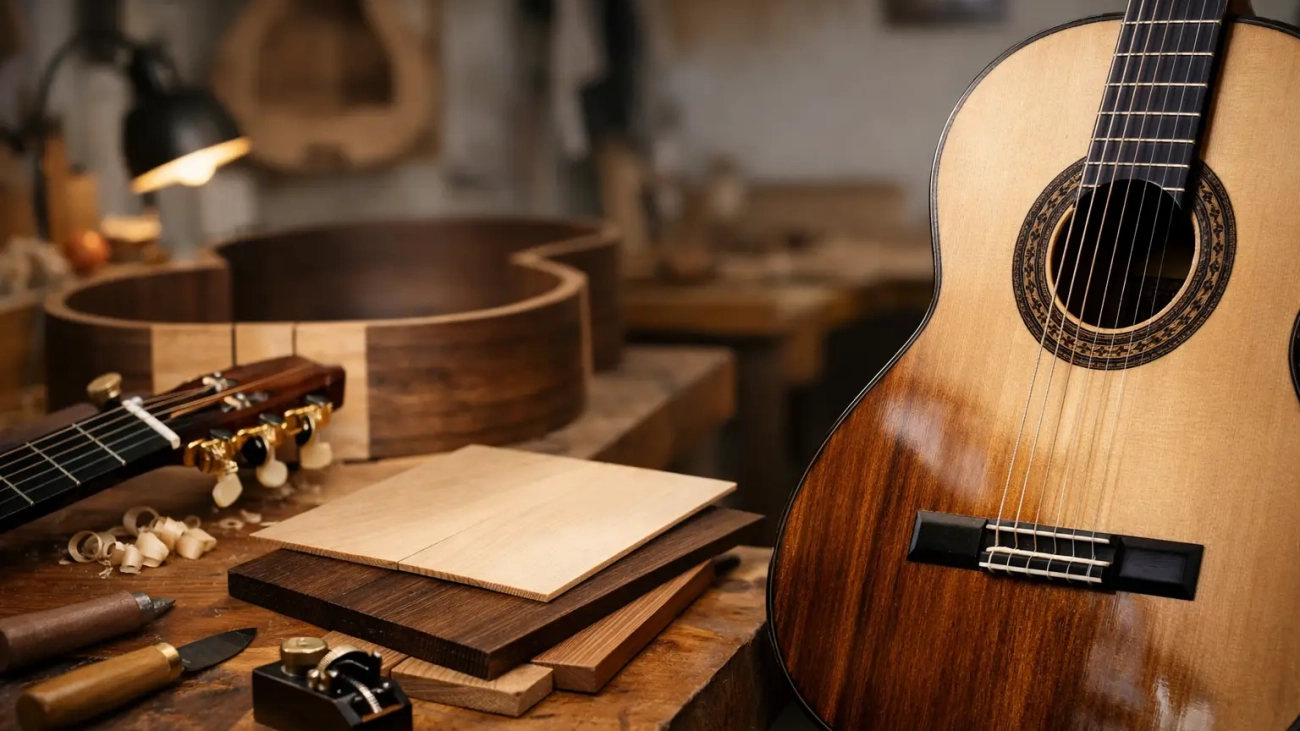
The first time a serious player encounters a truly personal instrument, the difference is rarely loud. It is felt in the way the note starts, how the body answers the right hand, and how the guitar seems to meet the player halfway. This guide to bespoke classical guitars begins there – with the understanding that a fine instrument is not simply chosen, but shaped around a musical voice.
A bespoke classical guitar exists for players who already know that broad categories are not enough. “Warm” and “bright” are useful starting points, but they do not describe the finer realities of projection, separation, sustain, resistance under the fingers, or the way an instrument behaves in a hall versus a studio. Custom work matters because those details matter.
What a guide to bespoke classical guitars should really explain
Many discussions of custom instruments stop at cosmetics. They talk about wood species, decorative details, and rarity, then assume the case is closed. But the true value of a bespoke classical guitar lies in the relationship between design choices and musical outcomes.
A commissioned instrument is not merely a more expensive version of a standard guitar. It is a carefully balanced system. Top stiffness, body geometry, scale length, neck shape, fretwork, action, bridge weight, finish thickness, and setup all interact. Change one element, and another responds. That is why serious players seek out a master builder rather than a menu of upgrades.
The best custom work is neither indulgent nor arbitrary. It is disciplined. Every choice should serve sound, playability, and long-term musical satisfaction.
Why players commission bespoke classical guitars
The most compelling reason is simple: the player cannot find their instrument off the rack.
For some, the issue is tonal. They may want quicker response under a light touch, greater headroom for aggressive attack, stronger note separation for contrapuntal repertoire, or a more colorful treble line that does not become brittle. Others need ergonomic refinement – perhaps a specific nut width, a slightly different neck carve, a scale length that better supports left-hand comfort, or a left-handed build that feels fully considered rather than adapted as an afterthought.
Then there is the artistic dimension. Advanced players often reach a point where the instrument must stop imposing a generic personality on the music. It should reveal phrasing, dynamics, and color with less friction. In that sense, a bespoke guitar is not about luxury alone. It is about removing barriers between intention and sound.
Collectors, too, understand another truth: individuality has lasting value when it is grounded in serious craftsmanship. A guitar built with deep attention to tonal architecture and material integrity can become not only a treasured possession, but a lifelong artistic companion.
Tone begins with the top, but not only the top
Every experienced guitarist knows the soundboard is central. Cedar and spruce remain the defining choices, yet the decision is not as simple as matching cedar with warmth and spruce with clarity.
Cedar often offers immediacy, richness, and a sense of tonal generosity early in the instrument’s life. Many players are drawn to its quick response and lyrical character. Spruce can bring exceptional transparency, precision, and a wider arc of development over time. But these are tendencies, not rules. One cedar guitar may be refined and transparent. One spruce guitar may be deeply warm.
What matters is how the luthier voices the top. Thicknessing, bracing, stiffness, and the interaction with the back and sides all shape the final result. Indian rosewood, maple, cypress, and other body woods influence reflection, overtone content, and feel, but they do so within a larger design. The finest builders do not treat wood names as marketing labels. They treat each set as a living material with its own density, elasticity, and musical potential.
This is where bespoke work earns its place. A master luthier is not choosing from abstract categories. He is listening, measuring, flexing, judging, and building around the actual pieces of wood in hand.
Playability is an artistic issue, not a comfort feature
Players sometimes speak of ergonomics as if it were secondary to tone. In reality, playability shapes tone at every moment.
If the neck profile creates unnecessary tension, the left hand loses ease. If the scale length fights the player’s reach, phrasing changes. If action is too high or too low for the technique involved, articulation suffers. If the guitar does not balance naturally against the body, subtle right-hand control is compromised.
A bespoke classical guitar allows these variables to be addressed with intelligence. Nut width, string spacing, neck dimensions, body depth, and setup can be refined to suit repertoire and technique. A player focused on Romantic repertoire may want one kind of resistance and bloom. A concert artist needing projection in larger spaces may favor another. A crossover player recording in close-mic conditions may prioritize immediacy and balance.
None of these preferences is universally correct. They are correct only in relation to the individual musician.
The consultation matters as much as the build
A good commission begins with listening. Not just to the guitarist’s words, but to the musical intention beneath them.
When a player says they want warmth, do they mean rounded trebles, a broad midrange, or a forgiving response under the right hand? When they ask for projection, do they mean sheer volume, carrying power in a room, or clarity that survives distance? Precision in language matters, because custom work can only be as accurate as the conversation that guides it.
An experienced luthier will ask about repertoire, touch, venue, previous instruments, hand size, preferred string tension, and even what the player dislikes in otherwise fine guitars. He will also know when to challenge assumptions. Sometimes a musician asks for a trait that conflicts with another trait they value. Greater sustain can affect immediacy. Ultra-low action may reduce headroom. A very light build can be thrillingly responsive, yet require a different kind of right-hand control.
This exchange is not a sales ritual. It is part of the craft.
A guide to bespoke classical guitars must address trade-offs
No serious instrument is built from wishful thinking. Every design carries priorities, and priorities create compromises.
A guitar voiced for immediate responsiveness may feel alive at the slightest touch, but a player with a forceful attack may need more structural reserve. A darker, more complex voice can be beautiful for solo repertoire, while a player needing maximum separation may want a cleaner, drier response. Thin finish can enhance liveliness, yet durability and aging behavior must also be considered.
Even aesthetics involve judgment. Ornate appointments can be stunning, but many great instruments achieve their authority through restraint. Simplicity, when executed at a high level, often reveals confidence. The same is true of sound. Not every fine guitar must announce itself with spectacle. Some of the most profound instruments persuade through depth, balance, and honesty.
How to judge whether a custom guitar is right for you
The question is not whether you admire bespoke instruments. It is whether you are ready to specify one with clarity.
If your technique, repertoire, and tonal preferences are still changing rapidly, a commission may be better approached after more playing time. Not because you are unworthy of a fine instrument, but because the more clearly you understand your own musical needs, the more successful the result is likely to be.
On the other hand, many committed players wait too long because they assume custom work is only for touring concert artists. That is not true. A serious amateur with developed taste can benefit enormously from a guitar built around their hands and ear. What matters is not status. It is seriousness of intent.
The most fruitful commissions happen when the player is curious, self-aware, and willing to trust expertise. In an atelier such as Scharpach, the process is not about imposing a fixed house formula. It is about bringing decades of luthiery knowledge into contact with one player’s musical identity.
What lasts after the first impression
A factory guitar often wins quickly. A master guitar often deepens.
Over months and years, the player begins to notice what was not obvious at first encounter: the evenness across registers, the way the trebles stay noble under pressure, the way the bass remains supportive without becoming thick, the way the instrument invites longer practice because it gives back more than it takes. This is the quiet authority of a truly bespoke classical guitar.
Its value is not exhausted by rarity or decoration. It lives in response, refinement, and the sense that the instrument continues to reveal itself as the player does.
If you are considering such a commission, begin not with ornament, but with sound. Ask what you want to hear under your own hands, what resistance helps you play your best, and what kind of voice feels unmistakably yours. The right guitar does not speak over you. It gives your music a more faithful body.