
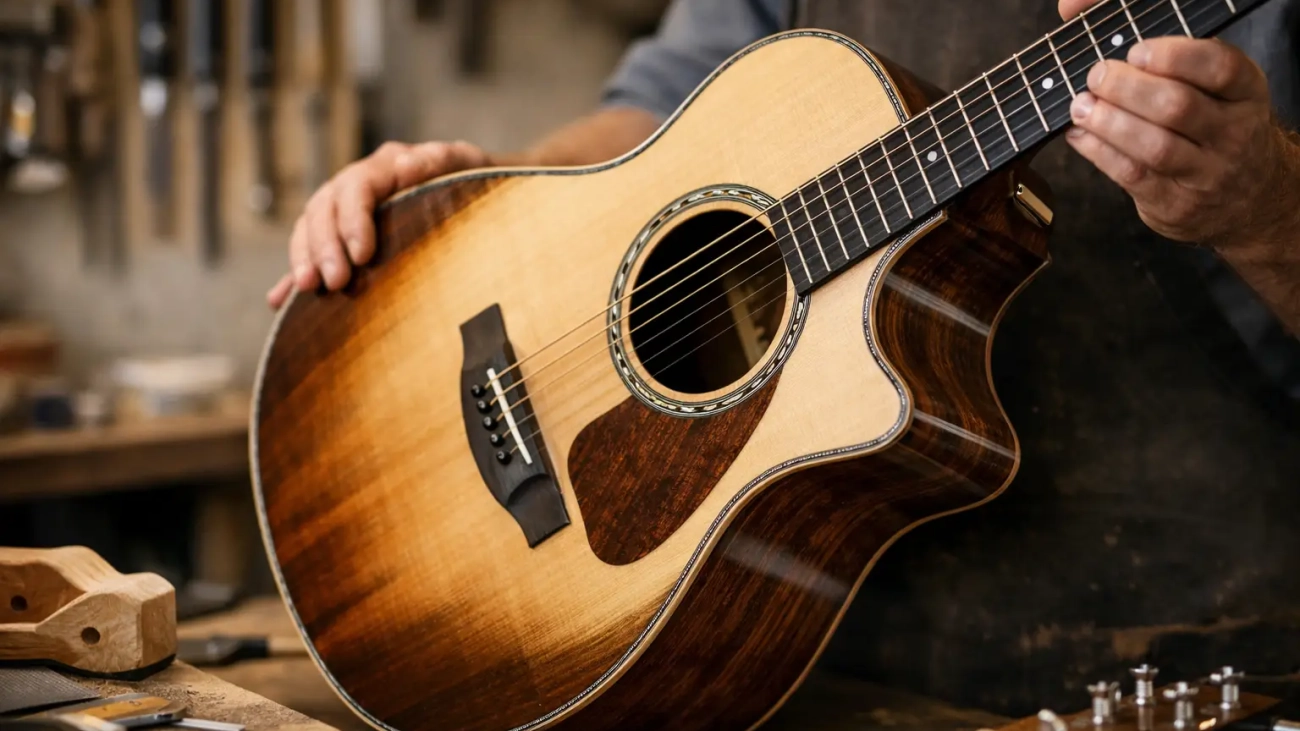
A professional musician usually knows the moment an instrument begins to limit the music. The response is slightly late under the right hand. A bass note blooms too slowly. The neck asks for accommodation when it should feel inevitable. That is where a custom guitar for professional musician work becomes more than a luxury. It becomes a practical artistic decision – one that shapes tone, comfort, confidence, and the range of expression available in performance.
For serious players, the question is rarely whether a fine factory instrument can sound good. Many do. The real question is whether an instrument can be made to answer a specific player with precision. Repertoire, touch, hand size, attack, projection requirements, recording habits, and tonal ideals all influence what the right guitar should be. A bespoke instrument is valuable because it begins there, with the musician rather than with a production model.
Why a custom guitar for professional musician work is different
A commissioned guitar is not simply a standard instrument with upgraded wood or decorative appointments. At its best, it is a carefully judged response to a player’s musical life. The scale length, neck profile, string spacing, body geometry, top stiffness, air resonance, and finish all affect how the instrument speaks.
For a concert classical guitarist, clarity between voices and a controlled, singing treble may matter more than sheer power. For a flamenco player, immediacy, dryness, percussive attack, and physical lightness may define the instrument’s success. For an archtop artist, the balance between warmth, articulation, and dynamic headroom becomes central. These are not cosmetic distinctions. They are structural and acoustical decisions that alter the relationship between player and guitar.
This is why professional musicians often outgrow generalized solutions. A career places very specific demands on an instrument. A player may need projection in a hall without losing intimacy at close range. Another may need exceptional note separation for studio work, where microphones reveal everything. Another may need a left-handed build that feels wholly resolved rather than adapted. Custom work allows those demands to be treated as the foundation of the build.
The true value of a custom guitar for professional musician performance
The most meaningful benefit is not exclusivity. It is accuracy.
When a guitar is built around the musician’s hands and ears, wasted motion begins to disappear. The instrument settles into the body more naturally. Position shifts feel more secure. Dynamic range becomes easier to access. The player spends less energy compensating and more energy shaping phrases. That economy matters on stage, in the studio, and over decades of practice.
Tone is equally personal. One musician hears beauty in a dark, velvety fundamental with restrained overtones. Another seeks transparency, quick attack, and a broader halo of harmonic color. Neither is universally superior. The right guitar is the one that supports the player’s language.
A custom instrument can also be calibrated for repertoire. Romantic literature may benefit from sustain and breadth. Early music can ask for immediacy and definition. Flamenco requires a different architecture of attack and decay than classical concert work. A professional often lives inside these distinctions, and the guitar should meet them with equal seriousness.
There is also the matter of trust. On a commissioned instrument, every choice has intention behind it. The builder has considered how the top will move, how the neck will sit in the hand, how the finish will influence vibration, how the body will mature over time. That coherence is felt. It gives the musician a sense that the instrument is not merely attractive or expensive, but deeply resolved.
What should be customized
Not every player needs every variable adjusted. Good custom work is not excess. It is discernment.
The neck is often one of the first places where personalization pays off. Depth, width, shoulder shape, and string spacing influence left-hand ease more than many players realize. Small changes can relieve tension, improve accuracy, and support longer playing sessions without fatigue.
Scale length is another important decision. A longer scale may offer added tension, clarity, and headroom. A slightly shorter scale can feel more supple and lyrical under the fingers. Neither is automatically better. It depends on technique, repertoire, and the sound the player wants to draw from the instrument.
Body dimensions and setup also deserve careful attention. Professional musicians know that comfort is not secondary to tone. If a guitar sits poorly, the body compensates, and musical freedom narrows. Rib depth, lower bout proportion, arm comfort, action, and saddle design all contribute to whether the instrument becomes a natural extension of the player.
Then there are the acoustic choices. Soundboard selection, back and sides, bracing concept, density, stiffness, and finish thickness all influence response. A master builder does not treat wood as a luxury label. Wood is chosen for how it behaves, how it resonates, and how it will develop. Fine materials matter, but they matter because of their musical consequences.
Aesthetic details have their place as well. Rosette design, purfling, headstock shape, binding, and varnish color can give the instrument a distinct identity. For some players, visual restraint is part of the guitar’s elegance. For others, certain details carry personal or cultural meaning. The key is that beauty should remain in service of the whole instrument, never a distraction from its voice.
The commission process and what discerning players should expect
A serious commission begins with listening. The builder should want to understand how you play, what you hear, what you miss in your current instrument, and where your musical life is heading. This conversation is not a formality. It is where the instrument begins.
The best consultations often move between technical detail and artistic instinct. A player may describe a desired sound in terms of warmth, focus, dryness, bloom, or elegance rather than decibel output or frequency response. An experienced luthier knows how to translate that language into material and structural choices.
This process also requires honesty. Some desires pull against each other. A player may ask for extreme warmth and extreme clarity, or effortless softness with unusual projection. Sometimes those qualities can be balanced. Sometimes one must be favored. This is where expertise matters most. A master builder does not promise everything. He guides the player toward the most musically intelligent compromise.
Timelines are another sign of seriousness. A handcrafted instrument should take time. Materials must be selected with care, construction must proceed without haste, and voicing decisions require patience. For musicians accustomed to instant availability, this can feel unfamiliar. Yet in fine luthiery, time is part of the craft.
At Scharpach, that relationship-driven process is central. The goal is not to steer every musician toward a house style at the expense of individuality, but to build an instrument with character, depth, and permanence that remains faithful to the player’s voice.
When custom is worth it and when it may not be
Not every guitarist needs a commissioned instrument immediately. If a player is still discovering basic preferences in setup, repertoire, or tonal direction, a custom build may be premature. It helps to know enough about one’s own technique and taste to make choices that will still feel right years later.
For the mature player, however, custom work often becomes increasingly rational. The longer one plays, the more specific the needs become. Nuance matters more. Physical comfort matters more. The distinction between a very good guitar and the right guitar becomes sharper.
Budget should be approached with equal clarity. A master-grade instrument is a significant investment, and it should be treated as such. But for a professional musician, the value is measured across years of work, travel, recording, performance, and daily practice. A guitar built with integrity and musical intelligence can become a lifelong partner, not a short-term acquisition.
Collectors understand another dimension of value: authorship. An instrument made by an established luthier carries the imprint of a singular hand and ear. Its worth lies not only in rarity, but in the coherence of its making.
The finest custom guitar for professional musician use is not built to impress a room at first glance, though it may well do that. It is built to reveal itself over time – in the way a note starts, in the way a chord settles, in the way the instrument continues to offer more as the player asks more of it. Choose the guitar that leaves you with less to fight and more to say.