
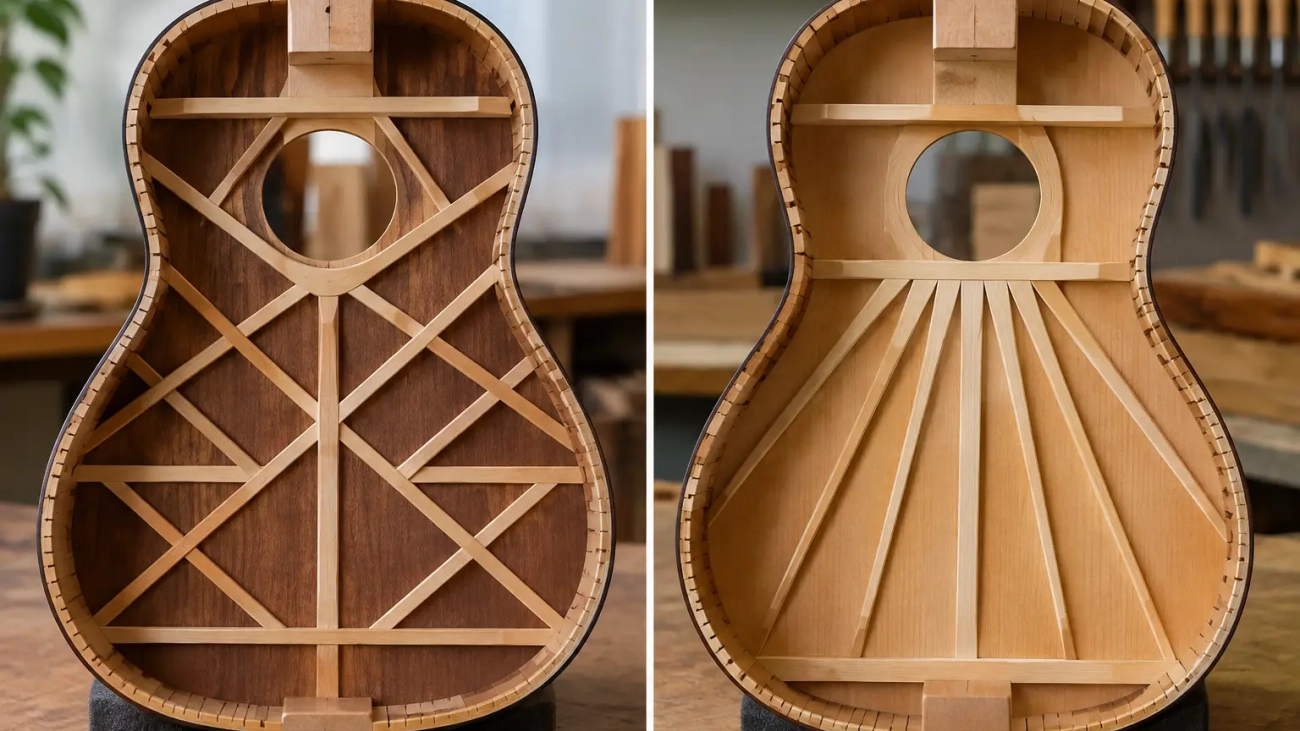
A classical guitar’s voice is decided long before its first note is played. In the meeting between spruce or cedar, carefully graduated thicknesses, and the hidden architecture beneath the soundboard, lattice versus fan bracing is one of the most consequential choices a player can consider. It is not a contest with a universal winner. It is a question of what the musician asks the instrument to reveal.
Bracing is the internal framework of the soundboard: slender wooden struts that support the top against string tension while directing its movement. The top must be strong enough to live for generations, yet light and responsive enough to translate the smallest change in the right hand into sound. This apparent contradiction is at the heart of guitar making.
For the serious player, the distinction is not merely technical. It affects projection in a hall, the resistance felt under the fingers, the way a note blooms, and whether the guitar seems to favor a broad singing line, sharply articulated dance rhythm, or a translucent web of inner voices.
Lattice Versus Fan Bracing: Two Ideas of the Soundboard
Traditional fan bracing is the historic language of the Spanish classical guitar. A series of braces radiates beneath the lower bout of the soundboard, usually in a fan-like pattern from the area near the bridge toward the guitar’s perimeter. Its proportions, placement, shaping, and relationship to the top are never incidental. A millimeter of position or a few careful strokes of the plane can alter the balance of the finished instrument.
The goal is not simply structural support. A well-conceived fan system permits the top to move in a complex, musical way. It can preserve separation between voices, give the attack a clear and immediate character, and allow the guitar’s color to change with the player’s touch. In an exceptional traditional instrument, power does not need to arrive at the expense of refinement.
Lattice bracing is a more modern development, most closely associated with concert guitars built for exceptional projection and efficiency. Rather than a small number of long, radiating braces, the soundboard carries an interlocking grid, often made from very light materials arranged in a diamond pattern. The top can be made extraordinarily thin while the lattice supplies carefully distributed support.
This architecture often creates a guitar that responds with remarkable ease. A modest input from the right hand may produce a substantial output, and the instrument can retain clarity at high volume. For players working in larger venues or alongside other instruments, that reserve of sound can be deeply persuasive.
Neither system should be reduced to a recipe. The brace pattern is only one part of an integrated instrument. Soundboard species and stiffness, bridge mass, body depth, back and side woods, doming, finish, neck geometry, and the luthier’s voicing all have their say. Two fan-braced guitars can be dramatically different. So can two lattice instruments.
What Fan Bracing Can Offer
A fan-braced guitar often speaks with a sense of intimacy and direction. The player may feel a close connection between gesture and response: a rest stroke has weight, a free stroke has air around it, and a change in nail angle can bring forward another shade of color. This is why many artists drawn to traditional Spanish and Latin American repertoire remain devoted to the finest fan-braced instruments.
The appeal is not nostalgia. It is about a particular relationship with resistance. A responsive fan-braced top may ask slightly more from the hand than a highly efficient lattice top, but that resistance can become expressive feedback. It gives the player something to lean into, especially when shaping a phrase, controlling a crescendo, or placing a bass note beneath a singing treble line.
Fan bracing can also reward tonal contrast. The fundamental of the note, its harmonics, and its transient attack may remain distinct enough for the musician to sculpt the sound actively. A guitar built in this tradition can possess a dry, percussive immediacy for flamenco, a warm lyricism for Romantic music, or a rounded, balanced voice for the classical canon. The pattern alone does not dictate any of these outcomes, but it provides a fertile framework for them.
For a player who values complexity over sheer output, the finest fan-braced guitar can feel less like a machine for producing volume and more like a conversation. It invites nuance. It leaves room for the musician’s hand.
What Lattice Bracing Can Offer
The first sensation many players notice in a lattice-braced guitar is abundance. The top is often quick to respond across a wide dynamic range, producing an expansive sound with comparatively little effort. Notes can sustain generously, and the instrument may project with an authority that remains clear at the far end of a room.
This can be invaluable for a concert artist. Modern repertoire, large halls, and demanding programs may call for a guitar that carries without forcing the right hand. When the instrument offers a broad dynamic ceiling, the player can preserve physical energy and still command the space.
Lattice construction can also create striking evenness. The transition between registers may feel exceptionally smooth, with a full bass response and a present, easily activated treble. For players who want immediate sound under the finger, especially in legato passages, extended harmonies, and contemporary textures, this directness can be liberating.
There are trade-offs. Some musicians find that a highly responsive lattice guitar offers less of the tactile resistance they use to organize articulation. Others prefer the more focused, woody, or rhythmically dry character often associated with a traditional build. These impressions are personal, and broad generalizations should be treated with caution. A lattice instrument can be subtle and colorful; a fan-braced guitar can be powerful enough for the stage. The quality of execution matters more than the label.
The Player Matters More Than the Pattern
The right bracing system begins with listening to the player. Repertoire is an obvious consideration, but it is only the beginning. A guitarist who plays Villa-Lobos, Bach, and contemporary works may have different needs from one who centers flamenco accompaniment and solo performance. Yet two artists playing the same program may seek entirely different instruments.
Consider the nature of your attack. Do you play with a strong, focused rest stroke or favor a lighter free stroke? Is your sound driven by nail, flesh, or a mixture of both? Do you need an instrument that gives freely at low effort, or do you prefer some resistance under the hand because it helps you control the phrase?
Think as well about the rooms in which you perform. A small, resonant salon reveals color, decay, and subtle dynamic inflection. A larger hall exposes whether the guitar can carry a melodic line above the natural absorption of the audience. Studio work brings another set of priorities, where balance, overtone structure, and microphone response may matter more than raw volume.
A commission should allow these questions to guide the build rather than forcing the player into a predetermined model. At Scharpach, the bracing concept belongs within a larger conversation about the player’s musical voice, physical comfort, chosen woods, tonal preferences, and long-term artistic aims.
Why the Luthier’s Voicing Is Decisive
Braces are not simply installed. They are voiced. Their height, taper, stiffness, and contact with the soundboard are judged as part of a living whole. The maker listens through the fingertips while working the wood, seeking a balance between strength and freedom, between immediate response and the depth that gives a guitar its continuing interest.
A soundboard that is too heavily restrained may survive but fail to speak. One that is too lightly supported may initially thrill, then lose stability or structural integrity. Great guitar making lives in the narrow, demanding territory between those failures.
Material selection adds further complexity. Cedar may offer warmth and immediacy, while spruce may provide headroom, clarity, and a long arc of development. Rosewood, maple, and other body woods reflect and shape the soundboard’s work in different ways. A bracing system that is inspiring under one top may not be the ideal solution under another.
That is why comparison by specification alone is misleading. A player should not ask only, “Is this lattice or fan braced?” Better questions are: “How does this guitar respond to my touch?” “Can I shape the color I hear in my mind?” “Does its sound remain compelling when I play softly?” And perhaps most tellingly, “Do I want to keep listening after the note is gone?”
Choosing With Your Ears and Hands
When possible, play both approaches in the same room and with familiar music. Begin quietly. Test how readily the guitar speaks with the least possible effort, then explore its reserve at a full concert dynamic. Listen from the player’s position, but also ask a trusted musician to play while you stand several feet away. The sound that reaches the audience is not always the sound heard behind the instrument.
Do not be seduced by volume alone. A guitar that appears impressive in the first minute may fatigue the ear over an hour. Equally, a more reserved instrument may reveal depth, color, and an increasingly personal character as the player learns its language. The finest choice is the one that enlarges your expressive range without asking you to abandon your natural technique.
A bracing pattern is hidden from sight, but its consequences are felt in every phrase. Choose the architecture that gives your hands greater freedom, your music a truer voice, and your listening a reason to continue.