
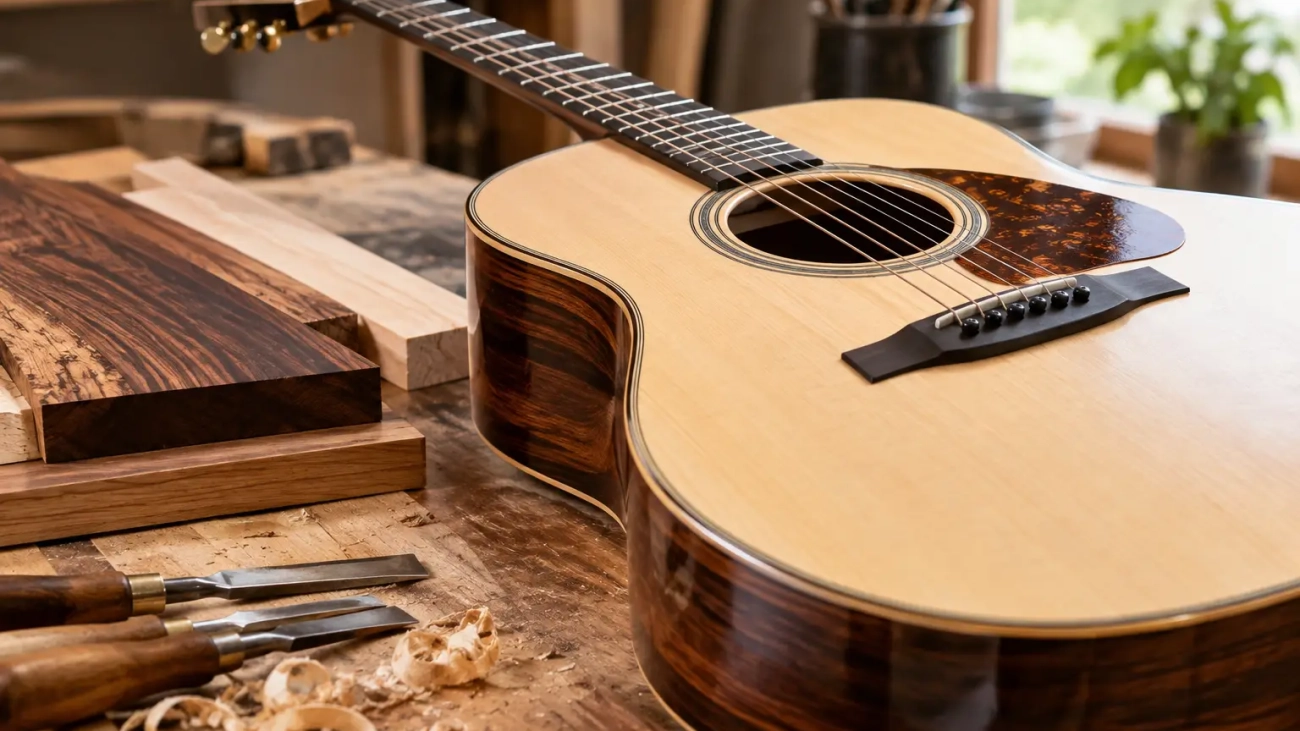
A guitar can be beautifully made and still feel like it belongs to someone else. The neck may ask too much of your hand. Its response may favor a style of playing that is not yours. Its voice may be pleasant, yet never quite say what you hear when you imagine a phrase. The top benefits of custom guitars begin precisely there: with the opportunity to commission an instrument around the player, rather than adapting the player to an instrument.
For the serious musician, a bespoke guitar is not an exercise in ornament. It is a considered meeting of hands, ears, repertoire, and materials. Every decision has consequences, from the depth of the body and the stiffness of the soundboard to the profile of the neck and the character of the finish. When those decisions are guided by an experienced luthier, the result can become a more intimate and enduring musical partner.
The Top Benefits of Custom Guitars Begin With a Personal Voice
No two players draw sound from a guitar in exactly the same way. One classical guitarist may seek a long, singing treble with generous separation between voices. Another may need a quick, articulate attack for rhythmic clarity. A flamenco player may prize dryness, immediacy, and a percussive edge, while an archtop player may listen for warmth, projection, and a complex bloom beneath the note.
A custom instrument gives those preferences a place at the beginning of the process. Instead of selecting from fixed specifications, the player and luthier can discuss the sound that matters: direct or expansive, bright or dark, dry or overtone-rich, intimate or projecting. The goal is not to manufacture a universally “better” guitar. It is to shape a guitar whose tonal character serves a particular musical intention.
This work begins with wood, but it does not end there. Spruce and cedar offer distinct possibilities in response and color. Rosewood, maple, cypress, and other tonewoods influence the way the body supports the voice of the top. Bracing, thicknessing, air volume, bridge design, and varnish all affect the balance between power, sustain, clarity, and complexity. In a fine custom guitar, these elements are not isolated features. They are a system, tuned toward a coherent result.
A Fit That Lets Technique Become More Natural
The finest tone means little if the instrument creates fatigue or interferes with technique. Factory guitars must accommodate a broad range of hands and bodies. A custom guitar can be shaped around the physical reality of one player.
Neck width, string spacing, scale length, nut dimensions, fingerboard radius, and neck profile can all be considered in relation to the player’s hand size, touch, and repertoire. A guitarist with smaller hands may value a slimmer profile or a slightly shorter scale. A player with a demanding right-hand technique may prefer spacing that gives each finger more room. For left-handed musicians, a true left-handed build is especially meaningful because the instrument can be conceived as a whole, rather than treated as an afterthought.
Body dimensions matter as well. A guitarist who performs for long periods may benefit from a body depth and upper-bout shape that sit more comfortably against the torso. The placement of an arm bevel, cutaway, or elevated fingerboard can be explored when it serves the player’s posture and musical needs. These choices are subtle, but comfort changes concentration. When the body is not negotiating with the instrument, the mind is freer to listen.
There is a trade-off worth respecting. Extreme customization is not automatically wise. A specification that feels novel on paper may prove limiting after years of playing. The value of a skilled luthier lies partly in knowing which requests will genuinely support the musician and which may compromise balance, structure, or long-term versatility.
Greater Dynamic Range and More Meaningful Response
A responsive guitar does not merely make sound. It translates touch. A light stroke can carry nuance rather than disappearing, while a stronger attack can expand without collapsing into hardness or congestion. That range is among the most compelling benefits of a thoughtfully commissioned instrument.
For concert players and recording artists, responsiveness can change the shape of a performance. It allows phrasing to live in smaller increments: the beginning of a note, the weight behind a rest stroke, the fading edge of a harmonic, the contrast between melody and accompaniment. In the studio, a guitar with clear note separation may require less correction to reveal its musical detail. Onstage, a focused fundamental can help a line remain intelligible within a hall.
Yet projection is not simply a matter of volume. A guitar that fills a room may do so through clarity, direction, sustain, or a voice that holds its identity at different dynamic levels. The desired balance depends on the player. A solo performer may seek breadth and carrying power. An ensemble musician may prefer a more precise, contained voice that blends without losing character.
Materials Chosen for Character, Not Convenience
The visual beauty of a custom guitar is often the first thing an observer notices. The deeper value is that carefully chosen materials can be selected for their acoustic potential and their relationship to the design.
Master-grade tonewoods are evaluated for more than dramatic grain. Density, stiffness, seasoning, tap tone, and structural suitability all matter. A luthier may reserve a particular set of spruce for a guitar intended to offer transparency and headroom, or select a back and side wood whose reflective qualities support the desired warmth and projection. The maker’s experience is essential here. Wood has personality, but it also has variables that demand judgment.
The finish deserves the same attention. A fine varnish must protect the instrument while allowing the soundboard to move freely. Its color and depth should enhance the wood rather than conceal it. Over time, a well-made guitar develops a patina that reflects use, light, and the passage of music through its body. For many owners, this gradual change becomes part of the instrument’s identity.
A custom commission also makes room for aesthetic restraint or distinction. A rosette, purfling scheme, headstock shape, inlay, or choice of bindings can be deeply personal without becoming decorative noise. The strongest visual details feel inevitable, as though the instrument could not have been made any other way.
An Instrument Built for a Long Musical Life
A handmade guitar should be judged not only on the day it is delivered, but by the life it is prepared to live. Properly seasoned materials, sound structural design, accurate fretwork, and careful setup create the foundation for stability and serviceability. These are quiet virtues, but they matter enormously over decades.
A finely built acoustic instrument also has the potential to mature. As the woods settle and vibrate through regular playing, the voice may open in subtle, rewarding ways. No maker can promise an identical path for every guitar, because wood remains a living material with its own history. Still, a guitar built with sensitivity to resonance and proportion is given the best conditions to develop gracefully.
This is why a custom guitar is often regarded as an heirloom instrument. Its value is not only financial, nor solely visual. It is carried in the familiarity that grows between player and guitar: the exact resistance of the strings, the sound that answers a certain touch, the memories attached to particular pieces and performances.
The Value of Being Heard During the Build
Commissioning a guitar is a conversation as much as a transaction. The player brings experience, questions, references, and sometimes an elusive idea of a sound that has not yet been found. The luthier brings the ability to translate those impressions into dimensions, materials, and construction choices.
That direct exchange can be especially valuable for musicians who have spent years moving between excellent instruments without finding one that fully aligns with their technique. At Scharpach, the commission process is founded on this attentive dialogue, joining more than four decades of luthiery knowledge with the individual player’s artistic direction.
A custom guitar will not replace practice, artistic curiosity, or a well-developed touch. Nor is it the right choice for every stage of a musician’s path. But when a player can clearly recognize what is missing from a standard instrument, a bespoke build offers something rare: the chance to make the instrument answer with greater truth.
Choose the builder whose ears you trust, speak plainly about the music you want to make, and allow enough time for the right decisions to reveal themselves. A guitar made with that degree of attention can remain a source of discovery long after the first note.