
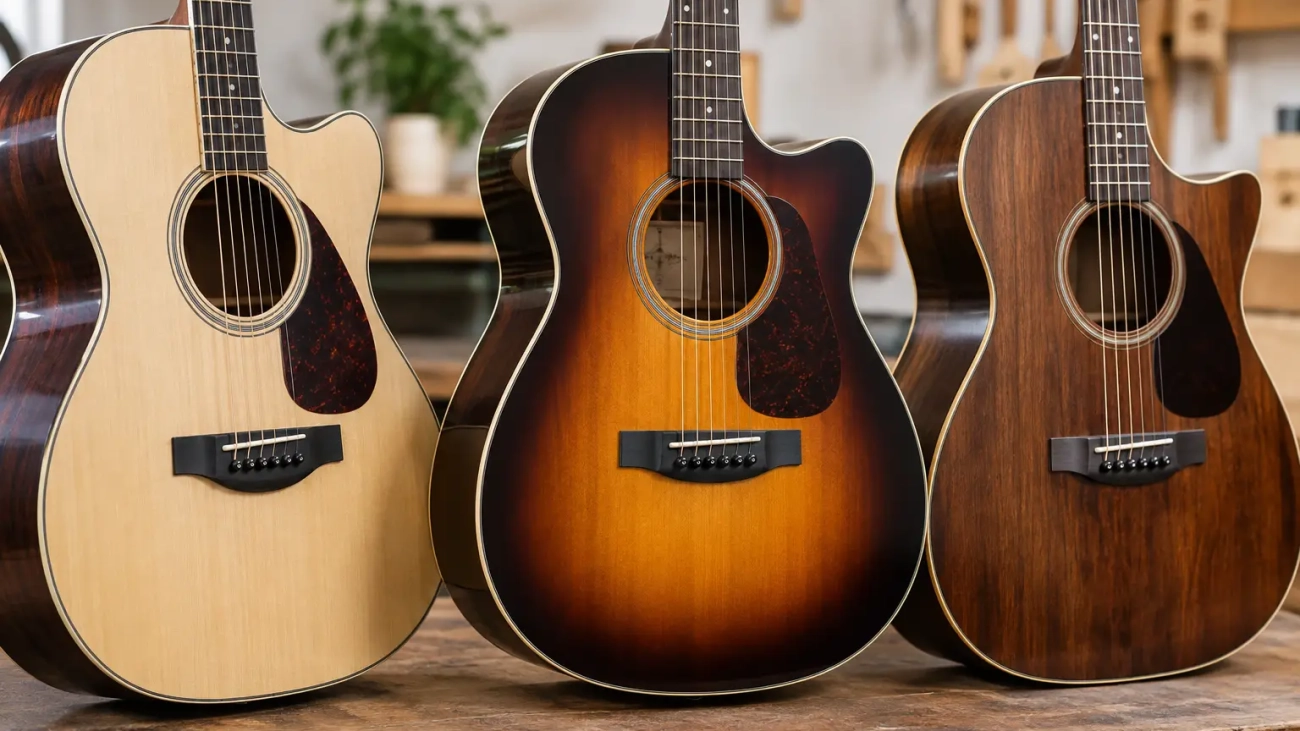
The moment a melody rises beyond the 12th fret, a guitar’s silhouette becomes more than an aesthetic decision. Choosing guitar cutaway style is a question of access, certainly, but also of balance, resonance, and the visual character you want to hold for decades. On a finely made instrument, every curve participates in a larger conversation between the player, the wood, and the music.
A cutaway removes a portion of the upper bout on the treble side, allowing the fretting hand to travel farther up the fingerboard with less compromise in wrist position. Yet this familiar feature should never be treated as an automatic upgrade. For some players it is essential; for others, it solves a problem they rarely encounter while slightly changing the acoustic and visual equilibrium they value most.
Start With the Music, Not the Shape
The right question is not whether a cutaway guitar is better. It is whether your repertoire asks you to live in the upper register. A classical guitarist performing contemporary works, a flamenco player shaping falsetas high on the neck, or an archtop player building chord melodies above the octave may gain real freedom from a cutaway. The benefit is most apparent not simply in reaching a high note, but in reaching it without tension.
That distinction matters. When a player must rotate the shoulder, bend the wrist sharply, or shift the instrument’s position to reach the 15th through 20th frets, the phrase can lose poise. A thoughtfully designed cutaway lets the hand arrive with greater calm. Intonation becomes more secure, vibrato more expressive, and the player can remain focused on musical line rather than physical negotiation.
If your work stays largely below the 12th fret, a traditional full-bodied outline may be the more honest choice. Much of the classical and flamenco canon does not require frequent access to the highest positions. A standard body also carries a visual continuity that many players associate with the enduring language of the Spanish guitar.
How a Cutaway Influences Sound
Removing material from the upper bout changes the body’s internal air volume and the outline of the soundboard. In theory, this can slightly affect the guitar’s low-frequency response, its distribution of overtones, and the way the top moves. In practice, the result depends on the entire instrument: scale length, body depth, top thicknessing, bracing, wood selection, bridge placement, and the stiffness of the back and sides all matter more than the presence of a cutaway alone.
A poorly considered cutaway can make an instrument feel less generous in the bass or less unified across its registers. But on a master-built guitar, the design is never isolated. The luthier can account for the altered body geometry through the architecture of the top and the refinement of the voicing. The aim is not to disguise the cutaway, but to make the instrument feel whole.
There is still a trade-off worth acknowledging. A full upper bout offers the largest uninterrupted soundboard area and body volume. For players seeking the broadest possible bass foundation, maximum warmth, and a deeply traditional response, that extra real estate may be meaningful. For players who need fluent high-register work, a slight shift in tonal emphasis can be a worthwhile exchange for the expressive possibilities gained.
It also depends on the voice you seek. A guitar with a focused, articulate treble response may suit intricate contemporary classical writing or lyrical jazz phrasing beautifully. A player drawn to dark, enveloping bass and expansive accompaniment may prefer a full-bodied design. Neither is superior. Each serves a different musical imagination.
Venetian or Florentine Cutaway?
The two most familiar cutaway profiles are Venetian and Florentine. Their functional difference is modest, but their aesthetic language is distinct.
A Venetian cutaway has a rounded, flowing contour. It softens the transition into the upper register and often feels at home on classical guitars, refined steel strings, and elegant archtops. Its curve can preserve a sense of visual grace, particularly on an instrument with traditional rosette work, restrained binding, or a delicate varnish finish. For many players, it is the most natural meeting point between modern access and timeless form.
A Florentine cutaway comes to a defined point. It has more visual drama and a sharper, more assertive identity. On an archtop, it can complement the strong geometry of f-holes, tailpiece, and carved arch. On a flamenco or classical instrument, it may speak to a player who wants a bolder silhouette without sacrificing the instrument’s essential seriousness.
Neither profile automatically provides more usable fret access. That is determined by the exact cutaway depth, the neck-to-body joint, fingerboard extension, heel design, and the player’s own hand size and technique. A beautifully rounded Venetian cutaway can be more practical than a shallow Florentine, and the reverse can also be true. The outline is only the visible part of an ergonomic decision.
The Heel Matters as Much as the Cutaway
Players often focus on the missing section of the upper bout while overlooking the heel, where the neck meets the body. Yet the heel can be the true barrier to upper-fret comfort. A substantial, traditionally shaped heel may offer strength and visual authority, but it can limit the hand’s path even when the body has a generous cutaway.
For a player who spends significant time above the 12th fret, the cutaway, heel, neck profile, and fingerboard width should be considered as one system. A slight refinement in heel contour can make a greater difference than a more dramatic body cut. The goal is not to make the neck feel insubstantial. It is to preserve structural integrity while allowing the hand to move naturally.
This is especially relevant for left-handed players. Reversing a body shape is not merely a matter of mirroring the visible features. The playing posture, arm contact points, picking-hand relationship to the top, and the player’s approach to high positions deserve individual attention. A custom instrument allows these questions to be resolved at the design stage rather than accepted as compromises after the fact.
Consider Posture, Repertoire, and Performance Setting
A cutaway may feel different in the workshop than it does after two hours onstage. Players who use a footstool, an ergonomic support, or a raised left-leg position often approach the upper register from a different angle than those who play with the guitar lower on the body. A flamenco guitarist standing with a strap may have entirely different needs from a seated classical performer.
Think also about how often your music genuinely requires upper-fret access. Occasional high notes may not justify altering the body shape you have always loved. But if upper-register passages are central to your arrangements, improvisation, or composition, the ease of a cutaway can become part of your artistic vocabulary. You may take more melodic risks because the instrument welcomes them.
For collectors, the decision has another dimension. A cutaway gives an instrument a recognizable personality. It can express modernity, elegance, or purposeful individuality. A full-body outline, by contrast, may honor a historic model or place the emphasis on the purity of the wood, rosette, and proportions. The best choice is one that remains convincing after the first excitement of the commission has settled.
Choosing Guitar Cutaway Style With a Luthier
The most rewarding decisions arise from a detailed conversation rather than a catalog option. Bring the music you play, describe the positions you use, and be candid about discomfort or limitations on your present guitar. If possible, identify the exact passages where the instrument seems to resist you. This gives the builder meaningful information about how deeply the cutaway should reach and how the neck joint should be shaped.
It is equally useful to describe sound in personal terms. Do you want a dry, immediate flamenco attack? A singing classical treble with sustaining color? The quick clarity and projection of an archtop? These preferences help establish whether the modest acoustic trade-offs of a cutaway align with the voice you want from the instrument.
At Scharpach, such choices belong to the larger act of building an instrument around a musician rather than fitting a musician to a predetermined form. The cutaway is not a decorative subtraction. It is a deliberate adjustment to the relationship between hand, body, and sound.
Choose the shape that lets your technique disappear from your awareness. When the guitar gives your hand room to move and still answers with the character you hear in your mind, its outline has done its work quietly and well.