
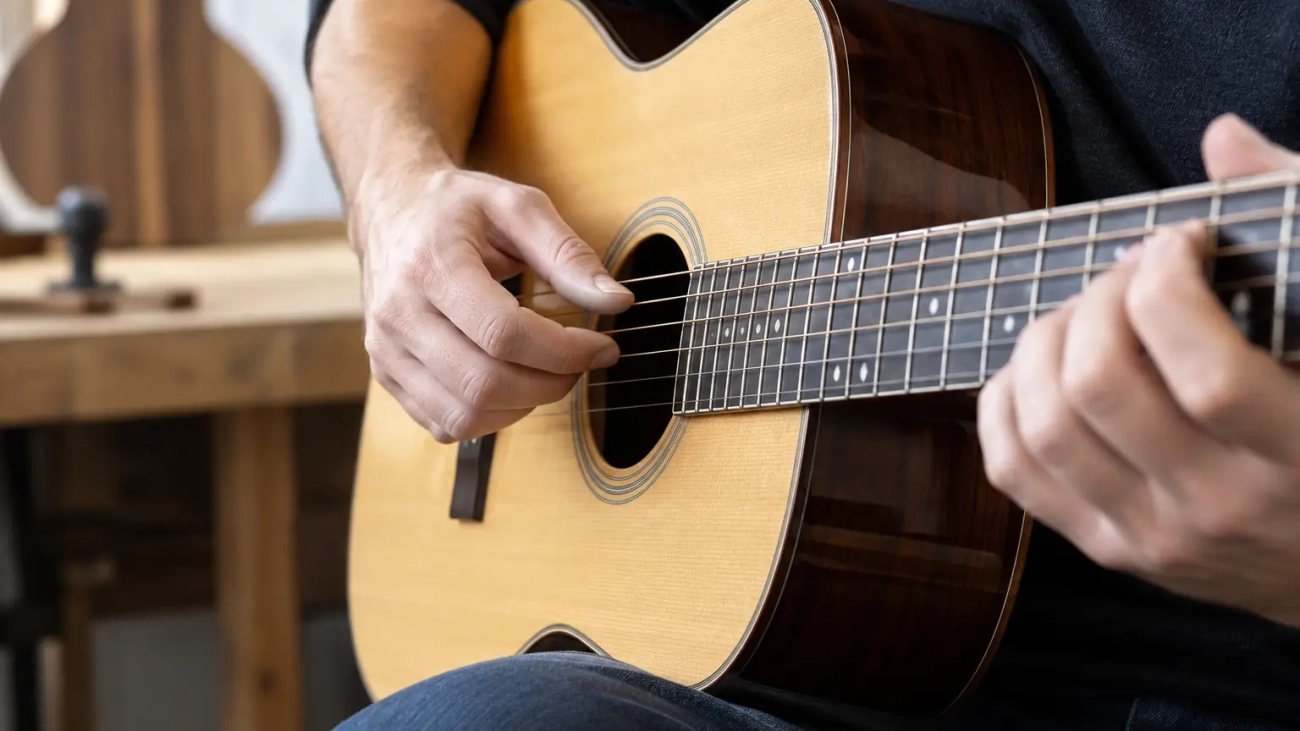
A beautiful fingerstyle phrase can be undone by a small physical resistance: a shoulder lifting toward the ear, a fretting wrist folded too far, a picking hand searching for its balance. Fingerstyle guitar ergonomics explained properly is not a matter of finding one ideal posture. It is the study of how the player and instrument meet so that technique serves musical thought rather than competing with it.
For a serious player, comfort is not a luxury added after tone. It is part of tone. When the body works against the guitar, the hands become guarded, timing tightens, and color narrows. When the guitar rests naturally within the player’s frame, a quieter touch becomes possible. So does a wider dynamic range, greater endurance, and the confidence to let a phrase breathe.
Why Ergonomics Changes the Sound
Fingerstyle players ask both hands to perform fine, independent work. The right hand must articulate bass, inner voices, melody, and color. The left must form shapes cleanly while allowing shifts, vibrato, slurs, and extensions to occur without strain. A marginal mismatch in the instrument’s dimensions can become significant after an hour of Bach, Brazilian music, flamenco, or a demanding original arrangement.
This is why ergonomics cannot be separated neatly from sound. A neck that is too deep for a player’s hand may encourage excessive thumb pressure. That pressure can make the notes speak, but often at the cost of tension and a less elastic left hand. A body that sits too low or too far to the right may force the picking arm into an awkward angle, reducing control over attack. The instrument may still be excellent in isolation. Yet it is not fully available to that particular player.
The aim is not a posture that looks correct from across the room. The aim is a poised, repeatable relationship in which the shoulders remain unforced, the wrists retain useful mobility, and the hands arrive at the strings with minimal compensation.
Fingerstyle Guitar Ergonomics Explained at the Point of Contact
The seated position and body geometry
Most classical and fingerstyle players perform seated, but seated does not mean static. The guitar should be stable enough that the arms do not have to hold it in place. Whether the instrument rests on the left leg in a classical position, on the right leg in a more traditional folk position, or on a support, the essential question is simple: can the player release muscular effort without the guitar rotating or slipping?
The upper bout should meet the chest without forcing the shoulders forward. If the body is overly large or deep, a player with a smaller frame may reach around it rather than embrace it. This often draws the right shoulder forward and elevates the elbow. Over time, that position can make controlled rest strokes, free strokes, and tonal changes more laborious.
Body depth matters as much as outline. A shallower body may place the right arm in a more natural position and can be especially welcome for players who spend long sessions recording or practicing. The trade-off is not simply less sound. A thoughtful luthier can shape the voice of a shallower instrument with careful attention to top thickness, bracing, air volume, and material selection. The real question is which balance of physical ease, projection, and tonal depth serves the player’s music.
The fretting hand and neck profile
Neck width receives much attention, and rightly so, but it is only one part of the equation. Nut width, string spacing, neck depth, shoulder shape, fingerboard radius, scale length, and setup all influence how the left hand works.
A wider fingerboard can give the right hand and fretting fingers welcome separation, particularly in contrapuntal repertoire. It also asks more of the left hand in extended chords and reaches. A narrower neck can feel immediate and familiar, but it may crowd complex voicings or make accidental contact between fingers more likely. Neither choice is universally superior.
The profile of the neck is often more revealing than a measurement on paper. Two necks of identical depth can feel entirely different because their shoulders are shaped differently. A gentle, considered profile supports the hand without filling it excessively. For players with smaller hands, joint sensitivity, or a history of fatigue, this detail can determine whether a demanding instrument feels inviting or merely admirable.
Scale length deserves the same attention. A longer scale can offer clarity, string tension, and a certain authority in the bass. It may also increase the stretch between frets and demand more from the fretting hand. A slightly shorter scale can ease reaches and reduce effort, often without sacrificing refinement when the instrument is voiced accordingly. The appropriate choice depends on repertoire, tuning, hand size, preferred strings, and the player’s relationship with tension.
The picking hand and the guitar’s voice
The right hand needs room to move, but also a reliable point of reference. The position of the soundhole, bridge, string spacing, and body edge affects where the hand settles and how naturally the forearm rests on the guitar.
A sharp or high body edge can compress the forearm during extended playing. Some players benefit from an arm bevel, which softens this contact and allows the arm to approach the strings with less pressure. It is a small visual intervention with a meaningful physical result, particularly on larger-bodied instruments. For others, a traditional edge feels familiar and causes no concern. Ergonomics should answer real physical needs, not become decoration.
The right hand also reveals why tonal design and physical design belong together. A player who can move easily between the bridge and fingerboard has greater access to brightness, warmth, percussion, and color. If the body position restricts that movement, the guitar’s tonal resources remain partly unused. The finest topwood and most responsive bracing can only speak through the hand that meets them.
Setup Is Ergonomics, Not Maintenance
Many players think of setup as a corrective service performed when a guitar becomes difficult. In truth, action height, relief, nut slot depth, saddle shape, and string choice are foundational ergonomic decisions.
Action that is unnecessarily high asks the left hand for force rather than precision. Action that is too low can rattle under a firm attack, causing the player to pull back dynamically. A well-judged setup gives each note a clear beginning while preserving the player’s ability to shape it. This balance varies. A player with a light classical touch may prefer a different response from a flamenco guitarist seeking rapid attack and controlled buzz.
String tension changes the conversation as well. Higher tension can offer resistance and projection, but it can fatigue the hands if the guitar is not built and adjusted around it. Lower tension may feel supple and expressive, yet can become unfocused on an instrument designed for a firmer load. The answer is rarely found in a label alone. It emerges from the interaction of scale length, top response, action, and the individual player’s touch.
A Custom Instrument Begins With Observation
A bespoke guitar should not begin with an inventory of fashionable features. It should begin with observation: how the player sits, where the hands naturally fall, which passages create fatigue, how much pressure the player uses, and what kind of sound they are trying to draw from the strings.
At Scharpach, this dialogue is central to the making process. Measurements are useful, but they do not replace listening. An experienced builder considers the player’s physical proportions alongside repertoire, tonal priorities, and technique. A concert guitarist who values separation and sustain may need a different geometry from a fingerstylist who plays amplified arrangements, altered tunings, and percussive textures.
This is also where aesthetic decisions become meaningful rather than superficial. A cutaway may improve upper-fret access, but it changes air volume and can affect the instrument’s visual balance. A smaller body may reduce reach, but the top and internal structure must be voiced to retain the desired fullness. Good design accepts these trade-offs openly. It does not pretend every improvement comes without consequence.
How to Assess Your Current Guitar
Before assuming you need a new instrument, spend several sessions noticing patterns. Does tension appear only during difficult passages, or almost immediately? Does your right shoulder rise as you play? Are you avoiding certain chords because they require force? Does your wrist ache after a practice session, or does your hand become numb? These are not details to dismiss as ordinary effort.
Record yourself from the front and side while playing something familiar. Often, the body’s compensations become visible on video before they are felt clearly in the moment. Try adjusting chair height, foot support, strap use, and guitar angle one change at a time. A skilled setup may solve more than expected. But if the core geometry remains wrong for your body, technique alone should not be asked to carry the burden.
The finest ergonomic outcome is almost unremarkable while you are playing. The guitar remains present as sound, response, and possibility, not as an object demanding negotiation. When the instrument fits, the hands grow quieter, the ear grows more attentive, and the player can return to the work that matters: giving shape, color, and meaning to every note.