
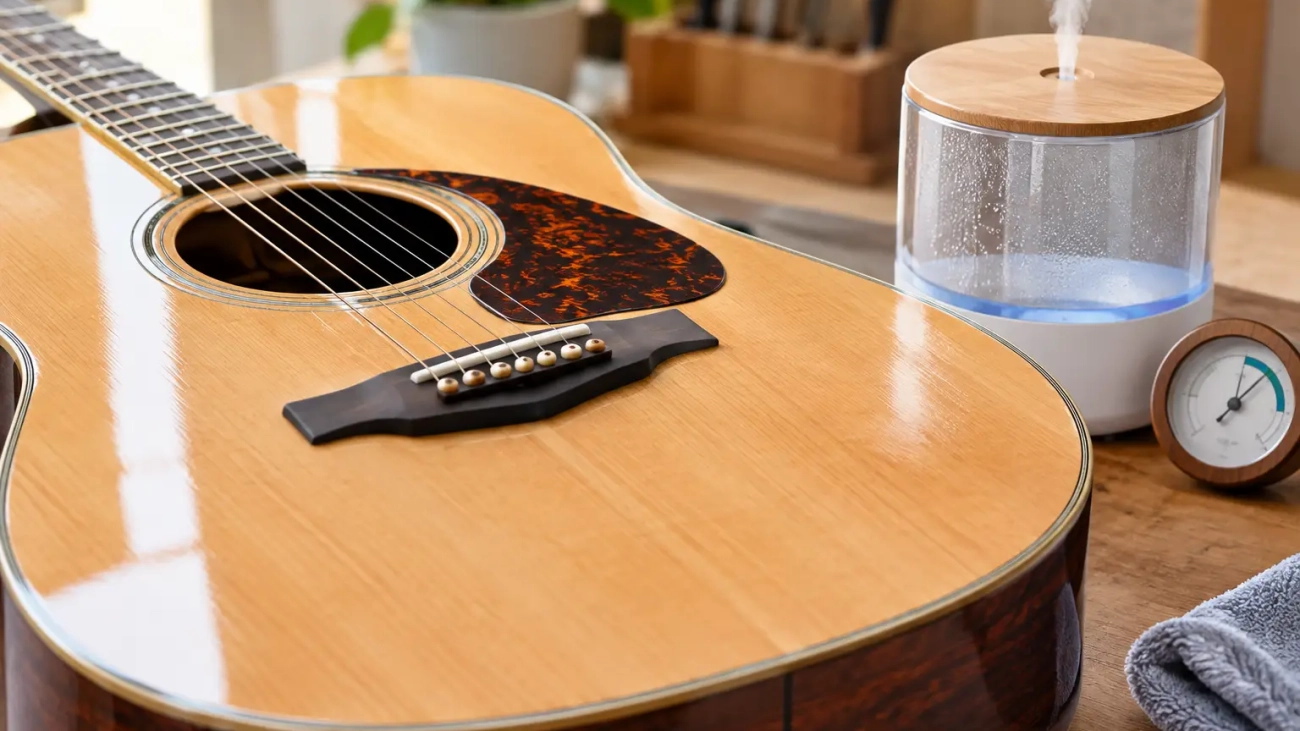
A fine guitar top is asked to do two opposing things at once: remain light enough to respond to the smallest impulse of a fingertip, yet strong enough to bear the continual pull of strings. That tension is part of its voice, but it also makes wood responsive to its environment. Preventing guitar top cracks is therefore less about treating an instrument delicately than about giving it a stable climate in which its carefully balanced structure can live.
A crack is not always a verdict on an instrument’s quality. Even beautifully seasoned spruce or cedar can move when the surrounding air changes too quickly. What matters is understanding why that movement occurs, recognizing its early signs, and responding before a seasonal shift becomes a repair.
Why Guitar Tops Crack
Wood is hygroscopic: it takes on and releases moisture from the air. As it loses moisture, it contracts. Across the grain, that contraction can be significant. A guitar top is thin by design, held under tension by bracing, bridge, binding, and the geometry of the body. When dry air draws moisture from the top, the wood wants to shrink, while those surrounding structures resist it. A crack can be the result.
The familiar winter top crack often follows the grain, commonly between the bridge and the lower bout. It may begin as a fine line that is easier to feel than see. In more severe dryness, the top can sink slightly, fret ends may feel sharp, and the action can drop as the geometry of the instrument changes. These are not isolated cosmetic events. They are signals that the entire guitar is asking for moisture.
Excess humidity presents a different problem. Wood swells, the top may rise, the action can become higher, and the instrument can lose some of its clarity and immediacy. Glue joints and finishes can also be stressed. The goal is not to make wood motionless, which is impossible, but to keep its movement gradual and within a healthy range.
Preventing Guitar Top Cracks Starts With Measurement
The most valuable accessory in a serious guitarist’s care routine is a reliable digital hygrometer. Place one where the guitar actually lives: in its case when traveling or storing it, and in the room when it is displayed or played regularly. Humidity outdoors is not the relevant number. The condition inside the home, studio, vehicle, or case is what the instrument experiences.
For most steel-string, classical, flamenco, and archtop guitars, a relative humidity of roughly 45 to 55 percent is an excellent working range. A brief variation outside that range is rarely cause for alarm. The greater danger is prolonged exposure below about 40 percent, or abrupt swings from one extreme to another.
Temperature matters because it changes relative humidity and can produce damaging transitions. A guitar brought from a freezing car into a warm room should remain in its closed case long enough to acclimate gradually. The same patience is wise after air travel, a winter delivery, or a hot summer drive. Wood, varnish, and glue all benefit from a measured return to equilibrium.
Humidify the Space When You Can
For an instrument that lives on a stand in a dedicated music room, a room humidifier is often the most elegant solution. It supports the guitar without concentrating moisture in one small area, and it makes the room more comfortable for its human inhabitants as well. Use a hygrometer to guide the humidifier rather than running it continuously by assumption.
In very dry climates or heated homes, a whole-home system may offer the most consistent result. It is an investment, but so is a concert instrument. Stability protects not only the top, but also neck relief, fretboard condition, bridge adhesion, and the long-term poise of the setup.
Use a Case Humidifier With Restraint
A well-fitted hard case is a guitar’s best climate buffer. For seasonal dryness, a case humidifier can be highly effective, especially when the instrument is not played daily. Choose a system designed for instruments, follow its instructions precisely, and check it often. A depleted humidifier offers false reassurance; an overfilled one can leak or create an overly damp pocket within the case.
The device should never touch the guitar, and free water should never be introduced into the case. If the guitar has become severely dry, resist the urge to force a rapid correction. Reintroduce humidity gradually over several days. Wood responds best to patience, and a sudden change can be stressful in its own right.
Storage Habits That Respect the Instrument
The convenient places in a home are often the hardest on a guitar. Exterior walls, direct sunlight, radiators, fireplaces, forced-air vents, and sunny windows all create local conditions that differ sharply from the room average. A guitar placed near a vent may endure repeated bursts of dry air even when the rest of the room reads acceptably.
A hard case is preferable for overnight storage, extended periods between playing, and every journey outside the home. It reduces the speed at which the instrument exchanges moisture with the air and offers essential protection from impact. A stand is perfectly reasonable during a stable day of playing, provided the room itself is monitored. It is less suitable as a permanent winter home in a dry house.
Cars deserve special caution. A closed vehicle can become dangerously hot in minutes, and winter cold can be equally severe. Beyond humidity, rapid thermal change can compromise finish and glue joints. No performance schedule justifies leaving a fine guitar in a vehicle longer than necessary.
Learn the Guitar’s Early Warnings
A guitarist who knows an instrument well is often the first and best line of defense. Run a fingertip lightly across the top in raking light. A new ridge, a line that catches the nail, or a subtle depression deserves attention. Look along the top from the neck toward the bridge and notice whether its arch or dome has changed.
Changes in playability can be equally revealing. Sharp fret ends, a lower action, a slightly sunken top, or a new dryness in the sound may point to low humidity. By contrast, a raised top, higher action, and a less focused attack can indicate excess moisture. None of these signs offers a diagnosis alone, since setup and string tension also affect feel, but together they tell a useful story.
Do not attempt to seal, fill, or glue a crack at home. A well-repaired top crack can be structurally secure and visually discreet, particularly when addressed early by an experienced luthier. Delaying repair, however, may allow the crack to collect dirt, widen, or affect adjacent bracing. The moment a line appears, stabilize the instrument’s environment and arrange a professional assessment.
Materials and Craft Cannot Cancel Climate
Master-grade tonewoods are selected, seasoned, joined, and voiced with great care. Thoughtful bracing gives a top both strength and freedom. Yet no responsible maker would claim that fine materials make a guitar immune to neglect. The very responsiveness players seek in a hand-built instrument comes from a top that is refined enough to move.
At Scharpach, a guitar is conceived as a long-term artistic partner, not a static object. Its tonal life continues after it leaves the workshop, shaped by playing, string choice, and the conditions in which it is kept. Climate care is part of honoring that relationship. It preserves the subtle equilibrium between bass, treble, projection, and color that the builder and player value.
A Seasonal Ritual Worth Keeping
Before the heating season begins, place fresh batteries in your hygrometers, inspect the case humidification system, and decide where the guitar will be stored. During dry spells, check the reading every few days rather than waiting for symptoms. In humid summers, reduce or stop humidification and make sure the case is not trapping excess moisture.
This modest ritual asks little of the player. In return, it helps preserve the top’s graceful arch, the instrument’s response, and the musical character that drew you to it in the first place. A guitar kept in a stable environment is free to do what it was built to do: turn touch into sound with clarity, depth, and lasting beauty.