
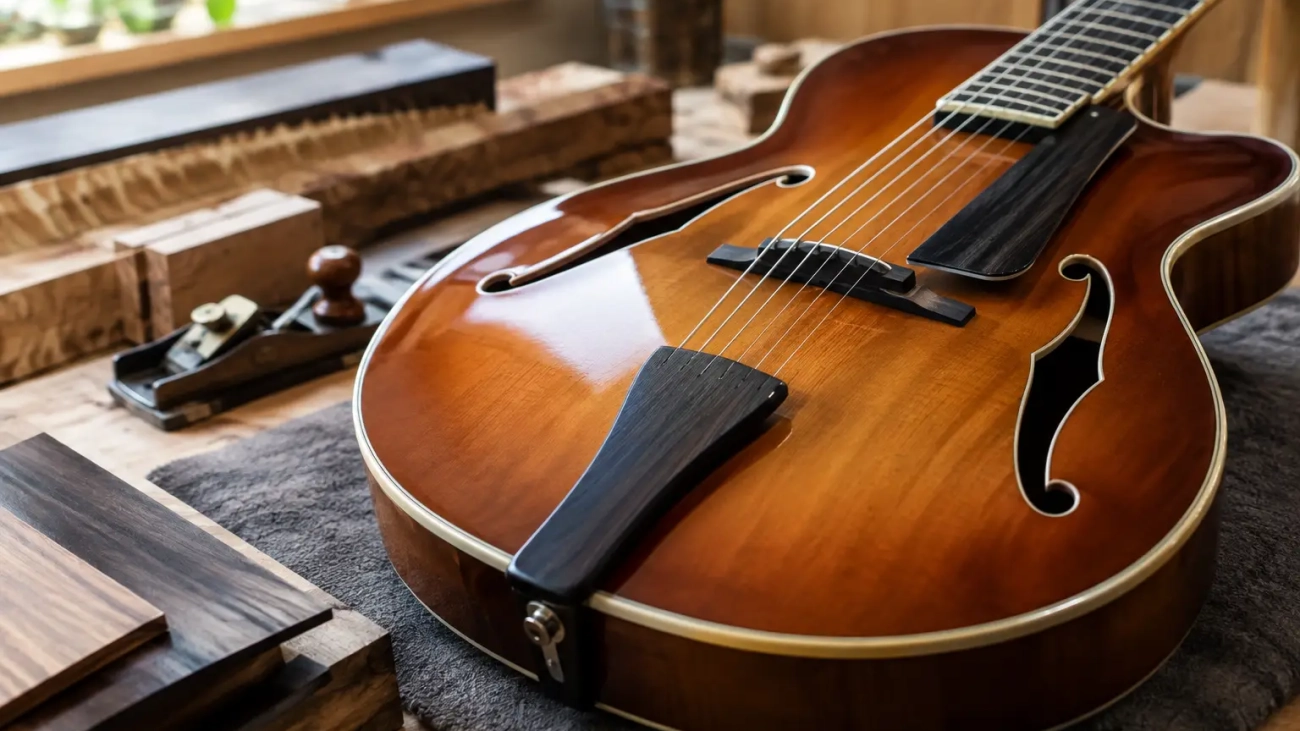
A great jazz archtop does not simply reproduce notes. It gives shape to the space around them: the soft rise of a chord melody, the dry authority of a Freddie Green rhythm part, the bloom at the end of a single sustained line. A jazz archtop commission begins with that understanding. The purpose is not to order a beautiful object from a list of options. It is to create an instrument whose voice, feel, and physical balance belong unmistakably to one player.
For the serious guitarist, this is where a handmade archtop becomes fundamentally different from a fine production guitar. Factory instruments must satisfy a broad idea of what players might need. A commissioned instrument can be drawn much closer to how you actually play, what you hear, and what you want to say.
Why a Jazz Archtop Commission Is Personal
Jazz players often speak about tone as though it lives in the amplifier, the pickup, or the hands alone. Each matters. Yet the acoustic character of the guitar remains at the center of the experience. It determines how the note begins, how it develops, and how much complexity remains after the initial attack.
A carved archtop is especially sensitive to these choices. Its top and back are not merely shaped pieces of wood. They are graduated, tuned surfaces that respond to string energy with a particular balance of immediacy, warmth, projection, and color. Small decisions in arching, thickness, bracing, and varnish can alter the instrument’s entire temperament.
That is why a commission should begin with the musician rather than a catalog specification. A player who works in a quiet trio may need a different voice than someone moving between a concert stage, a studio, and an amplified ensemble. One guitarist may seek a dark, broad fundamental with a restrained high end. Another may want a quicker attack, more separation between notes, and enough acoustic presence to play unamplified in an intimate room.
Neither preference is more correct. The right instrument is the one that makes the player’s musical intent easier to hear.
Beginning With the Sound You Hear
The most valuable part of a commission is often the conversation before any wood is selected. A skilled luthier listens for more than familiar descriptions such as warm, woody, or articulate. Those words are useful, but they are only a starting point.
It helps to discuss repertoire, ensemble settings, right-hand technique, and the instruments whose sounds have stayed with you over the years. Are you seeking a compact, percussive response for rhythm work? Do you favor a round single-note sound that carries without becoming sharp? Does your playing depend on dynamic shading at low volume? Are you primarily amplified, or do you expect the guitar to speak acoustically as well?
The answers guide meaningful structural choices. A 16-inch body may offer intimacy, comfort, and a focused response. A 17-inch body can offer greater air movement, broader bass, and a more expansive physical presence. Neither size is automatically superior. Body depth, scale length, top stiffness, and the player’s own posture all influence which proportion feels right.
The same applies to the distinction between a fully acoustic archtop and an instrument designed around a floating pickup. A fully acoustic guitar asks the carved plates to carry much of the musical conversation. A floating-pickup archtop can preserve that acoustic life while providing a faithful amplified voice with less interruption to the top. A built-in magnetic pickup may better serve players who require greater stage volume or a more immediate electric response, though it changes the relationship between the top and the amplified sound.
A good commission does not force an abstract ideal. It weighs the trade-offs honestly.
Woods Are Chosen for Character, Not Decoration
Flamed maple, European spruce, mahogany, ebony, and rosewood all bring visual beauty, but appearance is only part of their value. In an archtop, the stiffness, weight, grain orientation, and seasoning of each set of wood matter profoundly.
A spruce top is traditionally prized for its clarity, resilience, and capacity to mature over time. Yet no two spruce tops behave alike. One may carry a quick, dry response; another may offer greater richness and sustain. Maple can provide definition and a reflective quality that suits complex harmony, while a different maple set may produce a warmer and more forgiving result. The maker’s task is not to follow a recipe. It is to hear the potential in the material and build accordingly.
This is where decades at the bench matter. Fine tonewood is not selected because it is rare or visually dramatic. It is selected because its properties suggest a particular musical future. The luthier then brings that future forward through carving, bracing, graduation, and patient adjustment.
The Feel of the Instrument Matters as Much as Its Voice
An archtop can possess extraordinary sound and still remain underplayed if it does not sit naturally in the musician’s hands. Comfort is not a secondary luxury. It affects relaxation, timing, intonation, and the willingness to reach for the guitar every day.
A commission allows the neck profile to be shaped around the player’s preferences rather than borrowed from a generic standard. Some hands favor a fuller, more supportive carve. Others need a slimmer profile with carefully considered shoulder transitions. Nut width, string spacing, scale length, fingerboard radius, and fret dimensions can all be adjusted to serve a specific technique.
Left-handed players benefit especially from an instrument designed from the beginning for their orientation. A true left-handed archtop is not simply a reversed visual arrangement. The relationship of the bass and treble sides of the top, the bracing, the cutaway, and the player’s physical contact with the instrument deserve consideration as part of the design.
Even details that seem modest can become significant over a long performance or recording session. The contour of the heel, the height of the bridge, the placement of the controls, and the balance of the body against the rib cage all contribute to whether the instrument feels like an extension of the player or a beautiful compromise.
Beauty Should Serve the Music
There is no conflict between visual refinement and musical seriousness. A hand-carved scroll, a quiet burst, figured maple, precise binding, or an elegantly proportioned tailpiece can make an archtop deeply satisfying to live with. But on a master-built instrument, ornament should never be used to disguise an uncertain voice.
The most enduring aesthetic choices tend to arise from proportion and restraint. The line of the headstock, the flow of the f-holes, and the relationship of the pickguard to the body all affect the instrument’s character. When those elements are resolved with care, the guitar looks inevitable rather than overdesigned.
Varnish also deserves attention. Its role is both visual and acoustic. A finish must protect the instrument while allowing the wood to remain alive and responsive. A heavy, overly rigid finish can restrict vibration. A thoughtfully applied varnish lets the surface retain depth and luminosity without placing an unnecessary barrier between the player and the wood’s natural movement.
For collectors, this level of visual coherence is part of the instrument’s lasting value. For performers, it has another value: confidence. A guitar that feels resolved in the hands and looks true to its purpose invites a deeper commitment to the music.
What the Commission Process Should Feel Like
A commission is a relationship built on clarity. The player brings experience, preference, and aspiration. The luthier brings trained judgment, a knowledge of materials, and the willingness to explain why one choice will serve the instrument better than another.
At Scharpach, that process is guided by the belief that a guitar should become a vehicle for an individual musical voice. The consultation is not about offering limitless options for their own sake. Too many unchecked choices can dilute the design. The aim is to make each decision support the same musical center.
As the work progresses, patience matters. Fine wood must be prepared and understood. Carved plates require time, close listening, and an unwillingness to settle for approximation. The final setup must bring the instrument into a state where it plays cleanly and freely, but still leaves room for the guitar to continue developing in the player’s care.
That development is one of the quiet rewards of a handmade archtop. Wood changes with years of vibration, changing seasons, and repeated musical use. The guitar may become more open, more complex, and more familiar. It gathers the marks of work, travel, rehearsal, and performance. Properly cared for, it does not become less personal with age. It becomes more so.
A jazz archtop commission is worth considering when you no longer want to adapt your playing to an instrument’s limitations. The finest result is not a guitar that calls attention to its price, its ornament, or its rarity. It is a guitar that, when the room goes quiet and the first note is played, makes your own voice feel more present.