
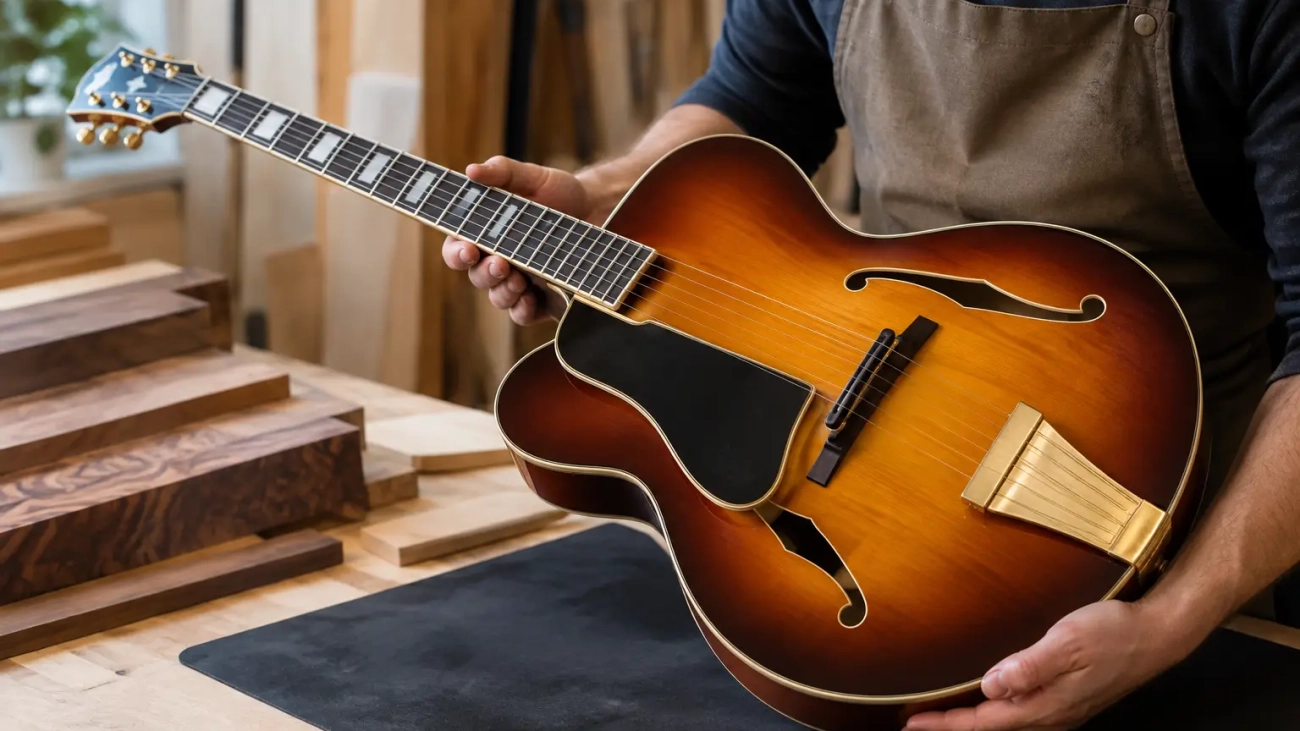
A left-handed archtop should never feel like a right-handed instrument reflected in a mirror. Its balance, response, visual lines, and setup must serve the player from the first chord. Knowing how to order a left handed archtop begins with a more useful question: what do you need the instrument to say when it is in your hands?
For a serious player, an archtop is a voice with a physical presence. The carved plates, air cavity, neck angle, scale length, and finish all shape the conversation between pick, fingers, strings, and room. A custom order is the opportunity to make those choices deliberately rather than accepting the compromises built into a scarce left-handed production model.
Start With Your Musical Life
Before discussing figured maple, f-hole shape, or tailpiece design, define where the guitar will live musically. A player working unamplified in a small jazz ensemble may need a dry, immediate fundamental with clear note separation. Someone playing through a floating pickup may prefer a warmer, more sustaining acoustic foundation that remains composed at stage volume. A chord-melody player often hears the instrument differently from a single-note improviser.
Bring references, but describe them in musical terms rather than only naming famous guitars. Are you looking for a quick, percussive attack or a rounder bloom after the note begins? Should bass notes remain compact beneath complex harmony, or should they carry a broad, orchestral weight? Do you favor a bright, articulate upper register, or a darker color that softens the edge of a heavy pick?
A skilled luthier will translate those preferences into construction decisions. This is where a commission becomes personal rather than merely decorative.
How to Order a Left Handed Archtop Without Guesswork
The most productive first consultation is honest and specific. Share your primary repertoire, whether you perform amplified, the strings and picks you use, and what has disappointed you in past guitars. Measurements matter, but so does observation. A player who grips hard during fast passages, uses a thumb-over approach, or has a sensitive picking-hand wrist may need a different solution than a player with the same hand size but a different technique.
Photographs or measurements of guitars you already own can be useful. They reveal familiar neck dimensions, preferred strap position, and whether you naturally hold the instrument high or low. If possible, provide a short recording. Tone is difficult to reduce to adjectives, while a recording can reveal articulation, dynamics, and the range of colors you actually draw from an instrument.
The left-handed orientation itself deserves more attention than a reversed headstock and bridge. The bass and treble sides of a carved archtop can be voiced with the string layout in mind. The cutaway, controls, pickguard, side markers, compensation at the bridge, and the position of a floating pickup all need to be conceived for a left-handed musician from the outset. This is particularly valuable when comfort and clean visual proportion matter as much as sound.
Choose the Body for the Music, Not the Photograph
A large-bodied archtop has undeniable visual authority and can offer a deep, enveloping acoustic character. It may also feel demanding during long sets, especially for a smaller player or anyone seated with the guitar high on the leg. A more compact body can respond with greater immediacy and remain easier to manage onstage, though it may not produce the same breadth of low-end air.
Body depth is equally consequential. Deeper rims can give the instrument a spacious, resonant quality, but may increase feedback sensitivity when amplified. Shallower construction can offer focus, definition, and practical control at volume. Neither choice is inherently superior. The right choice follows the player’s repertoire, physical comfort, and performing environment.
Cutaway design should be discussed in the same practical spirit. If your music regularly lives above the twelfth fret, access is not a luxury. Yet a cutaway also changes the body’s air volume and visual balance. A thoughtful design preserves elegance while giving the left hand meaningful freedom where it is needed.
Carved Woods and Tonal Character
The top is the principal source of an archtop’s acoustic speech. Spruce is prized for its elasticity, headroom, and ability to develop complexity over time. Different pieces of spruce bring different degrees of stiffness, grain density, and color. The finest choice is not simply the most visually uniform set, but the one whose acoustic properties suit the intended voice.
Maple remains a classic choice for back and sides because it contributes clarity, projection, and a focused reflective quality. Highly figured maple can be magnificent, although figure alone does not determine sound. Plainer wood of exceptional stiffness and resonance may be the more compelling musical material. Other woods can introduce a warmer, drier, or more immediate character, but should be selected in relation to the top, the player’s touch, and the desired response.
A commission of this level benefits from trusting the maker’s material judgment. The luthier works not with abstract species names, but with individual sets of wood, each carrying its own weight, tap tone, stiffness, and potential.
Specify the Neck as a Playing Surface
For many musicians, the neck determines whether a beautiful guitar becomes a lifelong companion. Nut width, string spacing, fretboard radius, profile depth, and shoulder shape work together. A broad nut may help articulate complex chord voicings, but can feel excessive if your hand prefers a narrower reach. A fuller profile can support a relaxed grip, while a slimmer neck may suit players who move constantly through position shifts.
Do not request a neck profile based solely on a specification sheet. Explain how your hand feels after an hour of playing and where fatigue appears. If you have prior injuries, arthritis, limited thumb mobility, or unusually long fingers, say so plainly. These are not minor details. They are central to the instrument’s ergonomic design.
Scale length deserves equal consideration. A longer scale generally brings more string tension, definition, and a firmer feel. A shorter scale can feel more supple and may favor a warmer attack. String gauge changes the equation again. The goal is not to chase a universal ideal, but to find a tension and response that let your musical intention arrive without resistance.
Plan Electronics and Hardware Early
An acoustic archtop, a floating-pickup archtop, and a guitar built around a mounted humbucker make different musical promises. A floating pickup preserves more of the top’s acoustic freedom and is often favored by players who value air, woodiness, and traditional jazz character. A mounted pickup can offer a stronger, more direct amplified signal, though it changes the relationship between the top and the electronics.
Discuss your amplifier, typical stage volume, pedals, and recording habits before choosing a system. Feedback is not simply a flaw to eliminate. Sometimes it is the predictable trade-off for an exceptionally open, responsive body. A maker can guide the design toward greater control without sacrificing the musical qualities that led you to an archtop in the first place.
Hardware should serve the same purpose. Tuners, tailpiece, bridge material, fretwire, and finish influence weight, resonance, touch, and longevity. A thin, carefully applied finish allows the wood to speak more freely than a heavy coating, while also requiring a degree of respect from the owner. An heirloom instrument is made to be played, not protected from every mark of a musical life.
Agree on the Process, Not Only the Specification
A custom instrument is a relationship built on clarity. Before work begins, establish the build timeline, deposit schedule, communication points, and the degree to which material availability may shape final choices. Fine tonewoods are individual, and responsible makers sometimes recommend an adjustment when a particular set proves especially suited to the intended guitar.
Ask how the final setup will be determined. Action, relief, bridge height, string gauge, and pickup balance should reflect the way you play, not a generic factory standard. The instrument should arrive ready for its first serious musical conversation.
At Scharpach, a left-handed archtop is approached as an original instrument, shaped around the player’s hands, ear, and artistic direction. That distinction matters because the best custom guitar does not announce its specifications first. It makes expression feel natural.
Give the process enough time for considered decisions. The right archtop will not merely accommodate your handedness. It will reward your touch, deepen with years of playing, and leave room for the musician you are still becoming.