
A guitarist can recognize an ill-fitting neck within a few phrases. The left hand begins to make small compromises: the thumb shifts, fingers crowd one another, a clean barre requires more force than it should. Understanding guitar nut width gives language to this experience. It explains why two otherwise beautiful instruments can feel entirely different before the first note has fully bloomed.
Nut width is a modest measurement with an outsized role in the relationship between player and guitar. For a serious musician, it should not be treated as a catalog specification to compare in isolation. It is one part of a larger ergonomic design, bound to string spacing, neck shape, scale length, setup, repertoire, and the individual architecture of the hand.
What Guitar Nut Width Actually Measures
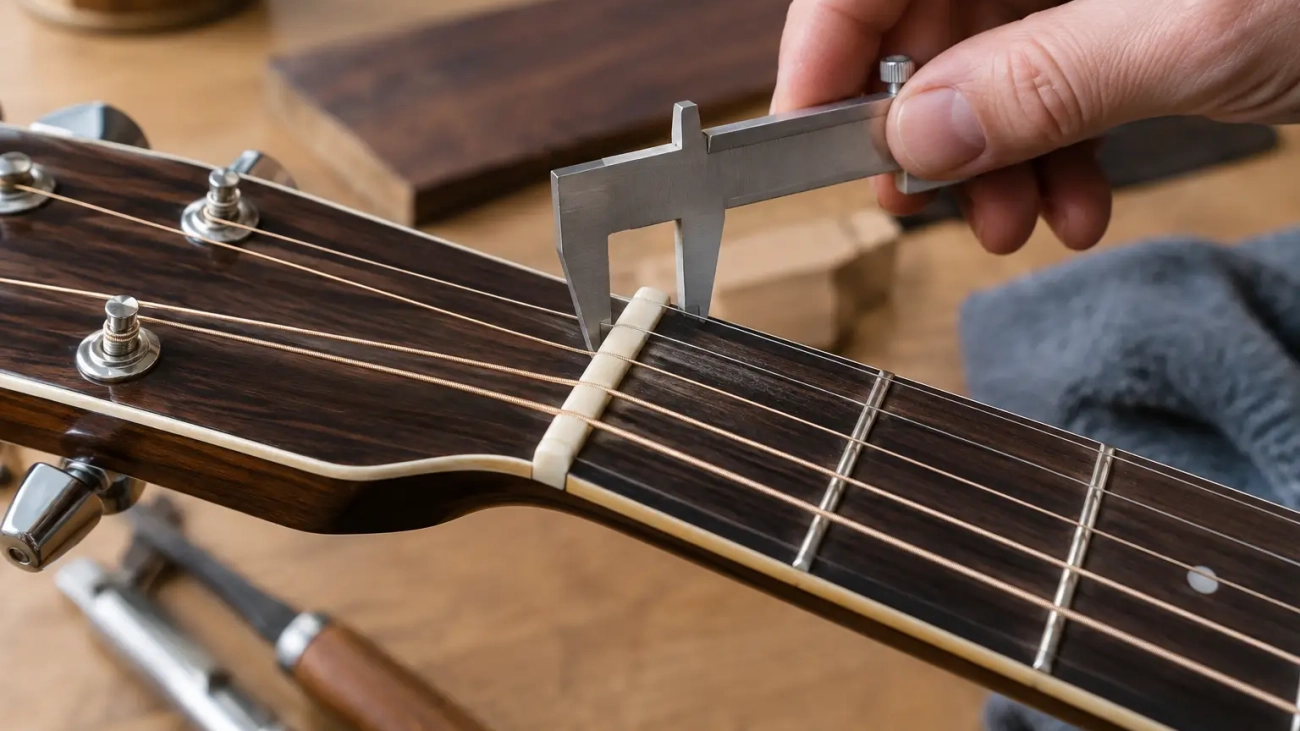
The nut is the small, carefully shaped piece at the end of the fingerboard, where the strings pass from the headstock toward the first fret. Nut width is the width of the neck at that point, generally measured across the fingerboard from one outer edge to the other.
It is not the same as the distance between the first and sixth strings. That measurement is called string spacing, and it is often the more immediate concern under the fingers. Two guitars can share the same nut width while offering slightly different usable spacing, depending on how much margin the maker leaves between the outer strings and the fingerboard edges.
This distinction matters. A wide nut with conservative edge margins may not feel as spacious as expected. Conversely, a slightly narrower nut can remain remarkably comfortable when the slots are positioned intelligently and the neck profile supports a relaxed hand.
Understanding Guitar Nut Width in the Hand
On a steel-string acoustic guitar, common nut widths range from approximately 1 11/16 inches to 1 3/4 inches. Classical guitars traditionally use a wider format, often 50 or 52 millimeters, though dimensions vary according to tradition, repertoire, and the player’s technique. Flamenco guitars may follow similar widths, but their overall neck depth, setup, and response create a character of their own. Archtop guitars occupy a broad territory, shaped by whether the instrument is intended for chord melody, plectrum work, or a more contemporary language.
A narrower nut generally places the strings closer together near the first position. For players with smaller hands, or for those whose work centers on fast single-note lines and compact chord forms, this can feel immediate and efficient. Yet narrow spacing can also ask the fretting hand to be unusually precise. Fingers may interfere with adjacent strings, particularly in complex voicings, open-position chords, and passages that require independent control of each note.
A wider nut gives each string more room to breathe. Fingerstyle players often appreciate the additional separation, as do classical guitarists who need clarity in contrapuntal writing. Wider spacing can make it easier to articulate bass, melody, and inner voices without accidental contact. For some hands, it also creates a more natural feeling when forming broad chord shapes.
But wider is not automatically better. A player who favors a compact hand position, has a shorter reach, or spends much of the evening navigating demanding jazz harmony may find an overly wide neck tiring. Comfort is not determined by hand size alone. It emerges from how a particular player moves, how much pressure they use, and which musical gestures they repeat thousands of times.
The Dimensions That Change the Meaning of Width
Nut width should be considered alongside several other measurements. The first is string spacing at the nut. This determines the actual interval between the strings, while the outer margins influence how secure the first and sixth strings feel during vibrato, pull-offs, and assertive fretting.
Neck profile is equally consequential. A 1 3/4-inch nut on a shallow, gently rounded neck may feel less substantial than the same width paired with a deep V or a pronounced oval profile. The former can encourage an open, relaxed grip; the latter may suit a player who prefers the thumb to anchor or wrap with greater intention. Neither is universally superior.
Fingerboard radius also shapes perception. A flatter fingerboard can make a wider neck feel orderly and accessible for polyphonic work, while a more curved radius may favor certain chord grips and lead techniques. On a classical guitar, the largely flat fingerboard serves a musical world in which clean separation of voices and right-hand articulation are central.
Then there is scale length. A longer scale increases string tension and changes fret spacing. If it is paired with a broad nut and a substantial neck, the result can be magnificent for a player seeking projection, definition, and authority. For another player, it may feel demanding over a long performance. The measure itself never tells the whole story.
Why the Nut’s Craft Matters as Much as Its Width
The nut is not merely a spacer. Its slots establish the strings’ starting points, their height above the first fret, and their freedom of movement. A beautifully chosen width can be undermined by slots that are too high, too narrow, improperly angled, or unevenly placed.
When the slots sit too high, first-position chords feel stiff and intonation can sharpen as the player presses the strings down. When they are cut with care, the guitar feels more willing. Notes speak cleanly, the left hand uses less effort, and the instrument seems to meet the player rather than resist them.
Material matters, though it should be discussed without superstition. Bone remains valued for its density, durability, and clear transfer of vibration. Other materials can serve particular musical or practical purposes. More decisive than fashion is the precision of fitting and slot work. At a refined level of luthiery, the nut belongs to the same continuum of decisions as fretwork, bridge design, top thickness, varnish, and final voicing.
Choosing Width by Musical Life, Not by Specification
The best question is not, “What is the ideal nut width?” It is, “What does my music ask my hands to do?” A solo classical player who lives in Bach, Albéniz, and contemporary repertoire has different needs from a singer-songwriter whose voice leads the performance. A flamenco player requires immediacy, percussive confidence, and room for articulations that would be foreign to an archtop player shaping dense chord melodies.
Consider where discomfort appears. If the first-position chords feel congested, more width or more thoughtful string spacing may help. If extended stretches fatigue the hand, a narrower width, altered profile, or shorter scale may be the wiser answer. If the outer strings slip off the frets during expressive playing, the issue may be edge margin and fretwork rather than nut width alone.
For left-handed players, standard dimensions can be especially unhelpful when an instrument has simply been adapted rather than designed around the player. The goal is not visual symmetry. It is a neck, spacing layout, and setup that feel native to the hand from the first phrase.
What to Notice When You Play
When evaluating a guitar, spend time in the first five frets, where nut width declares itself most clearly. Play open-position chords slowly, then move through the voicings that define your actual repertoire. Test a full barre, a thumb-over bass if that is part of your technique, and independent lines on neighboring strings.
Notice whether you are adjusting your hand to the instrument or whether the instrument permits your hand to remain calm. A fine guitar should still challenge the musician artistically. It should not waste energy through avoidable physical resistance.
For a commissioned instrument, this is where conversation becomes invaluable. At Scharpach, dimensions are not chosen as decorative options on a specification sheet. They are considered as part of the player’s musical identity: the sound they pursue, the repertoire they carry, the injuries or habits that shape their technique, and the feeling they hope to have after hours of playing.
A nut width is measured in fractions of an inch or millimeters, but its effect is felt in confidence. The right one disappears beneath the hand, leaving the player free to listen more closely, phrase more honestly, and let the guitar become a more faithful voice.