
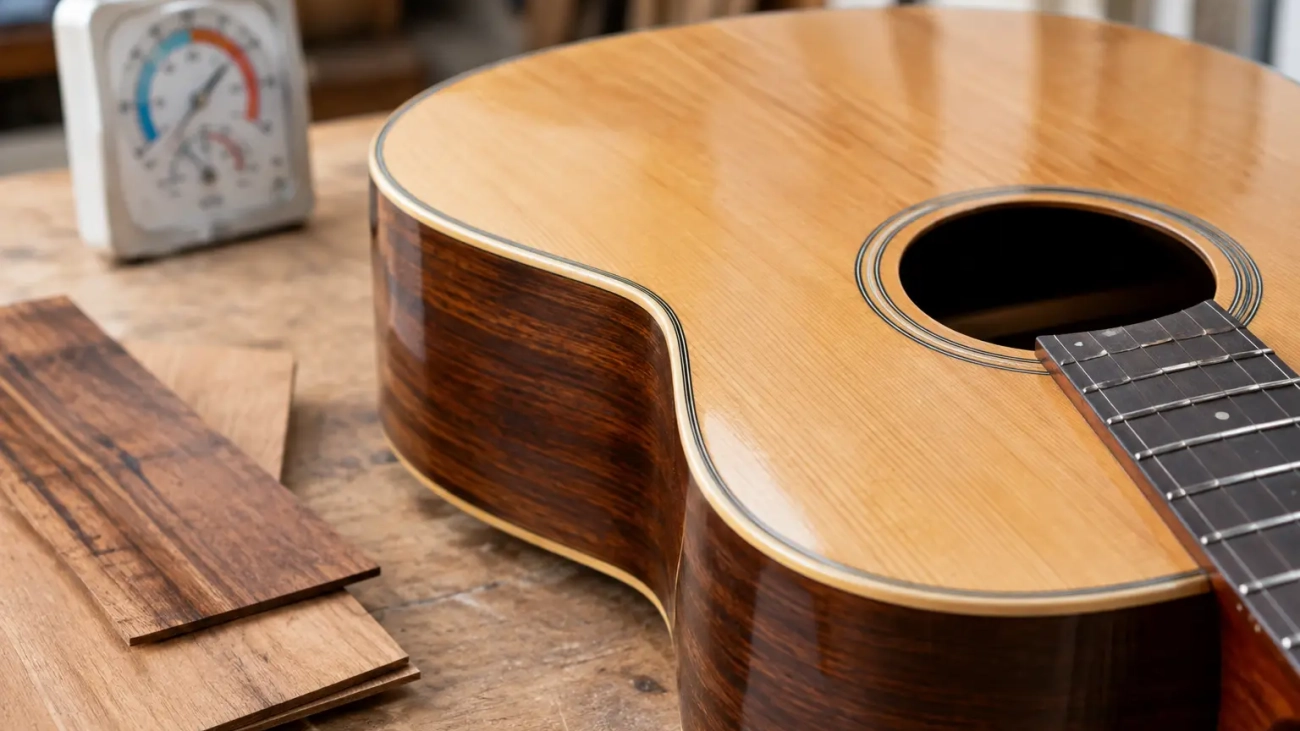
A fine guitar can speak differently before it shows visible distress. The action may feel unfamiliar, a bass note may lose its bloom, or a once-fluid response may become restrained. Guitar humidity damage rarely begins as a dramatic event. It begins in the quiet exchange between wood and air, then makes itself known through geometry, tension, and sound.
For a handmade classical, flamenco, or archtop guitar, this is not merely a matter of cosmetic care. Tonewoods remain responsive long after an instrument leaves the workshop. Their movement is part of what gives a guitar life, color, and resonance. Managed well, that movement is modest and natural. Left unchecked, it can place stress on the delicate balance a luthier has established between top, braces, neck, bridge, finish, and strings.
Why Fine Guitars Respond to Humidity
Wood is hygroscopic, meaning it gains and releases moisture according to the surrounding environment. Even seasoned, carefully selected tonewood continues to seek equilibrium with the air around it. A guitar built in a controlled workshop is designed with this reality in mind, but no instrument is immune to extremes.
The soundboard is especially sensitive. It is thin by design, lightly supported by a pattern of braces, and asked to withstand the constant pull of string tension while remaining free enough to vibrate. When relative humidity rises, the top absorbs moisture and expands. When the air becomes very dry, it contracts. The back, sides, neck, fingerboard, bridge, and internal braces respond as well, though not always at precisely the same rate or in the same direction.
This is why humidity management matters more with an expressive acoustic instrument than with a solid-bodied electric guitar. The very qualities a discerning player seeks – a responsive top, a nuanced dynamic range, a quick attack, a complex overtone field – are tied to finely calibrated materials. Sensitivity is not a defect. It is the nature of a serious instrument.
Guitar Humidity Damage From Dry Air
Low humidity is often the more urgent threat. During a cold season, heated indoor rooms can become exceptionally dry. In arid climates, the risk may persist throughout much of the year. As the guitar releases moisture, the top and back can shrink across the grain.
One of the earliest signs is a lowering of the action. The soundboard may flatten or sink slightly between the bridge and the lower bout, bringing the strings closer to the frets. A player may notice new buzzing, a loss of headroom under a firm right hand, or an instrument that seems less open and forgiving than it did a few weeks earlier.
The ends of frets may also begin to feel sharp. This does not necessarily mean the frets have moved. More often, the fingerboard has contracted around them. On a classical guitar, a dry fingerboard can make a normally elegant neck feel unexpectedly harsh under the hand.
If dryness continues, the danger becomes structural. A top or back may develop a crack, commonly along the grain. Seams can open where the wood has pulled away from a joint. Binding may separate at the edges. These are repairable conditions in many cases, but prevention is far kinder to the instrument than restoration. A repaired crack can be stabilized beautifully; it cannot be made to have never occurred.
Dry air also changes the voice of the guitar. Players sometimes describe it as tight, thin, brittle, or reluctant. These words are subjective, yet the underlying experience is real. A dehydrated soundboard has been pulled into a different shape and tension state. The guitar is no longer vibrating from the geometry intended for it.
What Excess Humidity Does to a Guitar
High humidity presents a different pattern. When a guitar absorbs excessive moisture, the top tends to swell and rise. The action increases, sometimes enough to make demanding repertoire feel unnecessarily difficult. Notes can feel less immediate, and the sound may become muted or overly soft at the edge.
A modest seasonal rise in action is normal. The concern begins when the change is pronounced or sustained. The bridge area may show increased rotation, the top may appear unusually domed, and the strings may feel high even when the neck itself is healthy. For a player who knows the instrument intimately, this change can be unmistakable.
Excess humidity can also affect finishes and glue joints. Traditional glues, carefully chosen in fine luthiery for their acoustic and repair qualities, do not welcome prolonged exposure to damp conditions. The issue is not that a well-made guitar will simply come apart in humid weather. It is that persistent moisture introduces unnecessary strain and can weaken the reliability of an instrument over time.
Cases deserve attention here. A closed case protects a guitar from sudden swings, but it can also trap damp air. Returning a rain-soaked case to a warm room, storing an instrument in a basement, or leaving it near a poorly ventilated exterior wall can create a small, humid chamber around the guitar. Protection is not the same as isolation. The case environment must be considered, too.
Reading the Instrument Before Damage Deepens
A guitar does not need laboratory equipment to tell you what it needs. Consistent observation is often more valuable than reacting only when something looks wrong. Notice how the action feels at the twelfth fret, how the top reflects light, whether fret ends have changed, and whether the instrument has lost a familiar ease of response.
A simple digital hygrometer kept in the case removes much of the guesswork. For most fine acoustic guitars, a stable relative humidity around 45 to 55 percent is an excellent practical target. Short deviations above or below this range are seldom cause for alarm. Large swings and long exposure to very dry or very damp air are the true enemies.
Temperature matters because it changes relative humidity quickly. A guitar should never be left in a car, near a heating vent, beside a radiator, or directly in the path of air conditioning. The danger is not only the temperature itself. It is the abrupt change in the moisture conditions surrounding the wood.
When traveling between climates, give the instrument time to acclimate. After bringing a cold case indoors, let it rest closed before opening it. This small act of patience protects both the finish and the wood from a sudden transition. A fine guitar rewards the player who understands that its condition is part of its musical readiness.
Humidification Is Useful, but Restraint Matters
A case humidifier can be an excellent tool during dry months, provided it is used with measurement rather than optimism. The goal is not to add as much moisture as possible. It is to create a stable environment. An overfilled or leaking humidifier can introduce the very excess it was meant to prevent.
For a single instrument, a properly maintained case humidification system is often sufficient. For a collection or a dedicated music room, room-level humidity control may be more sensible and more consistent. The right approach depends on climate, season, how often the guitar is played, and whether it lives primarily in its case or on a stand.
Avoid placing any moisture source directly against the wood. Never attempt to correct severe dryness in a few hours. Wood needs gradual recovery. If the guitar has developed buzzing, sinking, cracks, open seams, or a sudden action change, stabilize the environment first and consult a qualified repair professional. Adjusting the truss rod, saddle, or string height before the instrument has returned to equilibrium can solve the wrong problem.
A Guitar’s Voice Depends on Its Balance
There is a temptation to treat humidity as a maintenance detail separate from artistry. It is not. The relationship between air and wood affects the same physical balance that shapes projection, clarity, sustain, comfort, and tonal color.
At Scharpach, the selection and preparation of tonewood begins long before an instrument is voiced. Yet the care of that instrument continues in the hands of its player. A handmade guitar is built to mature into a personal musical partner, not to endure neglect as a test of its worth.
Keep the case measured, the environment calm, and your attention close. When a guitar feels different, listen before you play through the change. Often, a small correction in humidity is enough to restore not just its condition, but the ease and resonance that made it yours.