
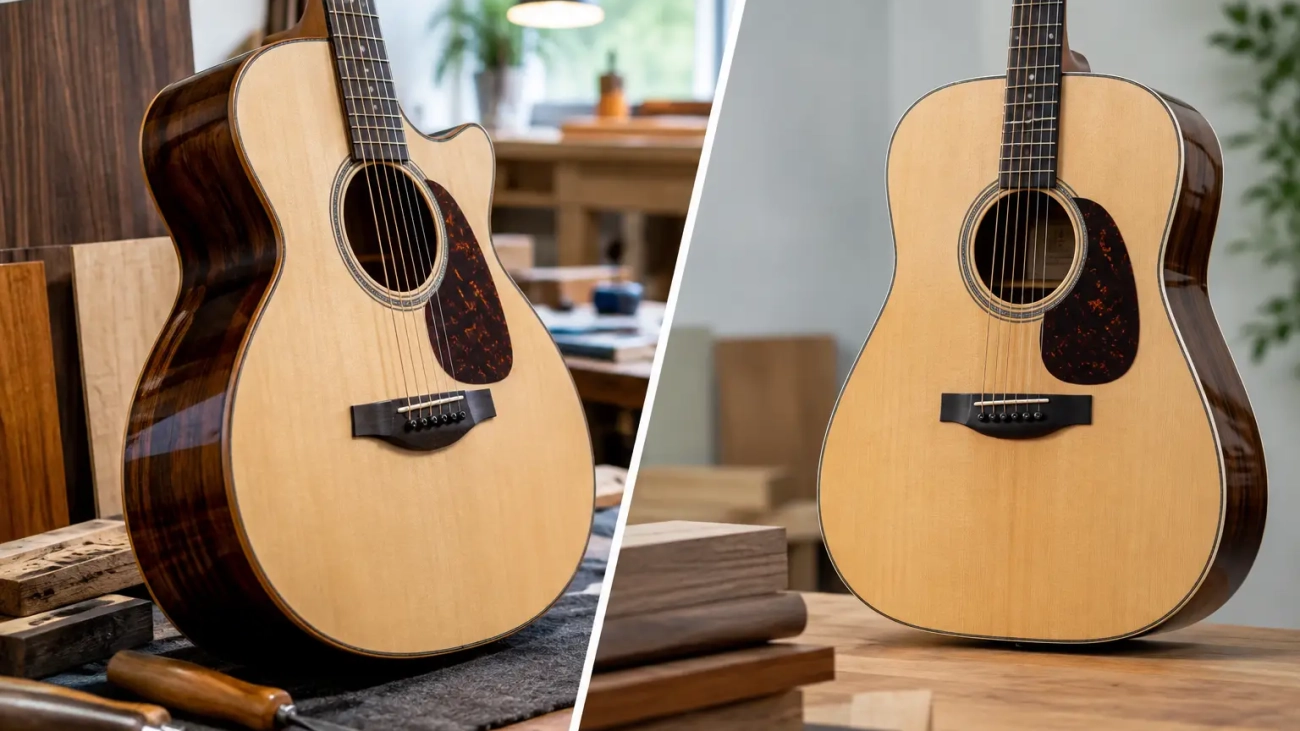
A fine guitar reveals its character in the first quiet note: the way a pianissimo holds its shape, the resistance beneath the right hand, the feeling that the neck belongs to the player rather than the other way around. The question of a commissioned guitar vs production model is therefore not simply a question of price or appearance. It is a question of whether an instrument is selected from a range or conceived around a musician’s individual voice.
A well-made production guitar can be a gratifying instrument. For many players, it is the sensible and immediate path to a reliable, recognizable sound. A commissioned guitar occupies a different territory. It asks more of the player in thought, patience, and investment, then returns something rarer: an instrument whose materials, dimensions, response, and visual language are considered as one whole.
Commissioned Guitar vs Production Model: The Fundamental Difference
A production model begins with a specification designed to serve many hands, repertoires, and musical expectations. Its body shape, scale length, neck profile, string spacing, bracing, finish, and wood choices are established before the individual player enters the picture. Even at the highest levels of factory or small-shop production, the goal is consistency across a model.
That consistency has real value. A player can try several examples, compare them quickly, and leave with an instrument in hand. The model has a known tonal identity, and its price is generally easier to anticipate. For a musician who needs a fine guitar promptly, or who already feels at home with a particular design, this can be the right decision.
A commissioned instrument begins with a conversation instead of a catalog specification. The luthier considers the player’s touch, repertoire, physical requirements, musical environment, and desired tonal direction. A flamenco player seeking explosive attack and dryness asks different things of a guitar than a classical artist pursuing long sustain, color, and a broad palette of dynamics. An archtop player may need clarity through an ensemble, a particular response under a pick, or a more intimate voice for solo work.
The distinction is not that one approach is inherently musical and the other is not. It is that a commission allows the instrument’s design to be directed toward a specific musical purpose.
Tone Is More Than a Wood Specification
Players often begin by asking for cedar or spruce, rosewood or maple. These choices matter, but they are only the visible part of a far deeper process. Two spruce tops can differ profoundly in stiffness, weight, grain, elasticity, and the way they respond to a particular bracing system. The same is true of back and side sets, neck wood, and the small structural decisions that govern how energy moves through the instrument.
In a production setting, materials must be chosen to meet a repeatable standard at scale. In a commissioned build, the luthier can select a particular set of wood for the voice it suggests, then adjust the architecture of the guitar in response. Top thickness, brace shaping, air volume, bridge mass, and varnish all become part of a single tonal argument.
This does not mean a custom guitar can be ordered with scientific certainty, as if tone were a menu item. Wood remains organic. Every instrument has a life of its own, and its voice continues to mature as it is played. A serious luthier does not promise a copy of another guitar’s sound. Instead, the work is to create the conditions for a desired character: warmth without losing definition, immediacy without harshness, projection that retains nuance, or a singing treble that does not leave the bass behind.
That distinction matters. The finest commissions are not exercises in control for its own sake. They are disciplined collaborations with material, acoustics, and the player’s imagination.
Fit Changes the Way a Player Speaks
Ergonomics are often the most immediate advantage of a commissioned guitar, particularly for experienced players who have learned exactly where standard dimensions hold them back. A few millimeters at the nut, the bridge, or the depth of the neck can alter comfort, accuracy, and endurance over long sessions.
For a classical guitarist, right-hand string spacing may influence articulation and confidence in complex repertoire. A left-handed player may require more than a mirrored layout to feel fully accommodated. The balance of the body, arm contour, scale length, fingerboard radius where appropriate, and neck shape all deserve attention. For players managing hand fatigue, shoulder tension, or a smaller reach, these decisions can be transformative rather than merely luxurious.
A production model necessarily aims for the center of a broad population. A commission can be built around the person who will live with it. That does not always mean choosing unusual measurements. Sometimes the most elegant solution is a familiar proportion refined with exceptional care.
The Value of Direct Dialogue With the Maker
When commissioning a guitar, the player is not only purchasing a finished object. They are participating in a process of translation. Musical language must become physical form: a description of dryness, bloom, separation, attack, softness, or reserve must be understood by hands that know how to shape wood into sound.
This is why the relationship with the luthier matters so much. A meaningful consultation includes more than a list of preferences. It may explore the guitars a player has loved and outgrown, the rooms they perform in, the balance they seek between projection and intimacy, and the repertoire that reveals their musical priorities.
At Scharpach, that exchange is central to the work. More than forty years of luthiery experience informs each decision, but the instrument is never reduced to a fixed formula. The maker’s responsibility is to listen closely, advise honestly, and distinguish between a request that serves the instrument and one that may compromise its voice.
A commission should not indulge every idea without judgment. Decorative choices, exotic materials, or extreme dimensions can be beautiful when they belong to the whole. When they do not, restraint is often the more enduring form of craftsmanship.
Time, Risk, and the Meaning of Investment
The strongest argument for a production model is often practical: availability. You can play the exact guitar before buying it, assess its present voice, and take it home without waiting through a build cycle. There is comfort in that certainty, especially when an upcoming performance, recording, or teaching schedule requires an immediate solution.
A commission requires patience. The player must make decisions before the final sound exists, and must trust the builder’s ear, method, and integrity. There is also an unavoidable degree of uncertainty because no handmade guitar should be treated as an identical product. The reward is not predictability in the industrial sense. It is an instrument made with attention that cannot be efficiently standardized.
Cost must also be viewed with clear eyes. A bespoke guitar commands a higher investment because it contains extensive handwork, carefully chosen materials, and years of accumulated judgment. Its value is not merely in rarity or ornament. It lies in the time spent refining the structure, voicing the top, finishing the surfaces, and bringing every component into balance.
For some musicians, that investment is not justified. A fine production guitar may meet every practical and artistic need. For others, especially players who have reached the limits of compromise, a commissioned instrument becomes a long-term artistic partner. It can retain meaning for decades because it was built in response to a real person rather than an abstract market.
How to Decide Which Path Is Right
Choose a production model when you need an excellent instrument now, when you prefer to evaluate the precise guitar before purchase, or when a proven design already gives you the sound and comfort you need. There is no lesser musical seriousness in choosing a well-built standard instrument that inspires daily practice.
Consider a commission when you can name the qualities you cannot find in existing guitars. Perhaps the sound is nearly right but the neck never is. Perhaps your current instrument projects beautifully but lacks color under a lighter touch. Perhaps you need a left-handed instrument designed from the ground up, or you have a mature musical identity that deserves a guitar capable of meeting it.
The best preparation is not a list of fashionable woods or visual details. It is honest observation. Notice where your current guitar resists you, where it surprises you, and which sounds make you want to keep playing. Bring those observations to a skilled maker. They are the beginning of a guitar with something personal to say.
A guitar should ask for your hands, reward your attention, and grow more familiar without ever becoming ordinary. If the instrument you seek must carry a voice that is unmistakably your own, the patience of a commission may be part of the music itself.