
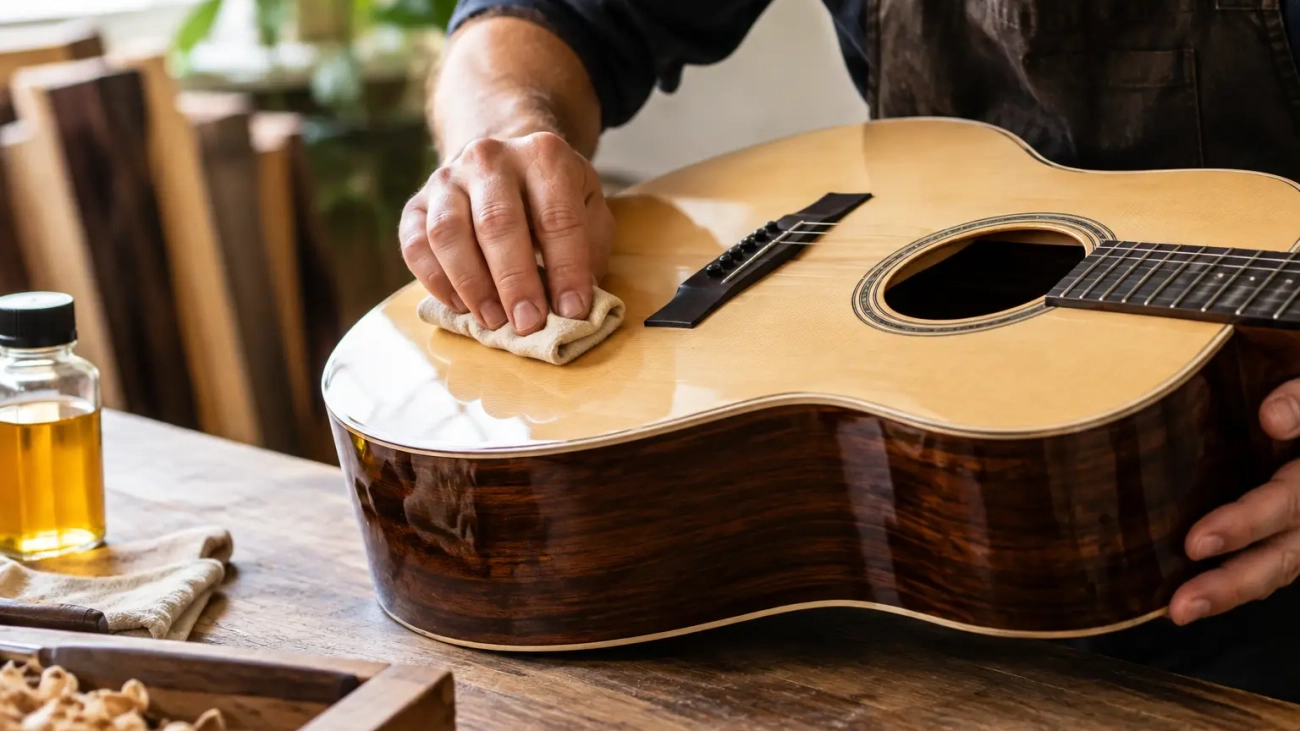
A French-polished guitar is not meant to feel armored. It is meant to feel alive beneath the hand: light-responsive, visually deep, and free to let the wood speak. French polish durability is therefore not a question of whether the finish can endure careless treatment like a thick factory coating. It is a question of whether its extraordinary musical and visual qualities can be preserved through an intelligent relationship between player, instrument, and maker.
For the serious guitarist, that distinction matters. A fine classical, flamenco, or archtop guitar is built around balance. The thickness of the top, the flexibility of the bracing, the character of the woods, and the finish all contribute to the final voice. A finish that is exceptionally hard and thick may protect against scratches, but it can also impose a small yet meaningful restraint on vibration. French polish accepts a different priority: protection sufficient for a cherished instrument, applied in an exceptionally thin film that honors resonance.
What French Polish Is Designed to Do
French polish is a traditional shellac finish, built gradually through many fine applications. Shellac is dissolved in alcohol and worked into the wood with a pad, often called a rubber, until the surface develops clarity, depth, and a distinctive natural luster. The process requires patience, a sensitive hand, and a clear understanding of how each wood will receive the finish.
On a master-grade guitar, its value is not merely visual. Because French polish can be applied so thinly, it adds little mass to the soundboard. This is particularly meaningful on instruments made for nuance: the classical guitarist shaping color through rest stroke and free stroke, the flamenco player demanding immediate attack, or the archtop artist listening for separation and bloom within a chord.
A well-executed French polish does provide real protection from normal handling, airborne moisture, and the small abrasions of a played life. Yet it is not chemically equivalent to polyester, polyurethane, or catalyzed lacquer. It is softer, more vulnerable to heat and alcohol, and easier to mark under pressure. Those are not defects concealed by romance. They are the practical consequences of choosing a finish that favors intimacy with the wood and repairability over industrial toughness.
French Polish Durability: The Honest Trade-Off
The durability of French polish depends greatly on how the guitar is used. A carefully played concert instrument, stored properly in its case and maintained with restraint, can remain beautiful for decades. Its surface may gather a gentle patina at the armrest, beneath the fingers, or near the soundhole. Many players consider this evidence of companionship rather than decline.
A guitar subjected to frequent travel, extreme climate shifts, crowded stage changes, or casual household use requires more vigilance. Belt buckles, metal jewelry, hard case hardware, and abrasive cloths can all leave marks. The finish can also soften when exposed to high heat, such as a parked car or direct sun through a window. Alcohol is especially troublesome. Spilled spirits, hand sanitizer, perfume, and some commercial cleaners can disturb or dull shellac quickly.
This does not mean a French-polished guitar is fragile in the sense of being unplayable. It means the owner must distinguish between an instrument made to serve music and an object finished to tolerate neglect. The finest guitars ask for attention in return for their responsiveness. For many discerning musicians, that exchange is entirely worthwhile.
Why thinness matters to sound
Finish is part of the guitar’s acoustical system. A guitar top moves in complex patterns, responding not only to string energy but also to the player’s touch. Adding material to that surface changes the system, however subtly. No honest maker should claim that finish alone determines tone. Wood selection, voicing, construction, setup, and the player’s technique carry greater weight.
Still, on a highly responsive instrument, small choices accumulate. French polish has long been favored by builders and players who seek immediacy, transparency, and a sense that the instrument releases sound without resistance. Its contribution is most compelling when it supports a guitar already designed with refined control of mass and flexibility.
Why repairability is part of durability
Durability is often misunderstood as the ability to remain untouched. For an heirloom instrument, a more meaningful definition includes the ability to be restored gracefully. Shellac has a rare advantage: fresh material can blend into existing French polish because the new application partially re-amalgamates with the old surface.
A skilled luthier can often reduce or remove light scratches, cloudy areas, and localized wear without stripping the entire guitar. More significant damage may require broader work, but French polish remains among the most sympathetic finishes to renew. Its life is not governed by a single pristine moment. With proper care, it can be maintained and revived over generations.
Caring for a French-Polished Guitar
The finest routine is also the simplest. After playing, wipe the guitar gently with a clean, soft, dry microfiber cloth. This removes perspiration and skin oils before they have time to build up, particularly around the neck, upper bout, and playing area. Avoid vigorous rubbing. The goal is to lift residue, not polish the surface by force.
Keep the guitar in its case when it is not being played, away from radiators, forced-air vents, fireplaces, direct sun, and vehicles. Stable humidity is as essential to the wood as it is to the finish. A sudden environmental shock can affect far more than the surface, influencing joints, action, and the shape of the soundboard.
Do not use furniture polish, silicone sprays, household cleaners, or products containing alcohol. Even a product marketed for guitars may be inappropriate for shellac, especially if its ingredients are unclear. When the finish needs more than a dry wipe, consult the maker or a respected repair specialist before applying anything. Restraint prevents many expensive corrections.
A few habits make a disproportionate difference:
- Remove watches, bracelets, rings, and prominent belt buckles before playing.
- Place the guitar on a clean stand or return it directly to its case, never against a chair or wall.
- Let the instrument acclimate after travel before opening the case in a sharply different temperature.
- Address spills immediately with a soft dry cloth, then seek professional advice if the finish changes.
These are not rituals of excessive caution. They are the ordinary disciplines that protect any exceptional instrument, whether its finish is shellac, lacquer, or oil varnish.
Patina, Wear, and the Player’s Decision
Some players want their guitar to remain immaculate; others want it to show the history of concerts, practice rooms, and long musical friendships. Neither preference is wrong. What matters is choosing a finish with clear expectations.
For a collector who rarely plays an instrument, French polish can retain an extraordinary, almost liquid beauty when stored correctly. For a touring professional, the decision may depend on repertoire, stage conditions, transport arrangements, and tolerance for visible wear. A flamenco guitarist may accept pick marks and a more immediate playing surface as part of the instrument’s character. A classical soloist may favor a carefully maintained finish that keeps the guitar visually composed under close stage lighting.
At Scharpach, a commissioned instrument begins with this kind of conversation. The finish is not selected as decoration applied at the end of a build. It belongs to the larger design of the guitar: its intended voice, the player’s touch, the woods chosen, and the life the instrument is expected to lead.
When a Finish Needs Professional Attention
Fine checking, faint swirls, and small playing marks are usually cosmetic and may not warrant intervention. Trying to correct every trace of use at home can create a larger problem than the original mark. Shellac is forgiving in expert hands, but it rewards precision rather than experimentation.
Seek professional assessment if the finish becomes sticky, develops a milky or cloudy patch, shows a deep dent, or has been exposed to alcohol or excessive heat. Likewise, any apparent crack in the wood deserves prompt examination. A finish mark and a structural issue are not the same thing, and an experienced luthier can tell the difference before unnecessary worry or delayed care causes harm.
The enduring appeal of French polish is not that it promises a guitar untouched by time. It offers something more fitting for a fine instrument: a finish of exceptional beauty, musical restraint, and renewal. Treated with the same attentiveness a musician brings to sound, it will age not as a barrier around the guitar, but as part of its story.