
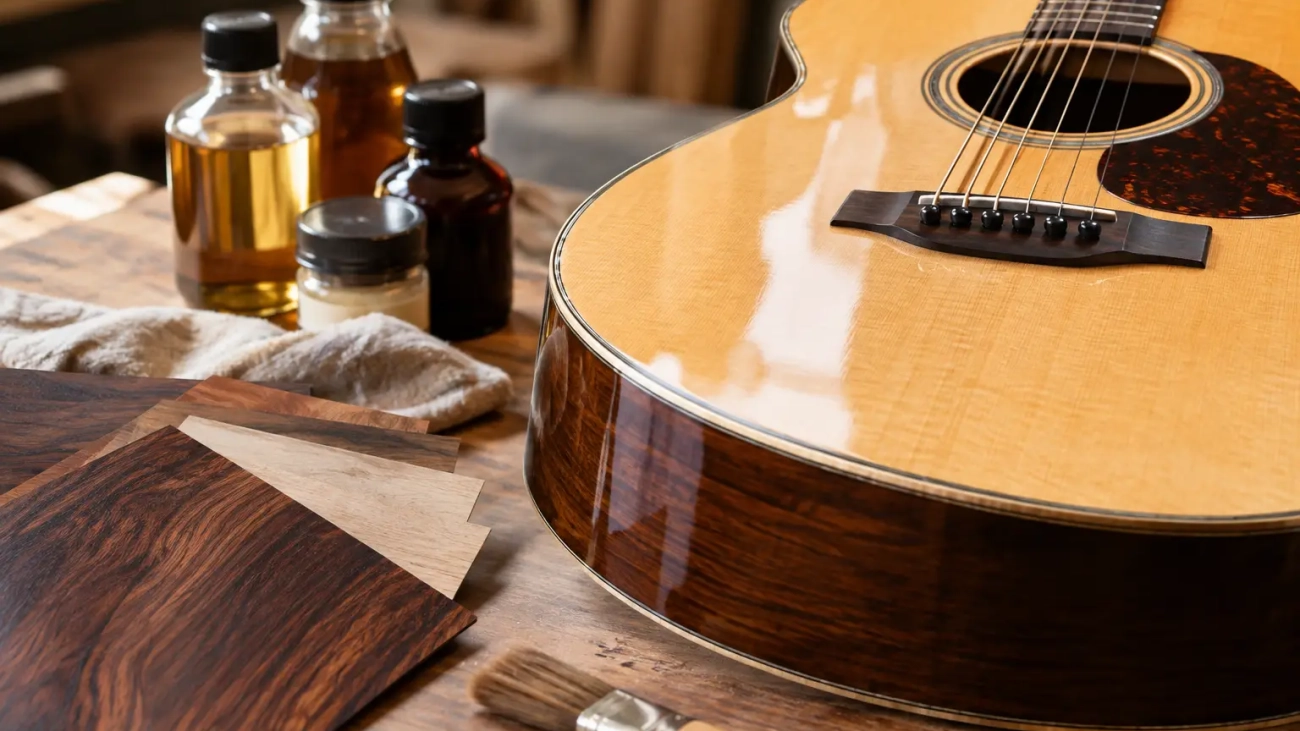
A finish is not merely the skin of an acoustic guitar. It is the final, extremely thin boundary between responsive wood and the air it must move. When players ask about the best finishes for acoustic guitars, they are often asking a more personal question: how can an instrument retain its beauty while speaking with the greatest possible freedom?
There is no single finish that serves every guitar, player, climate, or musical purpose. The right choice depends on the design of the instrument, the stiffness and character of its woods, the desired visual effect, and the owner’s expectations for care. A concert classical guitar built for color, immediacy, and subtle dynamic shading may call for a different finish than a stage-bound steel-string or a highly figured archtop intended to travel often.
For a fine handmade instrument, the question is never simply which finish is toughest. It is which finish allows the guitar to remain most fully itself.
What a Guitar Finish Must Do
A guitar finish has a demanding role. It protects delicate tonewoods from dirt, hand oils, handling marks, and rapid shifts in humidity. It also brings visual depth to spruce, cedar, rosewood, maple, and the many other materials that give an instrument its identity. Yet every coating adds mass and some degree of restraint to a vibrating soundboard.
The issue is not that any finish automatically ruins tone. A well-applied modern finish can produce excellent instruments. Rather, the luthier must consider thickness, elasticity, curing behavior, and the relationship between the finish and the wood beneath it. A heavy, rigid coating on a lightly voiced top can diminish some of the nuance the maker worked to create. An excessively delicate finish, meanwhile, may be impractical for a player who performs under changing conditions night after night.
The best work begins with restraint. A finish should be applied as thinly as its material and purpose allow, then leveled and polished with patience rather than built up to conceal imperfections.
Best Finishes for Acoustic Guitars: The Main Choices
French polish: unmatched finesse and visual depth
French polish is a traditional shellac finish applied in many fine, whisper-thin layers by hand. It is prized above all for its delicacy. Properly executed, it adds remarkably little weight to the soundboard and can allow a responsive guitar to retain exceptional clarity, quickness, and tonal complexity.
For classical and flamenco guitars, French polish remains a deeply compelling choice. It can reveal the medullary rays of spruce, the deep grain of cedar, or the luminous figure of rosewood with a warmth that more industrial coatings rarely duplicate. Its gloss has life to it. Rather than appearing like a thick layer above the wood, it seems to arise from within it.
Its trade-off is vulnerability. Shellac is more susceptible to scratches, heat, alcohol, and impressions from stands or cases than modern catalyzed finishes. It demands thoughtful ownership, especially from musicians who live in demanding touring environments. The reward is an instrument that can feel unusually immediate under the hands and can be refreshed or repaired by an experienced craftsperson with relative grace.
Nitrocellulose lacquer: a classic balance of sound and serviceability
Nitrocellulose lacquer has long been associated with revered American guitars. When sprayed in thin, carefully controlled coats and allowed sufficient time to cure, it offers an appealing balance of protection, repairability, visual character, and tonal openness.
Many players admire nitrocellulose because it tends to age visibly. Over years, it may soften in sheen, develop fine checking under severe temperature changes, and take on the marks of use. For some owners, this is not deterioration but biography: the record of rehearsals, stages, travels, and musical seasons.
Nitro is more durable than French polish, though it is far from indestructible. It can react with certain rubber materials and is sensitive to solvents and high heat. It also requires proper curing time, which matters greatly in a handmade workshop. A guitar should not leave the bench merely because it looks finished. The coating must settle into a stable, mature state before final polishing and delivery.
Catalyzed varnish: protection without needless heaviness
Modern catalyzed varnishes, including carefully selected polyurethane and polyester systems, are sometimes dismissed by players who associate them only with thick factory finishes. That judgment is too broad. The quality of the application matters more than the category alone.
A finely sprayed and meticulously leveled catalyzed finish can be thin, clear, stable, and highly resistant to ordinary wear. For an instrument that will encounter frequent travel, variable venues, or intensive professional use, this extra security can be sensible. It can also preserve a clean, glass-like surface over richly figured woods, particularly maple and rosewood.
The caution lies in excess. These finishes can become acoustically restrictive when applied too heavily or used to compensate for hurried surface preparation. On a master-grade acoustic guitar, the finish must follow the instrument’s voice, not overpower it. A luthier who understands voicing will adjust the entire finishing process to the sensitivity of the top and the intended character of the guitar.
Oil and oil-varnish finishes: tactile, restrained, and specialized
Oil and oil-varnish finishes appeal to players who prefer a lower-sheen, hand-rubbed appearance and a direct tactile connection with the wood. They can look especially beautiful on necks, where a satin feel may be more inviting than a high-gloss surface.
On an acoustic guitar body, however, oil finishes require careful consideration. They generally offer less moisture resistance and may need periodic maintenance. Their tonal effect is difficult to generalize because formulas and application methods vary widely. Used with discernment, they can create a quiet, organic elegance. Used in the wrong context, they can leave a fine instrument insufficiently protected.
Tone Is Shaped by Thickness, Not Myth
It is tempting to rank finishes in a simple tonal hierarchy, with one declared “best” and all others treated as compromise. Fine guitars do not work that way. Two instruments finished with the same shellac or lacquer can respond very differently because of their top thickness, bracing, arching, wood selection, and the player’s attack.
What can be said with confidence is that a lighter finish system, applied with great control, gives a sensitive soundboard less additional mass to carry. This is particularly meaningful on guitars designed for subtle articulation: a concert classical instrument, a responsive flamenco guitar, or an archtop built to reveal the smallest change in pick pressure.
But durability is also part of musical freedom. A player who worries constantly about a fragile finish may play with unnecessary caution. The right finish supports the life the guitar will actually lead, whether that life is in a climate-controlled studio, on an international stage, or in the hands of a collector who values pristine preservation.
Matching the Finish to the Instrument and Player
For a traditional concert classical guitar, French polish on the top is often the most expressive option, sometimes paired with a more durable finish on the back and sides. This approach protects the instrument where handling is greatest while preserving a light, responsive surface over the soundboard.
For flamenco, the priorities can be even more specific. Fast response, dryness of attack, and a finish that remains thin enough to respect the guitar’s percussive vitality are central. The surface will also acquire marks from golpe technique and active performance. Those marks are part of the genre’s physical honesty, though a player may still choose a finish with enough resilience for regular use.
For archtops, aesthetics often play a larger role alongside acoustic behavior. Sunbursts, transparent tints, and the dramatic flame of maple demand exacting surface preparation and color work. Here, nitrocellulose or a refined catalyzed system may be chosen for its clarity, depth, and ability to frame the carved architecture of the instrument.
At Scharpach, finish selection belongs in the same conversation as scale length, neck profile, top wood, bracing, and repertoire. A finish should never be an afterthought applied once all meaningful decisions have been made. It is one of the final acts of voicing.
Care Is Part of the Finish Choice
Even the most durable coating cannot protect a guitar from poor humidity control, a hot vehicle, or a careless stand. Keep the instrument in a properly fitted case when not in use, avoid abrupt temperature changes, and use only clean, finish-safe cloths and polishes. Alcohol-based cleaners should never come near shellac.
Small marks are often less alarming than they first appear. Shellac can frequently be revived, lacquer can often be repaired with skill, and many surface imperfections can be reduced without compromising the integrity of the instrument. The key is to consult a qualified repairer before attempting a home remedy.
Choose the finish that honors the music you intend to make and the life you intend to give the guitar. Over decades, a fine finish will do more than preserve wood. It will quietly gather the evidence of a player becoming more fully heard.