
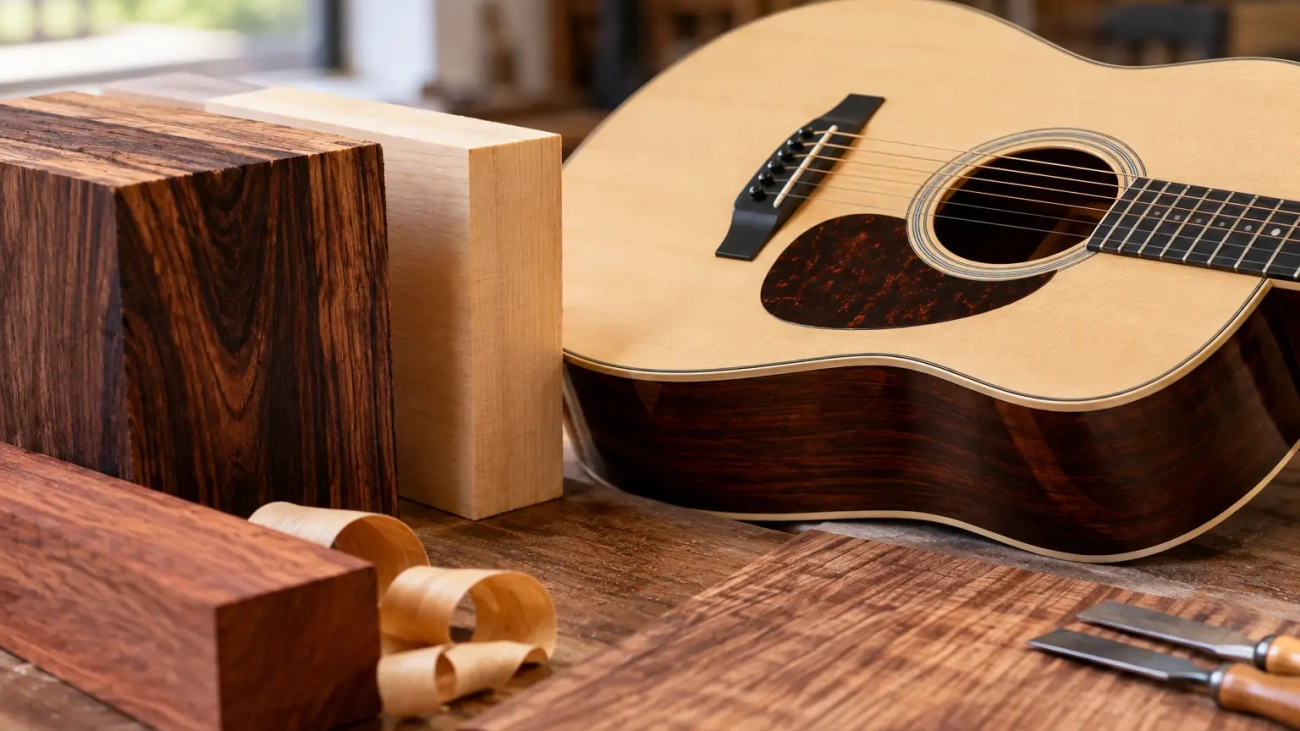
A guitar begins speaking long before its first string is tuned. The choice of guitar tonewoods sets the conditions for that voice: how readily the instrument responds, where its color gathers, how far its sound carries, and how gracefully it changes under a musician’s hands over decades.
For a serious player, wood selection is not a matter of choosing a tone from a catalog. A spruce top does not guarantee one kind of sound, nor does rosewood promise another. Every set of wood has its own density, stiffness, grain, weight, and internal character. The work of the luthier is to read those qualities with patience, then shape the guitar so its materials become a coherent musical whole.
How Guitar Tonewoods Shape a Guitar’s Voice
The soundboard is the guitar’s primary speaker. It receives energy from the strings and turns it into audible sound, so its stiffness and lightness have an especially direct effect on response, projection, and dynamic range. Yet the top does not work alone. The back and sides influence how the body reflects and supports that energy, while the neck, fingerboard, bridge, bracing, finish, and precise thicknessing determine how freely the instrument can breathe.
This is why descriptions such as “bright,” “warm,” or “dark” are useful only as a beginning. They describe tendencies, not guarantees. A player’s touch, the scale length, body design, string choice, and the room itself all participate in the final result.
A fine guitar is therefore not built from a recipe. It is composed. The woods offer a range of possibilities; the maker’s judgment decides which possibilities should be brought forward and which should remain restrained.
The Soundboard: Spruce, Cedar, and the First Breath of Sound
Spruce has long been valued for its exceptional strength-to-weight ratio. A well-chosen spruce top can be made remarkably responsive while retaining the structural reserve needed for a broad dynamic range. It often rewards a player who brings nuance to the instrument, offering clarity, separation between voices, and a sense of expansion as the guitar is played more deeply.
For classical repertoire, spruce can offer a compelling balance of brilliance, refinement, and headroom. Its sound may begin with an almost reserved elegance, then gradually open over years of playing into greater complexity and authority. Players who value articulation, tonal contrast, and a wide palette often feel at home with spruce.
Western red cedar generally speaks with greater immediacy. Its response can feel intimate and generous under a lighter touch, with a mature warmth and a bloom that many classical and fingerstyle players find deeply expressive. Cedar can be especially inviting for musicians seeking color and presence at modest dynamic levels.
Neither choice is superior in every circumstance. A concert player who needs a guitar to retain clarity at high volume may prefer the reserve of spruce. Another musician may want the direct, enveloping response of cedar for lyrical repertoire or recording work. The individual top matters as much as the species. A master-grade piece of cedar with unusual stiffness may lead to a very different instrument from a softer example, just as two spruce tops can possess distinctly different voices.
Back and Sides: The Character Around the Note
If the top begins the sound, the back and sides help give it dimension. They affect sustain, overtone content, perceived depth, and the sensation of space around each note.
Indian rosewood remains a revered choice for classical and concert guitars because it can offer a rich foundation beneath a clear treble voice. Its dense, resonant nature often supports powerful basses, long sustain, and a complex halo of overtones. It suits players who want breadth without sacrificing expressive detail.
Brazilian rosewood, when legally sourced and appropriate for a commission, is prized for an unusual blend of clarity, depth, and quickness. Its beauty is not merely visual. Fine examples can offer a sense of immediacy within a large tonal field, where individual notes remain distinct even as the guitar produces abundant color. Because availability and provenance matter profoundly, responsible material selection must be part of any serious discussion of this wood.
Maple moves in a different direction. It is often associated with a focused, transparent response and a quicker decay than rosewood. For an archtop, this can help preserve definition and rhythmic precision. In a classical guitar, maple may appeal to the player who wants clean lines, a more direct fundamental, and less lingering overtone wash.
Mahogany, walnut, and cypress each bring their own virtues. Mahogany can offer warmth, dryness, and a pleasingly immediate attack. Walnut often occupies a graceful middle ground, with clarity and warmth held in balance. Cypress is central to the traditional flamenco voice: fast, percussive, lively, and ready to answer the player without hesitation. In flamenco, that quick release is not a limitation. It is part of the language.
Woods Beyond the Body
The neck is a structural and musical component. Its weight, stiffness, profile, and relationship to the body influence the player’s comfort as well as the instrument’s balance and response. Cedar is traditional in many classical guitars for its lightness and stability, while mahogany and Spanish cedar remain respected choices depending on the design and the individual piece of material.
Fingerboards are often made from ebony because it is hard, stable, and smooth under the fingertips. Its density supports crisp articulation and enduring wear resistance. Rosewood fingerboards can offer a slightly different tactile character and visual warmth. Here again, the practical and musical considerations meet: a fingerboard must feel natural to the player while remaining stable through years of seasonal change.
The bridge deserves equal attention. It transfers string energy into the soundboard, making its placement, mass, material, and shaping consequential. A guitar may contain superb wood throughout and still fall short if the bridge and top are not conceived as a responsive partnership.
Why Construction Matters as Much as Species
It is tempting to speak about wood as if it determines everything. It does not. A beautifully aged spruce top can be overbuilt and muted; a less dramatic-looking set can become extraordinary in the hands of a maker who understands its potential.
Thicknessing is one of the quiet arts of luthiery. The luthier listens to the material, assesses its stiffness across the grain and along it, and removes wood with a specific tonal intention. Bracing then guides the top’s movement, balancing strength against freedom. A fraction of a millimeter can change the way a guitar responds to a rest stroke, a tremolo, or the harmonic weight of a low note.
Finish also matters. A heavy coating can restrict vibration, while a carefully applied thin finish protects the wood without obscuring its vitality. French polish, with its luminous depth and delicate touch, remains beloved on fine classical and flamenco guitars for good reason. It asks more of both maker and owner, but it can preserve an extraordinary sense of immediacy.
At Scharpach, material selection is inseparable from the larger conversation with the player. Repertoire, technique, physical requirements, performance setting, and the desired emotional character of the sound all help guide the choice. A left-handed guitarist, an artist who performs amplified on large stages, and a collector seeking an intimate salon instrument should not be offered the same solution.
Choosing Tonewoods for the Music You Actually Play
The most useful question is not, “Which wood is best?” It is, “What do I need the guitar to say?”
A classical player drawn to Bach, chamber music, and refined voicing may seek the separation and dynamic reserve often associated with spruce. A player whose sound lives in romantic repertoire may be captivated by cedar’s direct bloom and warmth. A flamenco guitarist may need cypress and a light, agile build that turns rhythm into physical energy. An archtop player may value maple’s definition and control when the music demands clarity in an ensemble.
There are trade-offs. Greater overtone complexity can be intoxicating in solo playing but may make a guitar feel less direct in a dense recording. A very immediate instrument can feel wonderfully alive under the fingers, while offering less room to push at extreme dynamics. The right answer depends on the musician, not fashion.
It is also wise to consider time. Fine woods and finely made instruments continue to settle and develop through use. A guitar that feels poised and focused when new may acquire greater depth, openness, and tonal integration as its fibers learn the patterns of vibration. Careful humidity control and thoughtful handling are not merely acts of preservation. They protect the conditions that allow the instrument to mature beautifully.
The finest choice of wood is the one that becomes transparent to the musician. When material, design, and craftsmanship are in balance, the player stops thinking about spruce, cedar, rosewood, or maple. What remains is a guitar that answers honestly, carries the music with grace, and grows ever more personal with every year of playing.