
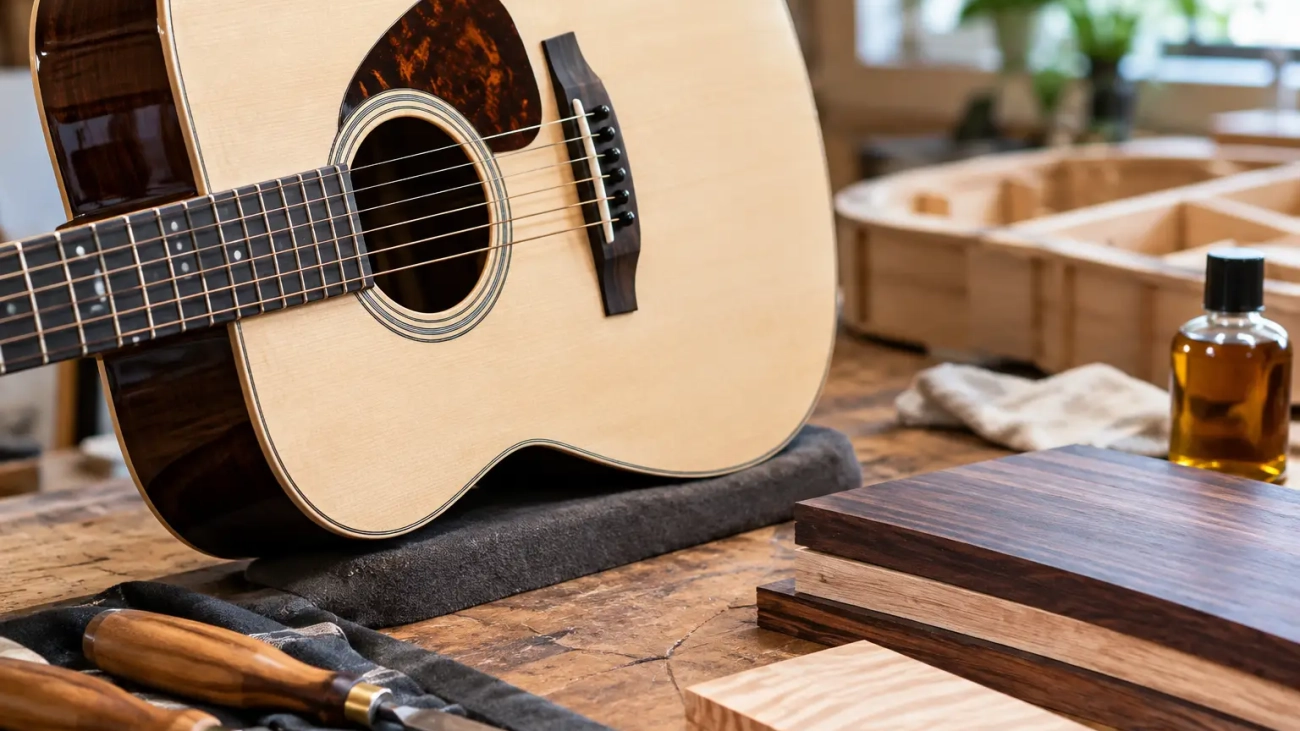
A bespoke guitar begins long before the first shaving falls from a brace. It begins with a conversation about the sound you hear, the music you play, the way your hands meet the neck, and the visual character you want to live with for decades. A guide to guitar commission deposits should make one point clear from the outset: a deposit is not simply an advance payment. It is the moment a shared artistic commitment becomes a working commission.
For a master-built classical, flamenco, or archtop guitar, that commitment carries real weight. The luthier begins reserving time, considering construction, sourcing and selecting materials, and translating a player’s language into an instrument with its own voice. Understanding how deposits work helps a serious player enter that process with confidence and the right expectations.
What a guitar commission deposit actually secures
A commission deposit secures a place in a builder’s schedule and confirms that the project will receive focused attention. In a small atelier, the builder is not drawing from a warehouse of identical parts or moving an order through an assembly line. Each commission occupies bench time that cannot be given to another instrument.
The deposit also supports the early work that defines the build. This may include consultation, measurements, design decisions, research into appropriate tonewoods, and the selection of materials suited to the desired response. A player seeking the dry immediacy and percussive clarity of a flamenco guitar will call for different priorities than someone seeking the sustained, orchestral depth of a concert classical. An archtop player may be listening for projection, warmth, articulation, or a particular balance between attack and bloom.
At Scharpach, the purpose of this stage is not to choose decorative options from a fixed menu. It is to establish the musical center of the instrument. The deposit allows that work to begin in earnest.
Why deposits are often non-refundable
Players sometimes wonder why a commission deposit may be non-refundable, especially when the guitar itself has not yet taken visible form. The answer lies in the nature of handmade work.
Once a commission is accepted, the luthier may decline another project for the same period. Specific woods may be set aside from a limited reserve, particularly when the commission requires exceptional visual figure, a certain density, or a rare tonal quality. Time is also invested in correspondence, planning, drawings, and decisions that are particular to one player.
A non-refundable deposit is therefore not a penalty. It is a fair recognition that the commission has already begun, even if the instrument is still represented by notes, measurements, and a chosen set of wood.
That said, terms vary between builders. Some makers apply the entire deposit to the final price, while others use it to cover consultation, materials, and scheduling. Some may allow a deposit to transfer to a later build date under specific circumstances. The only reliable approach is to read the written terms and ask direct questions before sending payment.
A practical guide to guitar commission deposits
The strongest commission relationships are built on clarity rather than assumptions. Before placing a deposit, ask what it reserves, whether it is refundable or transferable, and how it will be applied to the total cost. Ask for the anticipated timeline, while recognizing that handwork and natural materials do not always submit neatly to a calendar.
It is equally wise to understand the payment structure. A builder may request the balance at completion, before shipment, or through agreed milestones during a long build. None of these approaches is inherently better. What matters is that the schedule is stated plainly and feels appropriate for the scale of the commission.
The following details deserve confirmation in writing:
- the total estimated price and what may cause it to change
- the deposit amount and its refund or transfer policy
- the expected build period and how updates will be communicated
- the agreed specifications, including woods, scale length, neck profile, finish, and left-handed orientation if applicable
- the timing of remaining payments, shipping, insurance, and any applicable taxes or import duties
These are not bureaucratic details standing apart from artistry. They protect the artistry. When the practical terms are settled, both player and luthier can concentrate on the instrument itself.
The deposit should follow a meaningful consultation
A deposit is best placed after the essential questions have been explored. A serious builder needs more than a request for a particular wood combination or a familiar model name. The most useful conversation reaches into technique, repertoire, touch, listening habits, and physical comfort.
A classical guitarist may need a neck profile that supports long practice sessions without tension. A flamenco player may want a lower action, immediate attack, and a particular relationship between the right hand and the top. A left-handed musician should not have to compromise with an afterthought adaptation. In a true custom build, the orientation, balance, and ergonomics belong to the original design.
Tonewood choices should also be understood in context. Spruce and cedar can lead to very different first impressions, but the finished voice depends on far more than the species named on a specification sheet. The top’s stiffness and weight, the back and sides, the arching or doming, bracing, graduation, varnish, and the luthier’s judgment all contribute to the final response.
For this reason, a responsible luthier should be careful about promises. It is reasonable to discuss tonal direction, projection, color, separation, sustain, and responsiveness. It is less credible to guarantee that a guitar will reproduce an abstract sound exactly. Wood is alive with variation. The art lies in listening to each set of materials and guiding it toward the player’s needs.
When a change request affects the deposit or price
A commission can evolve, and many changes are simple if they are made early. Adjusting a rosette detail, selecting a different purfling, or refining an aesthetic preference may not alter the course of the build. A late request to change scale length, body dimensions, primary woods, neck geometry, or construction style can be another matter entirely.
The distinction is practical. Early in the process, the luthier may still be choosing materials and finalizing proportions. Later, decisions become embodied in joined plates, carved wood, established bracing, and a neck already shaped for a particular scale. At that point, a major alteration can require new materials, additional labor, or even a new build path.
A clear deposit agreement should explain how such changes are handled. The player should feel free to ask questions, but should also respect the moment when a decision must become final. A custom guitar gains its coherence from disciplined choices, not from endless revision.
What distinguishes a trustworthy commission process
Trust does not require excessive ceremony. It requires candor. A reputable luthier explains the deposit policy without evasiveness, defines the anticipated scope of work, and communicates honestly about timing. The player, in return, communicates preferences clearly and recognizes that a handmade instrument is not a retail transaction with a fixed delivery shelf waiting at the end.
Look for a process that leaves room for both precision and judgment. Exact specifications matter, particularly in dimensions and playability. Yet a fine instrument also depends on decisions that cannot be reduced to a checklist: which top has the right potential, how a brace should be voiced, how much finish allows the guitar to speak freely while protecting it for a long life.
A deposit supports that balance. It gives the luthier the confidence to reserve the right materials and the time to work without compromise. It gives the player a documented beginning to a commission shaped around a personal musical aim.
The best question before placing a deposit is not merely, “What am I paying now?” It is, “What kind of instrument and relationship am I setting in motion?” When the answer is thoughtful, specific, and grounded in mutual respect, the first payment becomes something more meaningful than a transaction: the opening gesture in the making of a guitar that can carry your voice for a lifetime.