
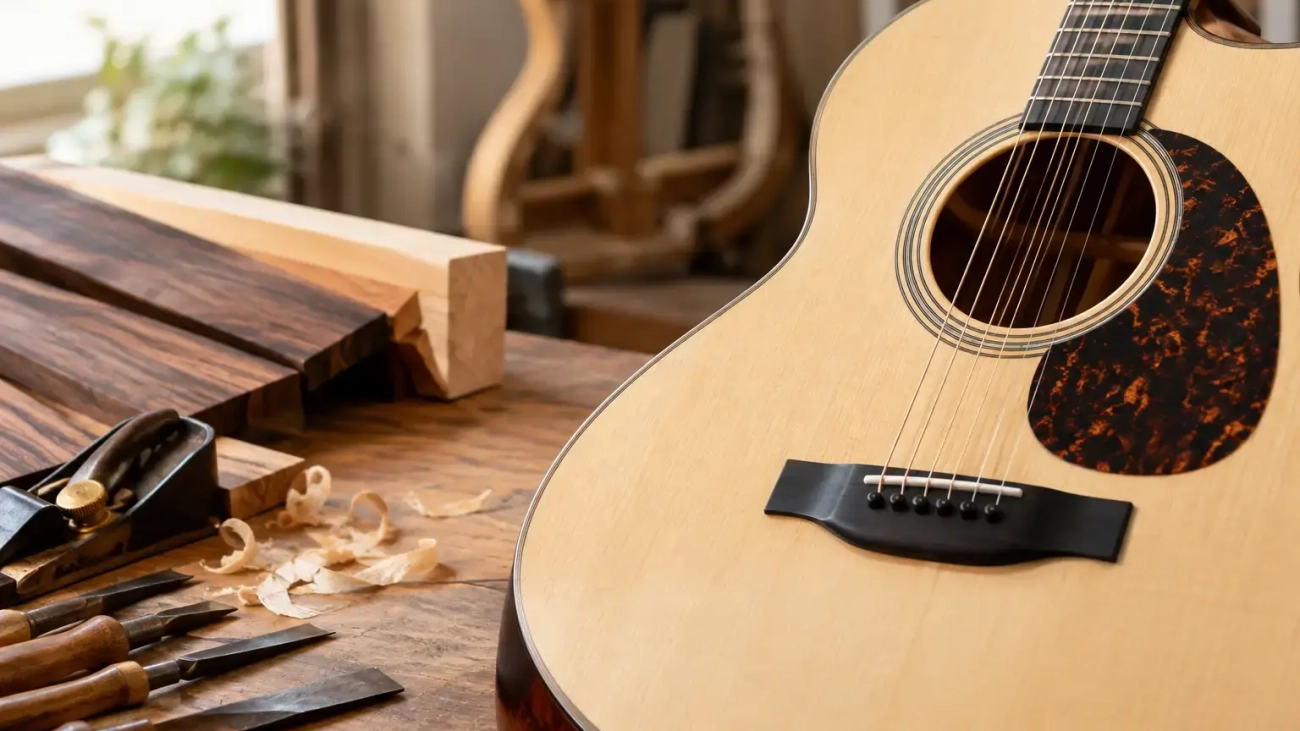
A serious luthier guitar review begins where most showroom comparisons end. It is not simply a question of whether an instrument is louder, prettier, or more expensive than the guitar beside it. The real question is whether the guitar gives a player more access to their own musical voice – through response, color, balance, comfort, and the rare feeling that the instrument is listening as closely as the musician is playing.
For an advanced player, this distinction becomes unmistakable. A factory guitar may be beautifully finished, reliable, and immediately familiar. A master-built guitar can be something more personal: an instrument whose proportions, materials, and voicing have been considered in relation to a particular technique, repertoire, and artistic intention.
What a Luthier Guitar Review Should Actually Examine
The word “handmade” is often used too loosely. It can describe an instrument with a hand-fitted nut, or one shaped, braced, voiced, and finished over many exacting hours by a single maker. Those are not equivalent experiences, and a useful review should make the difference clear.
A fine luthier guitar is the result of hundreds of connected decisions. The stiffness and weight of the soundboard, the character of the back and sides, the arching or doming of the plates, the bracing pattern, neck geometry, bridge mass, varnish, and final setup all influence the finished voice. No single feature guarantees greatness. The art lies in making these elements work together.
That is why specifications alone cannot tell the whole story. Two guitars built from the same species of spruce and rosewood may speak with entirely different accents. One may have a silvery, immediate treble and a dry, articulate bass suited to flamenco. Another may offer greater sustain, warmth, and harmonic bloom for lyrical classical repertoire. Neither is automatically superior. The meaningful judgment is whether the voice has coherence and whether it serves the player.
Response Before Volume
Volume is easy to notice and easy to overvalue. A guitar that projects well is valuable onstage, but projection without control can become blunt force. In a refined instrument, the more revealing quality is response: how readily the top begins to speak under the right hand, how clearly a soft attack carries, and how much tonal range remains available before the sound compresses.
Try a quiet rest stroke, then a barely touched apoyando or free stroke. Play a phrase at the edge of audibility. Does each note arrive cleanly? Does the guitar retain its center, or does the tone become thin and uncertain? The best instruments do not demand excessive effort to produce a meaningful sound. They reward precision, but they also make subtlety possible.
For a classical guitarist, that may mean distinct voices within a Bach line, even at a restrained dynamic. For a flamenco player, it may mean a dry, percussive attack that still carries pitch and shape. For an archtop player, it may mean notes that emerge with authority without becoming brittle or congested.
Balance Is Not Sameness
When players say a guitar is balanced, they do not necessarily mean every note has identical volume. A great instrument has an intentional relationship between registers. The bass should support without obscuring the middle. Trebles should sing without sounding detached from the body of the guitar. Notes around the neck joint should not suddenly lose presence or become strangely inflated.
Listen for continuity rather than uniformity. Play scales slowly across strings and positions. Move through a familiar piece that uses both open strings and stopped notes. A guitar with a mature tonal design will feel connected across the fingerboard. Its differences from register to register will sound musical, not accidental.
This is also where a player’s repertoire matters. A guitarist who performs Spanish music may welcome a fast, focused fundamental and concise decay. Someone devoted to Romantic transcription may prefer more overtone content and a longer, more enveloping sustain. A review that calls one character “better” without considering musical purpose is incomplete.
The Physical Conversation Between Player and Guitar
The hands recognize quality before language catches up. Neck shape, string spacing, scale length, action, body depth, and the placement of the bridge all affect the player’s relationship with the instrument. These dimensions are not luxuries. They shape endurance, accuracy, and freedom of expression.
An instrument can sound magnificent and still be wrong for a particular musician. A player with a smaller hand may find a conventional scale length needlessly demanding. A left-handed guitarist may have spent years adapting to instruments designed around someone else’s body and movement. A professional with an old hand injury may need a neck profile and setup that reduce fatigue without sacrificing clarity.
Custom work is most valuable when it addresses these realities with intelligence rather than novelty. A shorter scale, altered nut width, refined neck depth, or carefully chosen body proportion can change the daily experience of playing. The correct solution is not always obvious, which is why direct conversation with an experienced maker matters.
Setup Is Part of the Voice
Action is often treated as a simple number, but it is better understood as a balance of competing goods. Lower action can make the guitar feel fast and inviting, yet too little clearance may limit dynamic headroom or introduce unwanted buzzing. Higher action can offer power and separation, but it may ask more from the left hand than the player can comfortably give over a long performance.
A thoughtful setup reflects the player’s touch. Flamenco technique may call for a different compromise than classical concert playing. Steel-string habits do not automatically translate to nylon strings. The right setup allows the musician to work at the limits of expression while keeping the instrument composed and responsive.
Materials, Finish, and the Patience of Tone
Exceptional tonewoods matter, but not because a rare name on a label guarantees a rare sound. A luthier selects wood for acoustic behavior: grain, stiffness, elasticity, weight, damping, and the way a set of materials works as a whole. Beauty is welcome, especially in a commissioned instrument, but beauty must serve the music.
Spruce and cedar, for example, offer broad families of character rather than fixed outcomes. Spruce often carries exceptional clarity, headroom, and tonal complexity as it develops. Cedar can offer an immediate warmth and openness that many players find deeply expressive. The individual set, the design of the guitar, and the maker’s voicing decisions matter at least as much as the species.
The finish deserves the same attention. A finish protects the instrument, contributes to its visual presence, and can influence how freely the plates vibrate. The goal is not the thinnest finish at any cost. It is an appropriate finish, carefully applied and beautifully resolved, that respects both resonance and longevity.
A handmade guitar is also not a frozen object. With attentive care and regular playing, its tonal character can deepen over years. The soundboard learns to move more freely. The player learns the instrument’s hidden colors. This gradual opening is one reason a fine guitar becomes a companion rather than a purchase that is quickly replaced.
Reading a Luthier Guitar Review With Discernment
Player impressions are valuable, especially when they describe concrete musical experiences: a treble that holds its shape under vibrato, a bass that remains clear in ensemble work, a neck that permits relaxed shifts, or a guitar that projects without harshness. Broad claims such as “the best guitar ever” offer far less.
Consider who is speaking and what they play. A concert classical guitarist, a recording artist, a flamenco accompanist, and a collector may all hear the same instrument differently. Recording can reveal articulation and sustain that a noisy showroom conceals. A hall can reveal projection that a close-miked video exaggerates or misunderstands.
The most trustworthy assessment happens in the hands. Play familiar repertoire. Bring the passages that expose your demands: the rapid scale, the wide stretch, the delicate tremolo, the rasgueado, the sustained chord that must remain alive. Give the guitar enough time for first impressions to settle. A truly fine instrument often continues to reveal itself after the initial surprise has passed.
At Scharpach, this belief informs the commission process: the guitar is considered not as a standardized product, but as an acoustic and physical extension of an individual musician. That level of attention is not necessary for every player. For the musician who has outgrown compromise, it can be transformative.
The right guitar does not merely make a beautiful sound in the room. It makes you want to return to the room, pick it up again, and say something more honest than you could say before.