
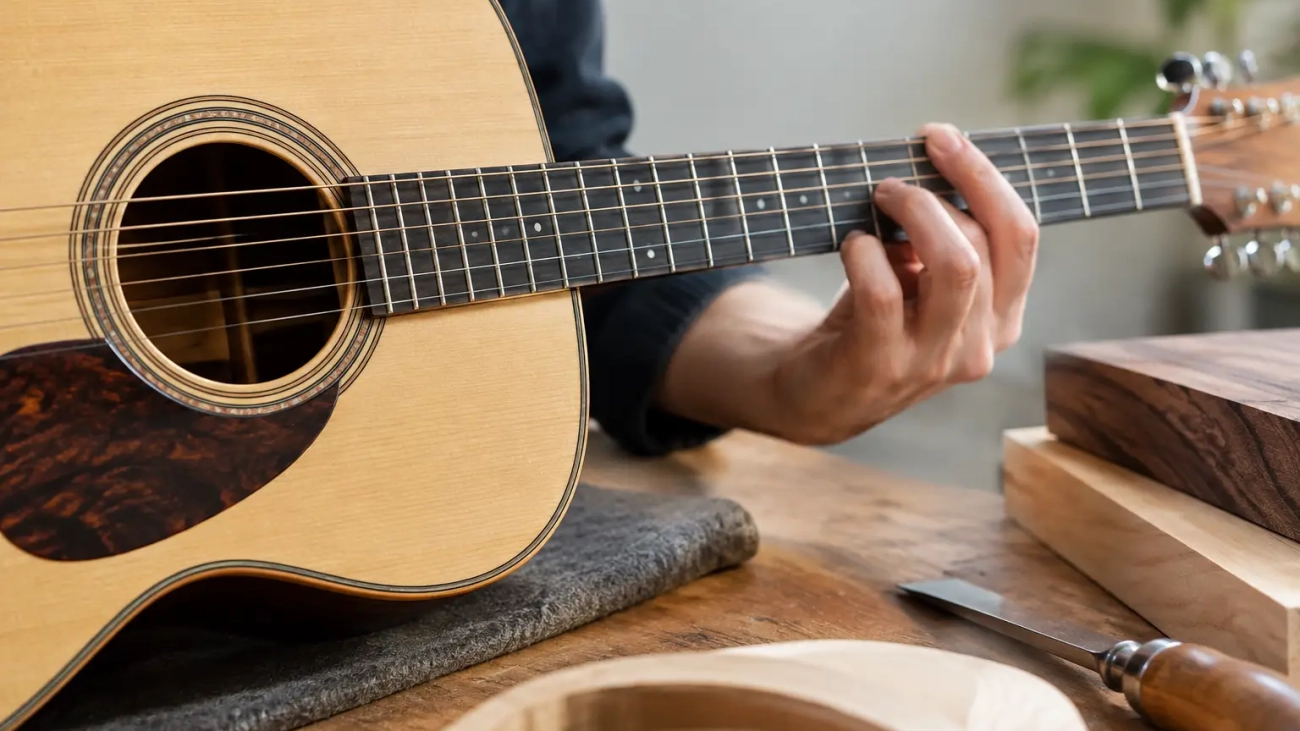
A fingerstyle guitarist feels the truth of an instrument long before an audience hears it. It appears in the left hand after an hour of shifting positions, in the right shoulder during a quiet tremolo, and in the ease or resistance of a single bass note. The top guitar features for fingerstyle comfort are therefore not cosmetic preferences. They are the physical conditions that allow technique, tone, and musical thought to move together.
Comfort is often mistaken for a soft setup alone. A low action may feel welcoming for a few moments, yet leave a player without sufficient clarity, dynamic range, or freedom of attack. The finest fingerstyle instruments balance several elements at once: neck geometry, string spacing, body proportions, tension, response, and the subtle relationship between the player and the instrument’s living materials.
Top Guitar Features for Fingerstyle Comfort
A Neck That Belongs in the Hand
Neck shape is among the most personal choices a guitarist can make. Its depth, shoulder profile, taper, and width determine how naturally the hand can form chords, reach extensions, and travel from the first position to the upper register. There is no universally correct profile. A player with broad hands and a classical background may find security in a fuller neck with generous string spacing, while a player moving between steel-string and nylon-string instruments may favor a more moderate carve.
The crucial quality is not thinness. It is support. A well-shaped neck gives the thumb a stable reference point without forcing the wrist into an acute angle. When the hand is supported, barre chords demand less effort, stretches become less tense, and the player can sustain musical concentration longer.
For fingerstyle work, nut width deserves equal attention. Classical guitars commonly offer a wider fingerboard, allowing each finger of the right hand to approach its string with clarity. Yet excessive width can make demanding left-hand passages needlessly tiring. The ideal dimension is informed by repertoire, hand size, nail technique, and whether the player favors traditional classical articulation, flamenco attack, or a more intimate steel-string-influenced voice.
String Spacing That Gives Each Voice Room
Fingerstyle playing is polyphonic by nature. A melody, inner harmony, and bass line must remain distinct under the hand. Sensible spacing at the nut and saddle prevents the right-hand fingers from feeling crowded, especially in arpeggios, rasgueados, and rapid alternating-bass patterns.
Saddle spacing has a particular influence on the right hand. A little more room can bring welcome precision and reduce accidental contact between strings. Too much can cause the hand to overextend, particularly for players with smaller hands or a compact picking motion. The best specification is not an abstract measurement. It is one that lets the thumb establish a relaxed bass foundation while the fingers land cleanly on the treble strings.
This is one reason a serious commission begins with listening. The dimensions of a guitar should arise from the player’s technique rather than asking the player to adapt to an inherited factory standard.
Body Proportions and a Relaxed Playing Posture
A guitar may sound magnificent across a room and still be wrong for the body that holds it. Lower-bout width, body depth, waist placement, arm contact, and upper-bout contour all affect posture. A deep, large-bodied guitar can offer grandeur and powerful bass, but may pull the right arm upward or force the shoulder forward. Over a long practice session, that compromise becomes audible in tightening tone and diminished control.
For many fingerstyle players, a carefully proportioned body offers a more intimate advantage: it sits close to the torso, keeps the fretting shoulder free, and brings the right hand to the strings without a raised elbow. Smaller dimensions do not automatically mean smaller sound. Thoughtful voicing, appropriate wood selection, and an efficient soundboard can create remarkable presence from an elegantly restrained body.
The placement of the guitar while seated matters as much as its overall size. Some players use a traditional footstool position; others prefer an ergonomic support or a more relaxed, contemporary posture. A custom instrument can be shaped around that reality, including the needs of left-handed musicians, rather than treating comfort as an afterthought.
Scale Length and Tension in Balance
Scale length quietly shapes nearly every tactile impression of a guitar. A longer scale generally increases string tension at pitch, often contributing to firmness, projection, and a focused response. It can be compelling for a player who uses a strong attack or needs definition in a large room. It can also make wide stretches, extended harmonies, and certain legato passages more demanding.
A shorter scale can feel more yielding beneath the left hand, with a warmer and more immediate character. But reduced tension is not automatically easier. If taken too far for the player’s style, it may soften articulation, reduce headroom, or cause the strings to feel imprecise under a confident right hand.
The meaningful question is how a guitarist asks the strings to speak. A delicate colorist, a forceful flamenco player, and a concert classical guitarist may all need different degrees of resistance. The scale length, string gauge, top stiffness, and setup should be considered as a whole. Comfort is achieved when the guitar returns energy to the player rather than absorbing it.
Action That Preserves Both Ease and Expression
Action is the distance between the strings and the frets, but its effect reaches far beyond a measurement. It determines how willingly the left hand can articulate, how hard the player may attack before buzzing occurs, and how much tonal color is available between whisper and forte.
Very low action can be appropriate for certain techniques and can make quick passages feel effortless. The trade-off is reduced clearance for vigorous playing and, at times, a loss of tonal bloom. Higher action can provide greater projection and a clean, powerful voice, but it must be accompanied by sound neck relief, precise fretwork, and a neck profile that does not turn resistance into strain.
The right setup is a conversation between the instrument and the repertoire. A guitarist who plays refined Bach transcriptions may choose differently from one whose music includes percussive golpe, expressive bends, or aggressive flamenco accents. Fine fretwork and a carefully cut nut make this conversation possible, because they allow the instrument to respond consistently in every position.
A Responsive Soundboard Rewards a Gentle Touch
Fingerstyle comfort also has an acoustic dimension. When a soundboard responds readily, the player does not need to force sound from the instrument. A light touch can produce a complete musical phrase, and the hand stays relaxed because it is not constantly compensating for an unresponsive top.
This does not mean a guitar should be fragile or overly sensitive. The finest soundboards possess both quickness and reserve. They reveal detail at low volume, then continue to open under a fuller attack without becoming harsh. That range gives the fingerstyle player confidence to shape phrases naturally.
The choice of spruce or cedar, the character of the bracing, the graduation of the top, and the maturity of the wood all contribute to this relationship. Back and side woods add their own color and projection, but the soundboard remains the central membrane through which the player’s touch becomes sound. Its voice should suit the player’s musical imagination, whether that voice calls for crystalline separation, dark lyricism, dry flamenco immediacy, or the rounded sustain of an archtop.
Arm Comfort, Finish, and the Small Details
The point where the forearm meets the edge of the guitar is easily overlooked until it becomes a distraction. A softened arm bevel or carefully rounded body edge can reduce pressure and allow freer circulation during long sessions. On a deep-bodied instrument, this detail may make a profound difference.
Finish matters as well. A thin, beautifully applied varnish allows the wood to vibrate with fewer restrictions while preserving its surface. Beneath the hands, it should feel refined rather than sticky. A guitar is touched thousands of times before it is truly known; its tactile character belongs to its identity.
Even the placement and balance of tuning machines deserve consideration. A headstock that feels excessively heavy can subtly alter how the neck rests in the hand and how the instrument balances while seated. Such details rarely sell a guitar in isolation, yet together they distinguish an instrument that merely fits from one that feels inevitable.
Comfort Should Serve the Music
At Scharpach, comfort is treated not as a concession to convenience, but as part of the instrument’s artistic purpose. A guitar that meets the body with intelligence gives the musician greater access to phrasing, color, and silence. Over years of playing, this becomes one of the most valuable forms of craftsmanship.
When considering a fingerstyle guitar, spend time with your own physical habits. Notice where your shoulders tighten, which chords ask too much of the hand, whether your right hand needs more space, and how much resistance brings out your best sound. Those observations are not minor preferences. They are the beginning of an instrument built to carry your voice with grace.